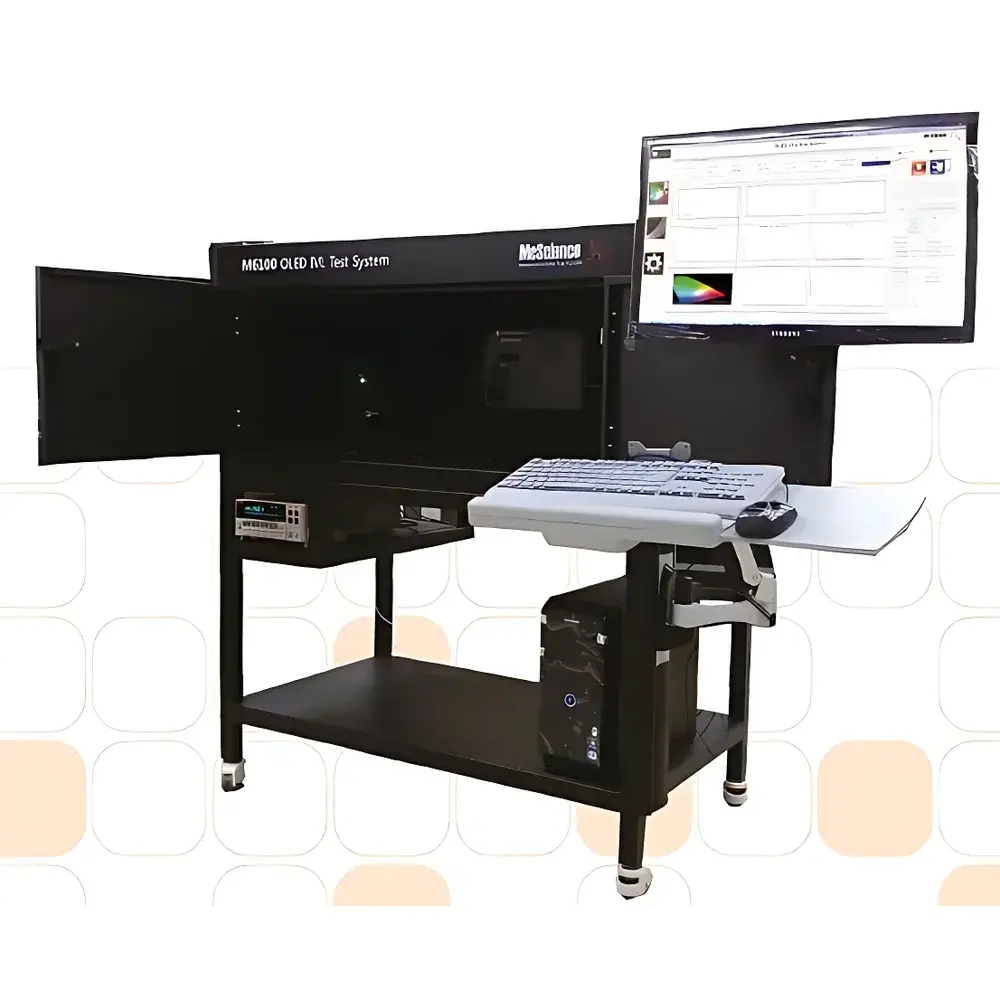
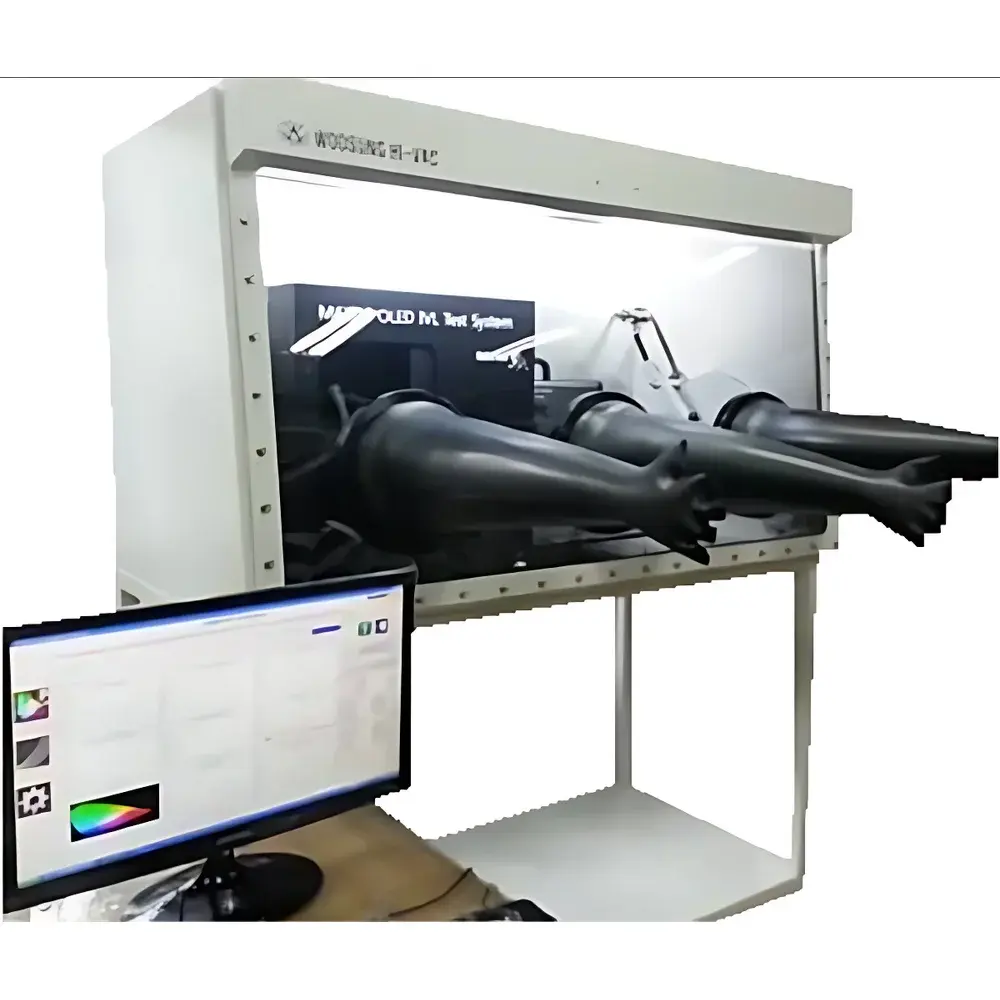
OLED I-V-L Measurement System M6100 by McScience
| Brand | McScience |
|---|---|
| Origin | South Korea |
| Model | M6100 |
| Instrument Type | Integrated Electroluminescence Characterization System for Organic and Emerging Light-Emitting Devices |
| Compliance | Designed for GLP-compliant lab environments |
| Electrical Source | Precision Source Measure Unit (SMU) |
| Optical Detection | Compatible with calibrated spectroradiometers and tristimulus colorimeters |
| Operating Environment | Light-tight enclosure with EMI-shielded chamber |
| Drive Modes | DC, pulsed, and programmable waveform injection |
| Sample Form Factor | Discrete devices, rigid/flexible substrates, micro-LED arrays, and active-matrix OLED panels |
Overview
The McScience M6100 OLED I-V-L Measurement System is an integrated electroluminescence characterization platform engineered for quantitative, traceable, and repeatable performance evaluation of organic light-emitting diodes (OLEDs), quantum-dot LEDs (QLEDs), perovskite LEDs (PeLEDs), and emerging micro-/mini-LED architectures. It operates on the fundamental principle of synchronized electrical excitation and optical radiometric detection under controlled dark-environment conditions. The system couples a high-stability, low-noise source measure unit (SMU) — capable of sub-picoampere current resolution and millivolt-level voltage accuracy — with calibrated optical sensors to simultaneously acquire current (I), voltage (V), luminance (L), chromaticity coordinates (CIE x,y), spectral power distribution (SPD), and photometric/photonic efficiency metrics. All measurements are time-synchronized to eliminate temporal misalignment between electrical stimulus and optical response, ensuring fidelity in transient analysis and efficiency derivation.
Key Features
- Modular architecture supporting interchangeable optical detectors: spectroradiometers (350–1000 nm, ±0.2 nm optical resolution) or NIST-traceable tristimulus colorimeters with f1’ < 3% and uniformity correction
- Programmable SMU with four-quadrant operation, enabling forward/reverse bias sweeps, constant-current/constant-voltage modes, and arbitrary pulse profiles (pulse width: 10 µs–10 s; duty cycle: 0.1–100%)
- Light-tight measurement chamber with internal black-body coating (reflectance < 0.1%), EMI shielding, and temperature-stabilized sample stage (±0.5 °C over 24 h)
- Automated alignment interface for planar and curved substrates, including flexible polymer-based OLEDs and thin-film encapsulated micro-LED arrays
- Hardware-triggered synchronization between SMU output and spectrometer acquisition, minimizing jitter (< 100 ns) for accurate transient EL decay analysis
- Compliance-ready data logging: timestamped raw I/V/L/SPD datasets with metadata tagging (operator ID, ambient RH/T, calibration date, instrument firmware version)
Sample Compatibility & Compliance
The M6100 accommodates a broad range of emissive device formats: single-pixel test structures, RGB stripe-patterned OLED panels, passive- and active-matrix micro-LED modules, and solution-processed PeLED films on glass, PET, or PI substrates. Its mechanical stage supports Z-axis height adjustment (0–25 mm travel) and rotational tilt (±5°) for angular emission profiling. From a regulatory standpoint, the system’s data structure and audit trail capabilities align with ISO/IEC 17025 requirements for testing laboratories. Exported datasets include embedded calibration certificates compliant with ISO/IEC 17025:2017 Annex A.2, and optional 21 CFR Part 11-compliant software add-ons support electronic signatures and role-based access control for GMP/GLP workflows.
Software & Data Management
McScience’s proprietary LumiSuite™ v4.2 software provides a unified interface for instrument orchestration, real-time visualization, and post-processing. It supports automated generation of standardized reports conforming to CIE Publication 127:2007 (measuring LED optical radiation), IEC 62341-6-1 (OLED display luminance uniformity), and ASTM E308-22 (colorimetric computation). Raw spectral data is exportable in JIS X 0510-compliant CSV or industry-standard HDF5 format. The software includes built-in algorithms for calculating external quantum efficiency (EQE), power conversion efficiency (PCE), luminous efficacy (lm/W), correlated color temperature (CCT), and color rendering index (CRI Ra/R9). All processing steps are logged with full parameter provenance for reproducibility auditing.
Applications
- Efficiency benchmarking of novel emissive materials (e.g., TADF emitters, hyperfluorescent systems) across voltage-dependent operating regimes
- Transient electroluminescence analysis for carrier recombination kinetics and trap-state density estimation
- Luminance uniformity mapping of large-area OLED panels under variable drive conditions
- Angular-dependent color shift evaluation for wide-viewing-angle display development
- Accelerated lifetime testing via periodic I-V-L monitoring under constant-current stress
- Validation of encapsulation integrity through time-resolved spectral drift analysis
FAQ
What types of light-emitting devices can be tested with the M6100?
The system is validated for OLEDs, QLEDs, PeLEDs, and micro-/mini-LEDs — including rigid, flexible, and transparent substrate configurations.
Does the M6100 support spectral measurement for EQE calculation?
Yes — when paired with a calibrated integrating sphere and spectroradiometer, the system enables absolute photon flux measurement required for external quantum efficiency derivation.
Can the M6100 perform pulsed I-V-L measurements for burn-in studies?
Yes — it supports user-defined pulse trains with adjustable amplitude, width, frequency, and delay, synchronized to optical acquisition for transient EL analysis.
Is third-party calibration documentation provided?
Each delivered system includes NIST-traceable calibration certificates for SMU current/voltage channels and optical detector spectral responsivity, valid for 12 months from commissioning.
How is data security and traceability ensured for regulated environments?
Optional LumiSuite™ Secure Edition offers 21 CFR Part 11 compliance with electronic signatures, audit trails, and encrypted database storage — configurable per institutional SOP requirements.