
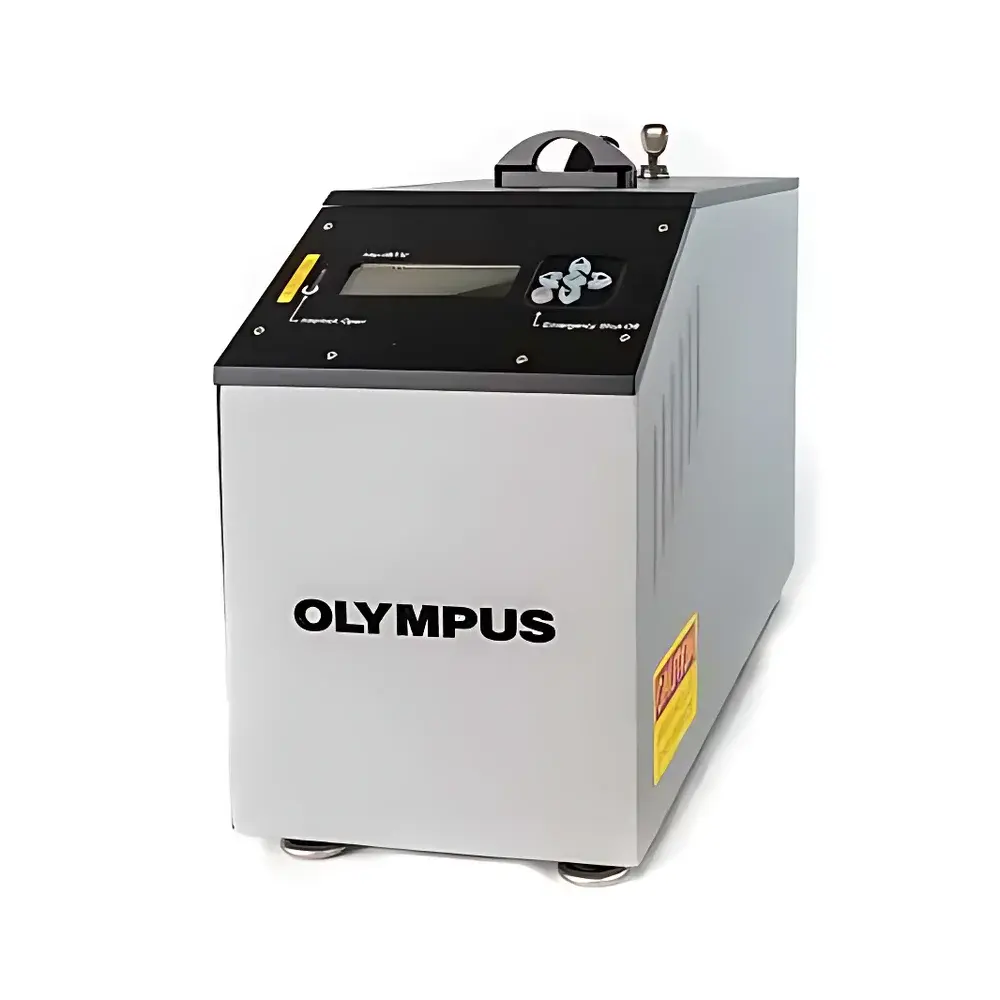
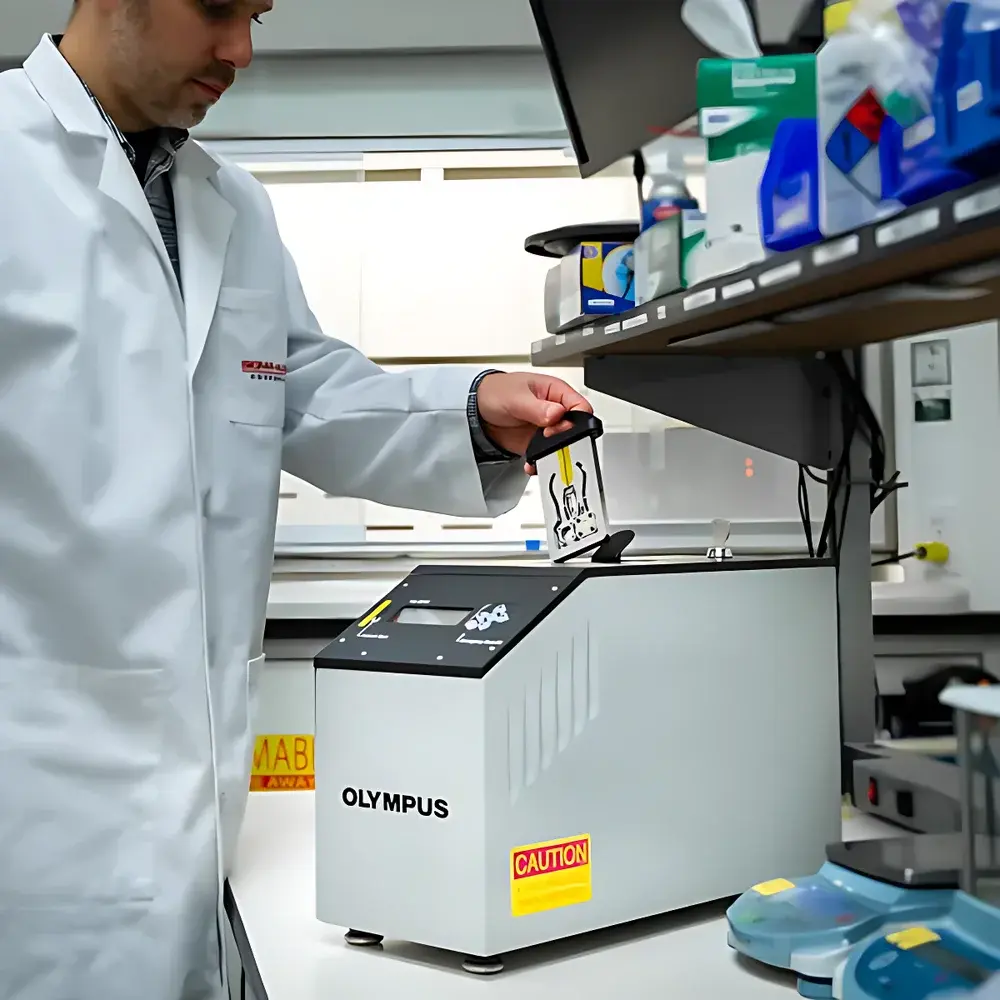
Olympus BTX III Benchtop X-ray Diffractometer
| Brand | Olympus |
|---|---|
| Origin | USA |
| Manufacturer Type | Authorized Distributor |
| Origin Category | Imported |
| Model | BTX III |
| Instrument Type | Powder X-ray Diffractometer |
| Power Consumption | 0.0001 kW (100 mW) |
Overview
The Olympus BTX III is a compact, benchtop powder X-ray diffractometer engineered for rapid, field-deployable, and laboratory-grade quantitative mineralogical and phase analysis. It operates on the fundamental principle of Bragg’s Law (nλ = 2d sinθ), utilizing Cu-Kα radiation (λ = 1.5418 Å) generated by a sealed-tube microfocus X-ray source. Unlike conventional floor-standing XRD systems requiring high-voltage transformers, water cooling, or compressed gas purge systems, the BTX III features an integrated, air-cooled X-ray tube and solid-state detection architecture—enabling true plug-and-play operation with minimal infrastructure dependency. Its core innovation lies in NASA-patented vibrational sample dispersion technology, which actively agitates the sample bed during acquisition to eliminate preferred orientation effects—a critical source of systematic error in powder XRD. This ensures high reproducibility across heterogeneous particulate samples without mechanical grinding or dilution. Designed for compliance with ISO 17892-12 (geotechnical investigation – laboratory testing of soils), ASTM D5163 (standard practice for XRD phase analysis of clay minerals), and USP (X-ray diffraction for pharmaceutical polymorph screening), the BTX III delivers traceable, audit-ready results suitable for regulated environments.
Key Features
- Integrated microfocus Cu-target X-ray source with <0.1 mm focal spot size and stable output at 40 kV / 10 µA
- High-efficiency silicon-based charge-coupled device (CCD) detector with direct photon energy discrimination—enabling simultaneous XRD and XRF spectral acquisition from a single irradiation event
- Vibrational sample stage (NASA Patent No. US 9,816,942 B2) ensuring isotropic particle orientation and minimizing texture-related intensity bias
- Ultra-low power consumption (0.0001 kW) and passive thermal management—no external chiller, no gas purge, no high-voltage cabinet required
- Wireless (Wi-Fi 5/802.11ac) and wired (Gigabit Ethernet) connectivity for remote instrument control, live pattern streaming, and networked data export
- Compact footprint (38 × 33 × 30 cm) and mass (<22 kg) enabling deployment in mobile labs, core logging units, or QA/QC rooms with space constraints
Sample Compatibility & Compliance
The BTX III accepts loose powders, pressed pellets, and granular solids with minimal preparation: only 15 mg of material is required, and particle size distribution should be ≤150 µm (achieved via included mortar/pestle and stainless-steel sieve kit). It supports analysis of crystalline phases in geological matrices (e.g., clays, carbonates, sulfates), industrial catalysts, battery cathode materials (LiCoO₂, NMC), cementitious compounds, and pharmaceutical polymorphs. All hardware and firmware comply with IEC 61000-6-3 (EMC emissions) and IEC 61000-6-2 (immunity), while software workflows support 21 CFR Part 11-compliant electronic signatures, audit trails, and role-based access control when deployed under GLP or GMP frameworks. Data integrity is preserved through SHA-256 hashing of raw .xy and .csv outputs, and all calibration files are digitally signed and version-locked.
Software & Data Management
SwiftMin® v4.2 software provides a unified interface for real-time pattern acquisition, automated phase identification (via ICDD PDF-4+ database), Rietveld refinement (using TOPAS-accelerated algorithms), and quantitative phase analysis (QPA) with internal standard or reference intensity ratio (RIR) methods. Key capabilities include:
- Single-dashboard workflow view integrating method templates, calibration history, and result validation status
- Password-protected Lab Manager mode for administrator-defined calibration sets—ensuring consistent performance across untrained operators
- Automated data export to network shares, SFTP servers, or LIMS via configurable triggers (time-based or acquisition-complete)
- Native support for exporting CIF, .xy, .csv, and .pdf report formats; raw diffraction patterns retain full metadata (kV, µA, exposure time, temperature, vibration frequency)
- Batch processing module for multi-sample QPA with statistical outlier detection and confidence interval reporting (95% CI for weight %)
Applications
The BTX III serves as a primary analytical tool in mineral exploration core logging, where it identifies clay swelling potential (smectite vs. illite ratios) and carbonate diagenesis stages in real time. In cement manufacturing, it quantifies alite (C₃S), belite (C₂S), and free lime content for kiln optimization. Battery material R&D teams use it to monitor phase evolution during cycling (e.g., layered-to-spinel transition in NMC cathodes). Regulatory labs apply it to verify polymorphic form identity in generic drug submissions per FDA guidance. Additionally, it supports forensic geology (soil provenance), cultural heritage pigment analysis (lapis lazuli vs. azurite), and additive manufacturing powder certification (Ti-6Al-4V α/β phase balance).
FAQ
What is the minimum detectable phase concentration?
Detection limits vary by phase symmetry and matrix absorption but typically range from 0.5–2 wt% for well-crystallized phases in low-Z matrices (e.g., quartz in kaolin), validated per ISO 11937.
Does the BTX III require annual recalibration?
No routine recalibration is needed; the monolithic optical path and solid-state detector eliminate drift-prone goniometer mechanics. A single factory calibration certificate (traceable to NIST SRM 660c LaB₆) is provided with each unit.
Can SwiftMin® perform Rietveld refinement?
Yes—SwiftMin® integrates a streamlined Rietveld engine optimized for speed and robustness on embedded hardware, supporting constrained refinements for lattice parameters, phase fractions, and microstrain.
Is XRF data quantifiable without separate standards?
XRF mode provides semi-quantitative elemental composition (Z ≥ 11) using fundamental parameter algorithms; full quantification requires matrix-matched standards for trace elements (<100 ppm).
How is data security ensured during wireless transmission?
All Wi-Fi communications use WPA3-Enterprise encryption with TLS 1.3 tunneling; instrument authentication is enforced via IEEE 802.1X/RADIUS integration with corporate directory services.





