
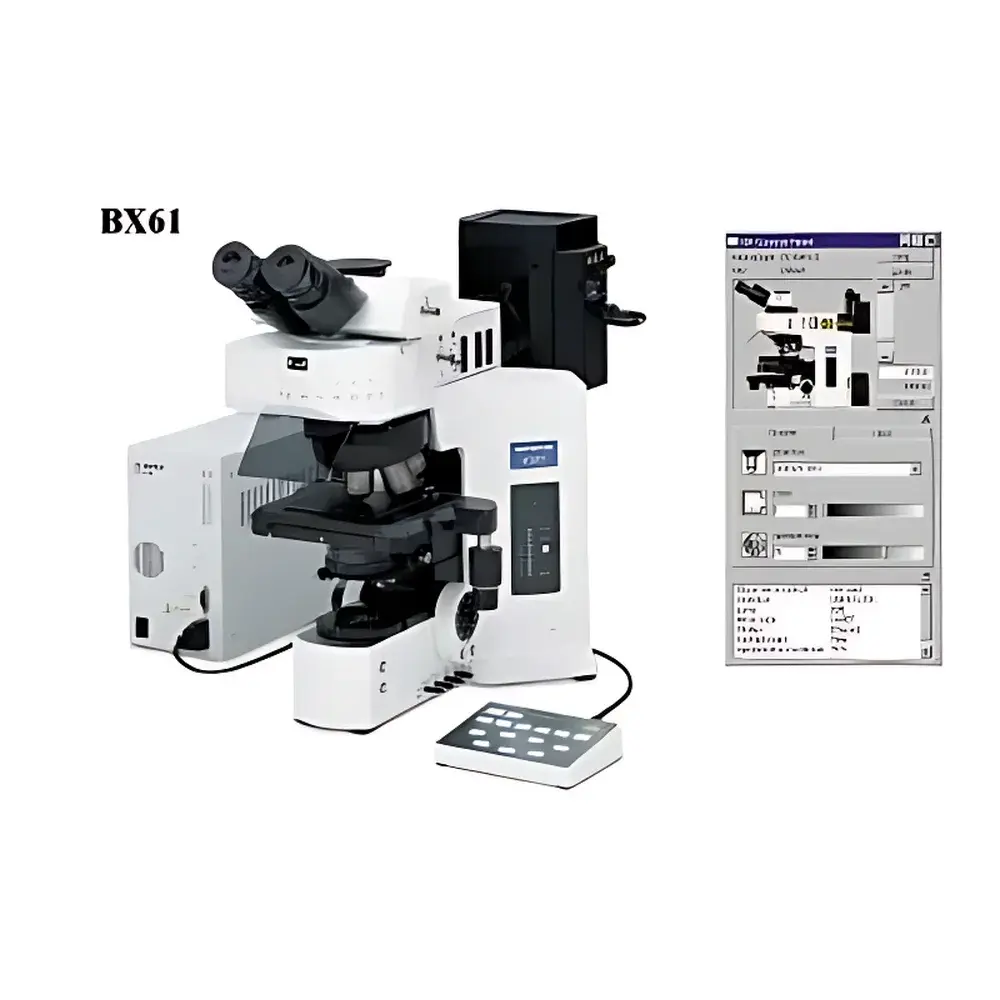
OLYMPUS BX61 Research-Grade Fully Motorized Upright Metallurgical Microscope
| Brand | OLYMPUS |
|---|---|
| Origin | Japan |
| Manufacturer | OLYMPUS Corporation |
| Product Category | Imported Instrument |
| Model | BX61 |
| Pricing | Upon Request |
Overview
The OLYMPUS BX61 is a research-grade, fully motorized upright metallurgical microscope engineered for high-precision microstructural analysis of opaque, reflective specimens—including metals, alloys, ceramics, composites, and semiconductor wafers. It employs the UIS2 (Universal Infinity System 2) optical platform, an industry-standard infinite-conjugate optical design that delivers exceptional axial chromatic correction across an extended spectral range from ultraviolet (UV) to near-infrared (IR). This broad spectral fidelity ensures accurate color reproduction, high signal-to-noise ratio (S/N), and superior light transmission—critical for quantitative image analysis, fluorescence imaging, and multi-modal contrast techniques such as differential interference contrast (DIC) and polarized light microscopy. The BX61 features a modular, dual-path optical architecture supporting both reflected-light (epi-illumination) and transmitted-light observation, enabling seamless transition between metallurgical and material science applications without optical realignment.
Key Features
- Fully motorized operation with programmable control of focus, illumination intensity, filter turret, objective revolver, and illumination mode (brightfield/darkfield/DIC/polarization/fluorescence)
- UIS2 infinity-corrected optics with apochromatic and semi-apochromatic objectives offering consistent parfocality, uniform pupil position across magnifications (1×–150×), and minimal wavefront aberration for faithful sample representation
- Dual illumination capability: motorized epi-illuminator (100 W halogen, 100 W mercury arc, or 75 W xenon lamp options) and transmitted-light base (100 W halogen) with independent intensity control
- Motorized nosepiece configurations: 5-position or 6-position revolvers, including center-output variants optimized for DIC and polarization alignment
- Dynamic autofocus unit compatible with up to 150× reflective objectives, utilizing multi-point laser sensing for stable, wide-field focus maintenance during Z-stack acquisition or stage scanning
- Ergonomic inclined binocular and trinocular observation tubes (22 mm or 26.5 mm field number), designed to reduce cervical strain during prolonged inspection sessions
- Integrated motorized aperture diaphragm and field diaphragm in all illumination modules for precise Köhler illumination setup and contrast optimization
Sample Compatibility & Compliance
The BX61 accommodates specimens up to 25 mm in height and supports diverse mounting formats—including standard metallographic mounts, 4-inch silicon wafers (via BH2-WHR43 wafer holder), and transmission-compatible glass slides (U-MSSPG stage plate). Its mechanical stage offers X–Y travel of 76 × 52 mm (standard) or 100 × 105 mm (wafer configuration), with fine positioning resolution of 0.01 µm and repeatable mechanical registration. All optical components comply with ISO 10934-1 (microscopy terminology), ISO 8578 (microscope mechanical tolerances), and JIS B 7151 (Japanese industrial standards for optical instruments). The system is compatible with GLP/GMP workflows when paired with analySIS FIVE software featuring FDA 21 CFR Part 11–compliant audit trail, electronic signature, and user-access controls.
Software & Data Management
The BX61 integrates natively with analySIS FIVE, OLYMPUS’ validated image acquisition and analysis suite. The software enables full remote control of motorized functions, automated multi-channel fluorescence capture, Z-series stacking, tiling, and morphometric measurement. All hardware states—including objective ID, illumination mode, diaphragm settings, and focus position—are logged with timestamped metadata in each image file (TIFF or OIB format). AnalySIS FIVE supports DIC vector quantification, grain size analysis per ASTM E112, phase fraction calculation, and customizable reporting templates compliant with ISO/IEC 17025 documentation requirements. Optional export modules facilitate direct data transfer to LIMS environments via HL7 or CSV protocols.
Applications
- Metallurgical quality control: grain boundary characterization, inclusion analysis, phase identification, and heat-affected zone (HAZ) evaluation per ASTM E3, E112, and E344
- Semiconductor process monitoring: defect mapping on polished wafers, CMP residue inspection, and interconnect integrity assessment
- Failure analysis laboratories: fracture surface topography, corrosion morphology, and coating adhesion evaluation using DIC-enhanced relief rendering
- Advanced materials R&D: ceramic microstructure quantification, composite fiber orientation analysis, and thermal barrier coating porosity measurement
- Forensic metallurgy: toolmark comparison, bullet jacket microstructure correlation, and counterfeit alloy verification
FAQ
Is the BX61 compatible with third-party digital cameras and image analysis software?
Yes—the BX61 provides standardized C-mount and F-mount interfaces, and its motorized functions are controllable via TTL/RS-232 and USB protocols. While analySIS FIVE delivers full native integration, many commercial machine vision SDKs (e.g., Thorlabs DCx, Basler pylon) support basic camera triggering and stage synchronization.
Can the BX61 perform automated grain size analysis according to ASTM E112?
Yes—when configured with analySIS FIVE and calibrated stage encoders, the system executes linear intercept and planimetric grain size measurements with traceable calibration against NIST-traceable stage micrometers.
What is the maximum working distance achievable with the BX61’s motorized focusing system?
The total focusing travel is 35 mm, with a minimum step size of 0.01 µm. When combined with long-working-distance UIS2 objectives (e.g., LMPLFLN 20×, WD = 20.5 mm), the system accommodates thick-section samples and environmental chambers.
Does the BX61 support darkfield illumination for particle detection on highly reflective surfaces?
Yes—the motorized brightfield/darkfield illuminator includes a dedicated darkfield stop and annular condenser optics optimized for metallic specimens, enabling high-contrast visualization of surface scratches, pits, and embedded contaminants.
How is optical alignment maintained during repeated mode switching (e.g., BF → DIC → Fluorescence)?
All UIS2 components—including prisms, analyzers, and excitation filters—are mechanically registered and motor-position-locked. The system retains alignment parameters per user-defined “observation method” profile, eliminating manual recalibration between modalities.





