
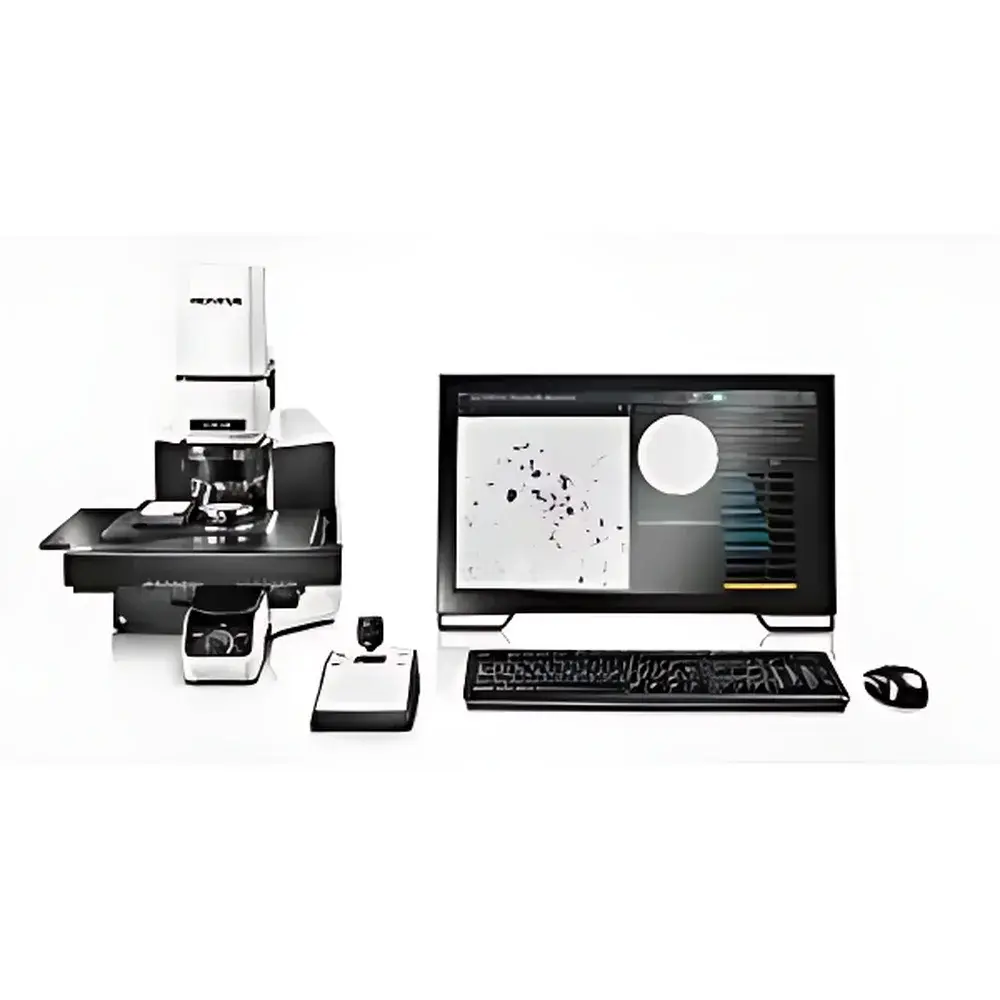
Olympus CIX100 Technical Cleanliness Microscopy System
| Brand | Olympus |
|---|---|
| Origin | Japan |
| Manufacturer Type | Original Equipment Manufacturer (OEM) |
| Import Status | Imported |
| Model | CIX100 |
| Pricing | Available Upon Request |
Overview
The Olympus CIX100 Technical Cleanliness Microscopy System is a dedicated, automated optical microscopy platform engineered for standardized particulate contamination analysis in precision manufacturing and quality assurance environments. It operates on the principle of brightfield and optional contrast-enhanced (e.g., darkfield, differential interference contrast) reflected-light microscopy, optimized for high-resolution imaging and morphological characterization of residual particles extracted from components via solvent-based rinsing or ultrasonic agitation. Designed in alignment with international technical cleanliness standards—including ISO 16232 (Road vehicles — Cleanliness of components of fluid circuits), VDA 19.1 (Contamination of Components in Automotive Industry), and ISO 4406 (Fluids — Fluid contamination by solid particles)—the CIX100 enables quantitative assessment of particle count, size distribution (typically ≥5 µm up to 500 µm), shape descriptors (aspect ratio, convexity, roundness), and elemental classification (via optional integration with EDS). Its architecture supports traceable, auditable workflows required under ISO/IEC 17025-accredited laboratories and GMP-compliant production facilities.
Key Features
- Automated motorized stage with programmable XY travel (≥150 × 100 mm) and Z-axis focus control for systematic scanning of filter membranes (e.g., black polycarbonate or white mixed cellulose ester filters)
- Dedicated CIX software with embedded particle detection algorithms compliant with ISO 16232 Annex D and VDA 19.1 Section 5.3 for reliable, operator-independent segmentation and classification
- Integrated LED illumination system with adjustable intensity and uniformity control to minimize glare and shadow artifacts on reflective metallic residues
- High-magnification objective turret (5×, 10×, 20×, 50×) with parfocal, apochromatic correction optimized for particle edge definition and dimensional accuracy
- Real-time image stitching and large-area mosaic generation for full-filter coverage without manual repositioning
- Built-in calibration verification routine using NIST-traceable stage micrometers and certified particle reference standards (e.g., PSL spheres)
Sample Compatibility & Compliance
The CIX100 accommodates standard filtration media (25 mm, 47 mm, and 90 mm diameter filters) mounted on reusable metal filter holders. It supports both dry and solvent-wetted sample conditions—compatible with common extraction solvents including n-hexane, isopropanol, and aqueous surfactant solutions. All measurement protocols adhere to the sampling, filtration, drying, and imaging procedures defined in ISO 16232-3 and VDA 19.1 Annex A. System validation documentation—including IQ/OQ/PQ templates, uncertainty budgets per ISO/IEC 17025 Clause 7.6, and audit trails for image metadata (timestamp, magnification, illumination settings, operator ID)—is provided to support regulatory submissions and internal quality audits.
Software & Data Management
CIX Software v3.x delivers a secure, role-based user interface with configurable access levels (Operator, Supervisor, Administrator). It records full digital audit trails compliant with FDA 21 CFR Part 11 requirements—including electronic signatures, immutable log files, and change history for all measurement parameters and classification rules. Export formats include PDF reports (with embedded raw images and metadata), CSV datasets for statistical process control (SPC) integration, and XML files compatible with LIMS platforms. Optional modules support automated report generation per customer-specific templates, batch-level trend analysis across multiple components, and cross-lot comparison against historical baselines.
Applications
- Technical cleanliness verification of fuel injection systems, brake calipers, transmission valves, and electric motor stators in automotive and aerospace OEM supply chains
- Validation of cleaning process efficacy during development of medical device components (e.g., surgical instrument housings, implantable pump assemblies)
- Root cause analysis of premature bearing failure or hydraulic valve jamming through correlation of particle morphology with wear mechanisms (abrasive, fatigue, adhesive)
- Supplier qualification and incoming material inspection per contractual cleanliness thresholds (e.g., “Class 4” per VDA 19.1)
- Supporting ISO/TS 16949 and IATF 16949 clause 8.5.1.5 (Contamination control) through documented, repeatable measurement evidence
FAQ
Does the CIX100 comply with ISO 16232 and VDA 19.1?
Yes—the system’s optical configuration, software algorithms, and reporting structure are validated against the measurement definitions, classification logic, and documentation requirements specified in both standards.
Can it integrate with existing laboratory information management systems (LIMS)?
Yes—via standardized CSV, XML, and HL7-compatible export interfaces; custom API integration is available upon request.
Is hardware calibration traceable to national metrology institutes?
All optical and mechanical calibration artifacts used during factory acceptance testing are NIST- or PTB-traceable, and calibration certificates are supplied with each unit.
What filter types and sizes are supported?
Standard support includes 25 mm, 47 mm, and 90 mm diameter polycarbonate, MCE, and nylon membrane filters; custom holders for non-standard substrates can be commissioned.
How is operator variability minimized during particle classification?
Classification is fully algorithm-driven using morphology-based thresholds defined in ISO 16232 Annex D; manual override is logged and requires supervisor-level authorization.





