
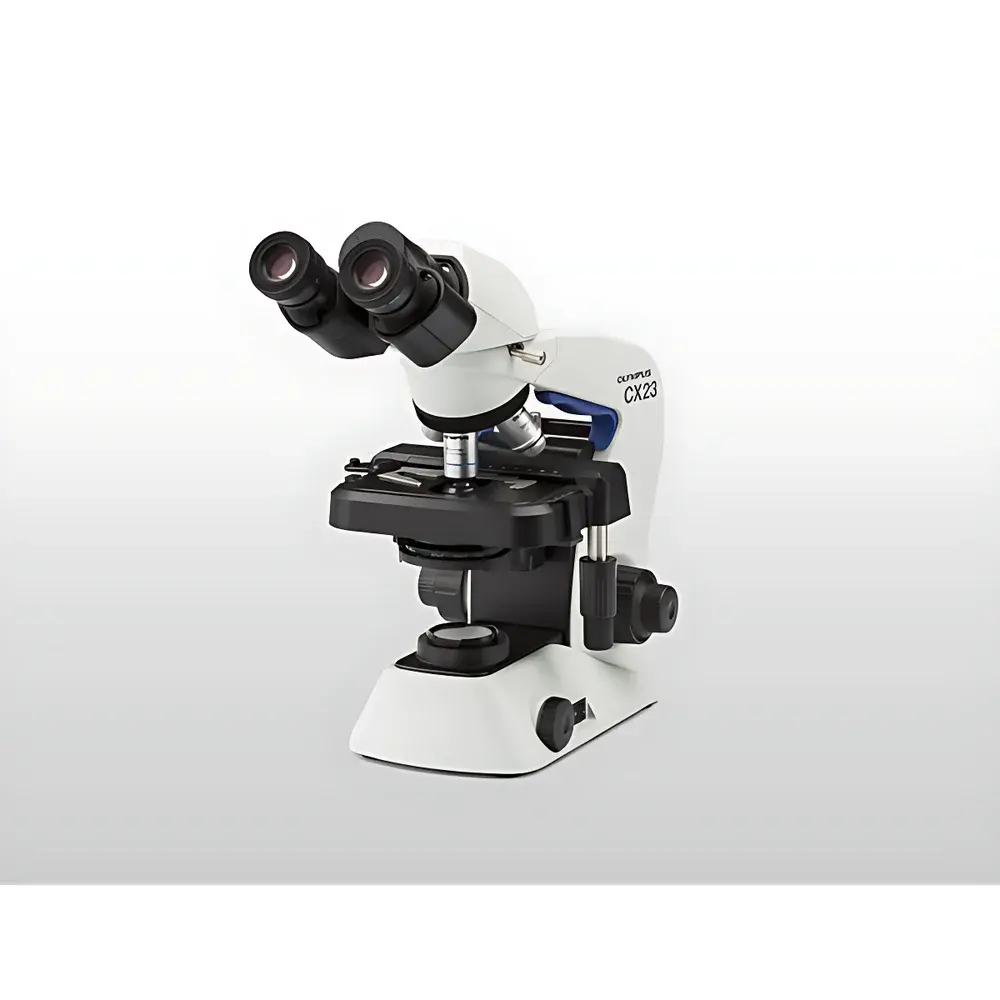
Olympus CX23 Upright Biological Microscope
| Brand | Olympus |
|---|---|
| Origin | Japan |
| Manufacturer Type | Original Equipment Manufacturer (OEM) |
| Product Category | Imported Instrument |
| Model | CX23 |
| Instrument Type | Upright Microscope |
| Illumination | LED (20,000 h lifetime, stable color temperature) |
| Field Number (FN) | 20 |
| Objective Type | Plan Achromatic |
| Ergonomic Design | Integrated non-slip carrying handle, compact footprint, lightweight chassis |
| Safety Features | Reinforced eyepiece tube, secured nosepiece, anti-slip stage clips, shock-absorbing base |
Overview
The Olympus CX23 upright biological microscope is an entry-level, education-optimized optical instrument engineered for consistent performance in undergraduate teaching laboratories, community college biology programs, and introductory life science courses. It operates on conventional brightfield transmitted-light microscopy principles, utilizing Köhler illumination geometry to deliver uniform, glare-free illumination across the entire field of view. Its optical path is optimized for standard 10× and 40× plan achromatic objectives—corrected for chromatic and spherical aberrations across the central 80% of the field—and paired with wide-field 10× eyepieces (FN20) to maximize visual throughput and student engagement. Designed from the ground up for pedagogical durability—not research-grade modularity—the CX23 prioritizes mechanical stability, intuitive operation, and long-term serviceability under high-frequency classroom use.
Key Features
- Ergonomic portability: Compact footprint (250 × 370 × 360 mm) and lightweight aluminum-magnesium alloy frame (≤7.5 kg) enable safe transport between lab rooms; integrated non-slip rubberized carry handle conforms to ISO 9241-5 ergonomic guidelines.
- Stable LED illumination system: Cold-white LED (6,000 K CCT) provides flicker-free, color-accurate illumination with <±3% intensity variation over 20,000 hours; power consumption ≤3 W, eliminating heat-induced specimen drying or thermal drift during prolonged observation.
- Optimized optical train: FN20 wide-field optics combined with plan achromatic objectives (4×, 10×, 40×, optional 100× oil) deliver flat-field imaging with minimal edge distortion; all lenses are multi-coated for >90% transmission in the 400–700 nm visible spectrum.
- Robust mechanical construction: Reinforced dovetail-mounted nosepiece prevents objective misalignment; coaxial coarse/fine focus mechanism (coarse: 31.25 mm/rev, fine: 0.002 mm/grad) features adjustable torque and slip-clutch protection; stage equipped with dual-layer anti-slip aluminum plate and spring-loaded mechanical stage clips.
- Compliance-ready design: Meets IEC 61000-6-3 (EMC emissions) and IEC 61000-6-1 (immunity); CE-marked per Directive 2014/30/EU (EMC) and 2014/35/EU (LVD); RoHS 2011/65/EU compliant.
Sample Compatibility & Compliance
The CX23 supports standard glass microscope slides (76 × 26 mm), coverslips (No. 1.5, 0.17 mm thickness), and routine histological, cytological, and microbiological preparations—including Gram-stained smears, H&E sections, live unstained protozoa, and stained plant tissue cross-sections. Its fixed condenser (NA 0.65, with centering screws and iris diaphragm) is calibrated for optimal resolution at 40× magnification (theoretical lateral resolution ≈ 0.65 µm). While not designed for fluorescence or phase contrast, optional accessories—including a 3W LED fluorescence illuminator module (CX23-FL) and phase contrast sliders—can be retrofitted without optical realignment. The instrument complies with ISO 8578:2017 (microscope performance testing) and supports GLP-aligned documentation workflows via external digital camera integration (e.g., Olympus UC50, USB 3.0 output).
Software & Data Management
The CX23 itself is hardware-only and does not include embedded software or onboard storage. However, it is fully compatible with Olympus cellSens Entry software (v2.4+), which supports image acquisition, basic measurement (length, area, particle count), annotation, and export in TIFF, JPEG, and BMP formats. When paired with certified USB 3.0 cameras, the system satisfies FDA 21 CFR Part 11 requirements for electronic records when deployed with validated IT infrastructure—specifically audit trail logging, user authentication, and electronic signature capability (via cellSens Enterprise license). Data integrity is preserved through lossless RAW capture modes and metadata embedding (objective ID, magnification, exposure time, date/time stamp).
Applications
- Undergraduate biology labs: Mitosis staging in onion root tip squashes, blood smear differential counts, algal motility assays.
- Microbiology instruction: Bacterial colony morphology assessment, yeast budding enumeration, fungal hyphae observation.
- Botany and zoology: Leaf epidermal stomatal density analysis, insect wing venation mapping, amphibian larval gill development.
- Veterinary and agricultural science: Parasite egg identification (e.g., Ascaris, Fasciola), feed grain contamination screening, pollen viability testing.
- Quality assurance training: Visual verification of filter membrane retention, particulate matter classification per USP , and sterility test support documentation.
FAQ
Is the CX23 suitable for fluorescence microscopy?
The base CX23 model lacks fluorescence capability; however, the optional CX23-FL LED fluorescence illuminator module (with EX/EM filter sets for DAPI, FITC, and TRITC) enables basic epifluorescence applications when installed with appropriate objectives.
Can digital imaging be integrated into existing LMS platforms?
Yes—images and annotated reports exported from cellSens can be imported into learning management systems (e.g., Canvas, Moodle) via standard SCORM-compliant packages or direct file upload.
What maintenance intervals are recommended for academic environments?
Olympus recommends annual optical cleaning and mechanical calibration by authorized service centers; daily lens wiping with lens tissue and 99.5% isopropanol is sufficient for routine classroom use.
Does the CX23 meet ISO/IEC 17025 requirements for accredited teaching labs?
While the CX23 itself is not a testing instrument per ISO/IEC 17025, its traceable optical specifications (per ISO 8578) and compatibility with validated imaging workflows support method validation documentation required under Clause 7.2.2 (selection of methods).




