
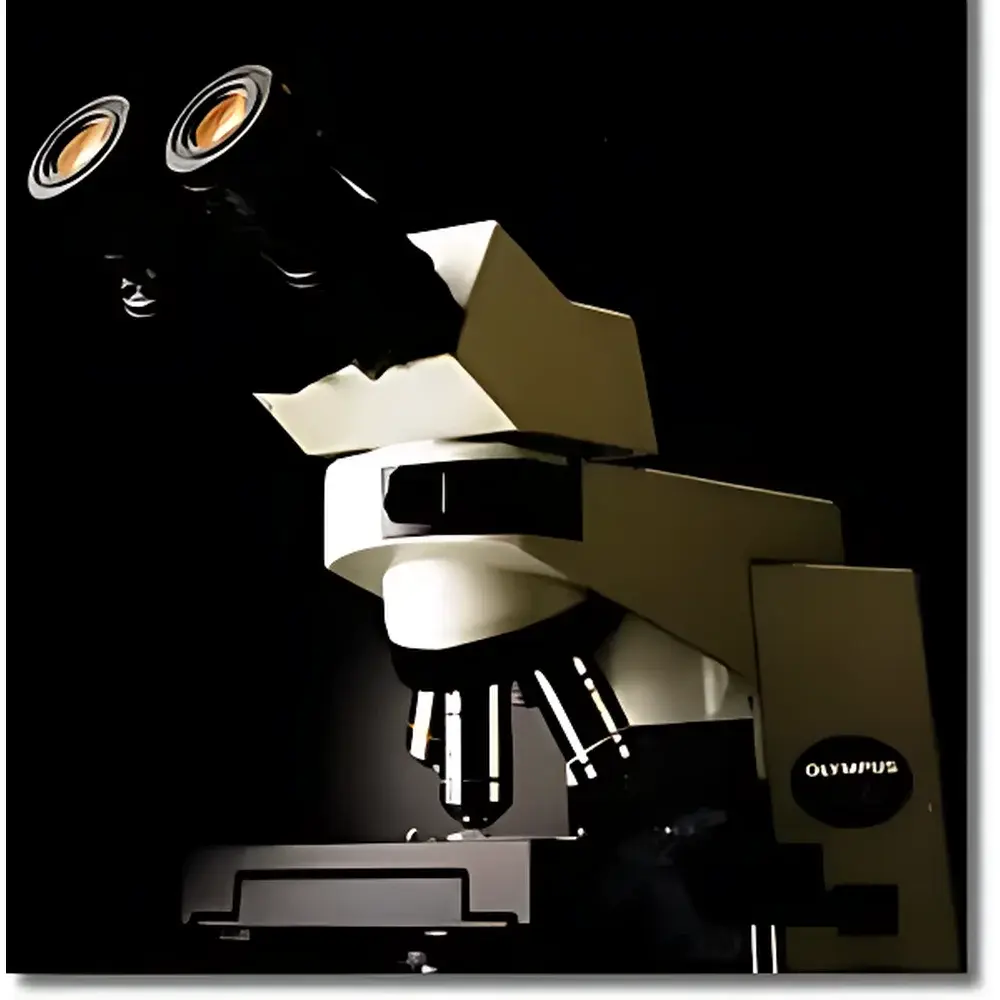
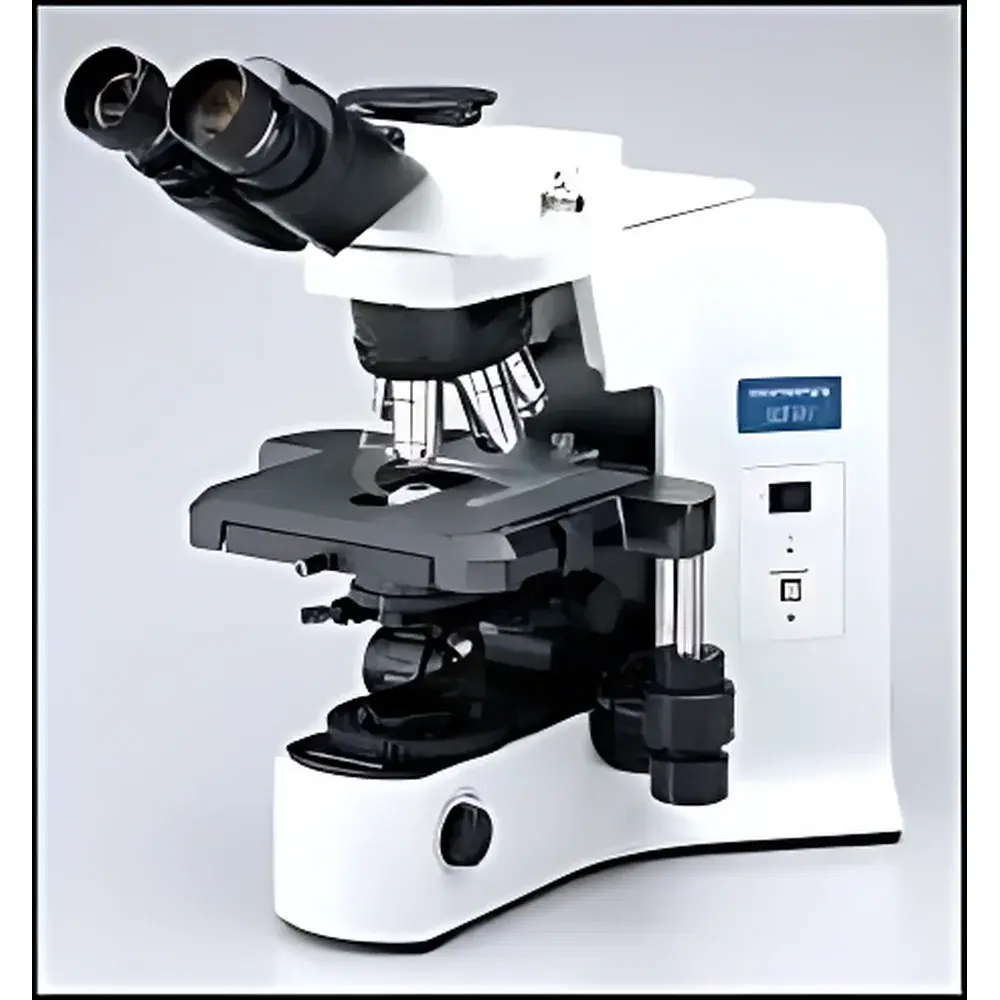
Olympus CX41 Biological Microscope
| Brand | Olympus |
|---|---|
| Origin | Singapore |
| Model | CX41 |
| Instrument Type | Upright Biological Microscope |
| Optical System | UIS2 Infinity-Corrected |
| Illumination | Built-in Köhler Transmitted Light, 6V/30W Halogen Lamp |
| Focus Mechanism | Coaxial Coarse/Fine Adjustment (Coarse Travel: 36.8 mm/rev, Total 25 mm |
| Fine Travel | 0.2 mm/rev) |
| Nosepiece | Inclined Fixed 5-Position Objective Turret |
| Observation Tubes | U-CBI30-2 (Binocular), U-CTR30-2 (Trinocular) |
| Field Number | 20 |
| Tube Angle | 30° |
| Interpupillary Distance | 48–75 mm |
| Stage Dimensions | 188 × 134 mm, Travel Range: 76 mm (X) × 50 mm (Y) |
| Condenser | Abbe Condenser, NA 1.25 (oil immersion), Integrated Iris Diaphragm |
| Objective Lenses (PLC Series Achromatic Plan) | 4× (NA 0.10, WD 18.5 mm), 10× (NA 0.25, WD 10.5 mm), 40× (NA 0.65, WD 0.56 mm), 100× Oil (NA 1.25, WD 0.13 mm) |
| Dimensions (W × H × D) | 233 × 432 × 367.5 mm |
| Weight | ~8.5 kg |
Overview
The Olympus CX41 is a high-performance upright biological microscope engineered for routine laboratory applications in education, clinical diagnostics, and basic life science research. Designed around the proven UIS2 (Universal Infinity System 2) optical platform, the CX41 delivers consistent image fidelity across magnifications through its infinity-corrected, parfocal, and chromatically balanced optical path. Its core imaging principle relies on transmitted brightfield illumination with Köhler optimization—ensuring uniform intensity, maximal contrast, and minimal glare across the entire field of view. The microscope supports multiple contrast modalities—including phase contrast (via optional CX-PH1/2/3 kits), darkfield (with CH2-DS central stop), and fluorescence (using the CX-RFL-2 epi-illuminator)—without compromising mechanical stability or optical throughput. All optical components—including eyepieces, objectives, and observation tubes—are treated with anti-fungal coating, ensuring long-term reliability in humid environments typical of tropical laboratories or shared core facilities.
Key Features
- UIS2 infinity-corrected optical system enabling modular expansion and consistent resolution from 4× to 100× oil immersion
- PLC series plan achromat objectives delivering flat-field imaging with improved edge-to-edge sharpness at 10× and 40× magnifications
- Ergonomic coaxial focus mechanism with adjustable tension control and coarse-focus limiter for reproducible, fatigue-resistant operation
- Inclined 5-position objective turret with forward-tilted design, optimizing working distance and simplifying objective exchange during live sample handling
- Anti-fungal treatment applied to all optical surfaces (eyepieces, objectives, prisms) to prevent microbial degradation under sustained high-humidity conditions
- Low-profile stage with non-protruding frame design, enabling unobstructed lateral specimen movement and minimizing accidental collisions during multi-user workflows
- Dual-purpose trinocular tube (U-CTR30-2) supporting simultaneous visual observation and digital imaging with standardized C-mount interface
Sample Compatibility & Compliance
The CX41 accommodates standard glass slides (76 × 26 mm), petri dishes (up to 100 mm diameter), and multi-well plates when used with optional stage adapters. Its Abbe condenser (NA 1.25) supports both dry and oil-immersion objectives, fulfilling ISO 8578:2017 requirements for optical microscopy performance validation. The instrument complies with IEC 61010-1:2010 for laboratory electrical safety and meets EN 62471 photobiological safety classification for halogen illumination systems. While not inherently GLP/GMP-certified as a standalone unit, its stable mechanical architecture, traceable calibration pathways (e.g., stage micrometer compatibility), and repeatable focus mechanics make it suitable for regulated environments when integrated into documented SOPs—particularly where ASTM E2877-22 (standard guide for microscope calibration verification) or USP (microscopy in pharmaceutical quality control) apply.
Software & Data Management
The CX41 operates as a hardware platform compatible with third-party digital imaging software (e.g., Olympus cellSens™, ImageJ/Fiji, or NIS-Elements via USB 3.0 or HDMI output). When paired with a compliant CMOS camera (e.g., Olympus UC50 or DP27), it supports time-lapse acquisition, Z-stack generation, and multi-channel overlay—essential for longitudinal cell culture monitoring. All image metadata (objective ID, magnification, exposure settings, timestamp) are embedded in TIFF or JPEG headers per Exif v2.31 standards. Audit trail functionality requires external software configuration; however, the microscope’s mechanical repeatability enables full traceability of acquisition parameters in 21 CFR Part 11-compliant workflows when combined with validated electronic lab notebook (ELN) systems.
Applications
The CX41 serves as a primary tool in undergraduate biology teaching labs for histology slide analysis and microbiology staining evaluation (Gram, acid-fast, hematoxylin-eosin). In clinical pathology departments, it supports peripheral blood smear examination and urine sediment analysis per CLSI H20-A3 guidelines. Research applications include routine phase-contrast imaging of adherent mammalian cells (e.g., HeLa, NIH/3T3), motility assays in protozoan cultures, and preliminary screening of transgenic zebrafish embryos. Its robust construction and thermal-stable illumination also support extended-duration observations in environmental microbiology labs assessing biofilm formation on abiotic surfaces.
FAQ
Is the CX41 compatible with digital cameras?
Yes—the trinocular version (U-CTR30-2) accepts standard C-mount cameras; adapter rings are required for CS-mount or proprietary interfaces.
Can the CX41 perform fluorescence imaging without modification?
Fluorescence capability requires the optional CX-RFL-2 epi-fluorescence illuminator and appropriate excitation/emission filter sets; base models include only transmitted-light optics.
What is the maximum usable magnification with the standard PLC objectives?
With the 100× oil-immersion objective (NA 1.25) and 10× wide-field eyepieces (FN20), the practical maximum is 1000×; higher nominal magnifications yield no additional resolvable detail due to diffraction limits.
Does the CX41 meet ISO 9001 or ISO 13485 requirements?
As a general-purpose instrument, it carries CE marking per Directive 2014/30/EU (EMC) and 2014/35/EU (LVD); formal QMS certification depends on end-user implementation and documentation practices.
Are replacement parts and service support available globally?
Olympus Life Science Service Centers provide technical support and spare parts distribution across APAC, EMEA, and Americas regions; warranty coverage varies by regional distributor agreement.





