
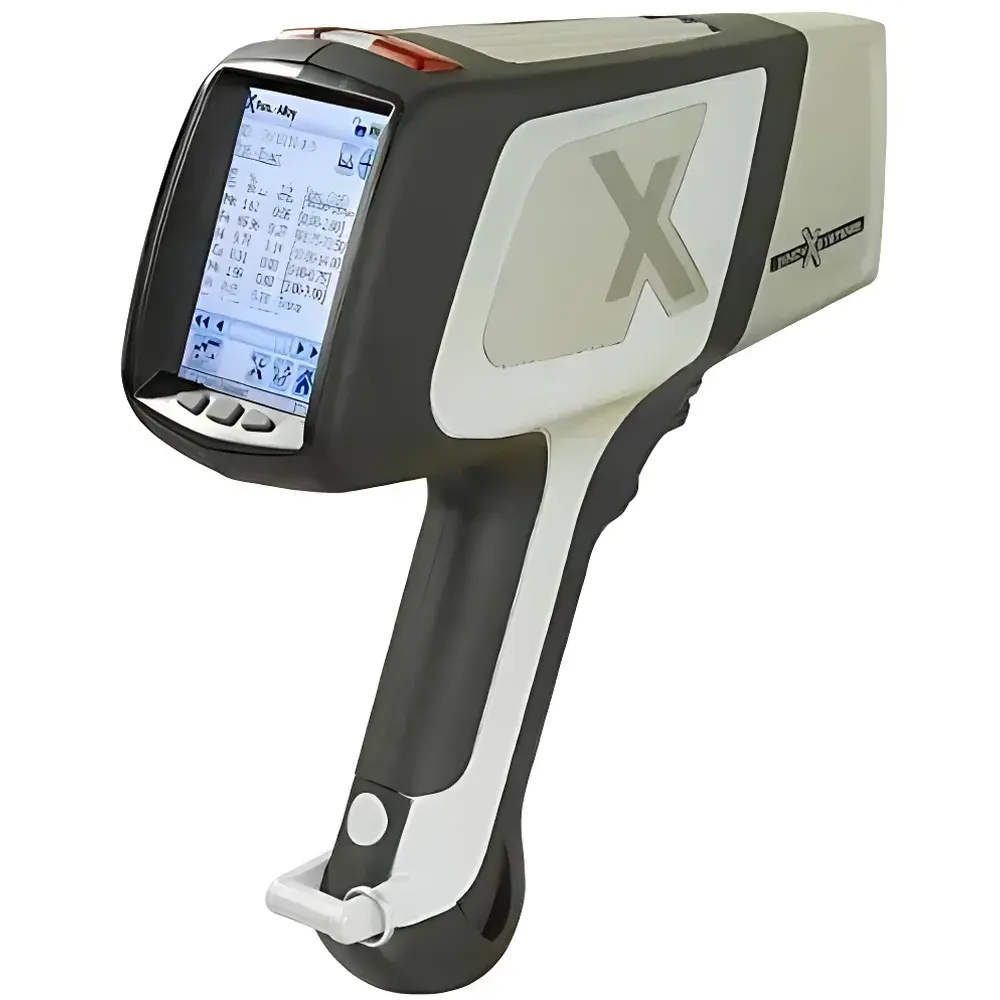
Olympus Delta DCC6500 Portable RoHS Analyzer
| Brand | Olympus |
|---|---|
| Origin | USA |
| Model | DCC6500 |
| Application | Handheld / Field-Portable |
| Industry-Specific Use | Electronics Manufacturing & Compliance Testing |
| Elemental Range | Mg (12) to U (92) |
| Quantification Range | ppm to 100% |
| Energy Resolution | <150 eV |
| Repeatability | ±0.1% |
Overview
The Olympus Delta DCC6500 Portable RoHS Analyzer is a field-deployable energy dispersive X-ray fluorescence (EDXRF) spectrometer engineered for rapid, non-destructive elemental analysis of regulated substances in electronic components, plastics, coatings, and consumer goods. Operating on the fundamental principle of EDXRF—where primary X-rays excite atoms in a sample, causing emission of characteristic secondary X-rays—the DCC6500 delivers laboratory-grade compositional data directly at the point of need. Its design addresses global regulatory requirements including EU RoHS 2011/65/EU, WEEE 2002/96/EC, China RoHS II (SJ/T 11364–2014), Korea RoHS (K-REACH Annex B), Japan JIS C 0950, and U.S.-based mandates such as CPSIA HR 404, California Proposition 65, and ASTM F2617–22. The instrument is calibrated and validated against certified reference materials traceable to NIST SRMs and supports measurement of restricted elements—including Pb, Cd, Hg, Cr(VI), Br (as proxy for PBB/PBDE), Cl (for chlorinated flame retardants), and other heavy metals—across heterogeneous and irregularly shaped samples without sample preparation.
Key Features
- High-power micro-focus X-ray tube with adjustable voltage (15–40 kV) and current up to 200 µA, optimized for enhanced excitation efficiency across light and heavy elements.
- Si-PIN semiconductor detector with Peltier thermoelectric cooling, maintaining stable operating temperature for consistent spectral resolution and long-term calibration stability.
- Multi-filter system with automatic filter switching to optimize signal-to-noise ratio for specific element groups (e.g., light elements Mg–Al, mid-Z elements Fe–Zn, high-Z elements Pb–U).
- Integrated 2 MP CMOS camera with crosshair overlay and micro-spot collimation (standard 8 mm; optional 3 mm), enabling precise targeting of small features such as solder joints, PCB traces, or plating layers.
- Ultra-short working distance window (<2 mm air path) combined with real-time barometric pressure compensation, significantly improving accuracy for low-Z elements (Mg, Al, Si, P, S, Cl) under variable environmental conditions.
- Dual hot-swappable Li-ion batteries supporting continuous operation >8 hours; simultaneous charging of both battery and main unit via single docking station.
- High-brightness Blanview transmissive color touchscreen (800 × 480) with glove-compatible interface and intuitive icon-driven navigation.
Sample Compatibility & Compliance
The DCC6500 accommodates a broad range of solid and semi-solid matrices encountered in electronics supply chain verification, including printed circuit boards (PCBs), plastic housings, metal alloys, wire insulation, conformal coatings, and assembled sub-assemblies. It meets ISO 17025:2017 requirements when operated within defined method validation protocols and supports GLP/GMP-aligned workflows through audit-trail-enabled software logging. Instrument performance complies with ASTM F2617–22 for RoHS screening, EPA Method 6200 for hazardous waste characterization, and NIOSH Method 7702 for workplace exposure assessment. All factory calibrations are performed using matrix-matched Certified Reference Materials (CRMs) and verified per IEC 62321-5:2013 and -7:2013 guidelines.
Software & Data Management
Running on Windows CE 6.0, the onboard Delta PC software provides full control over acquisition parameters, real-time spectrum visualization, peak deconvolution, and quantitative analysis using fundamental parameter (FP) and empirical calibration models. Data files include raw spectra (.spc), processed results (.csv/.xml), geotagged images, and operator metadata. Storage capacity exceeds 100,000 test records on internal SD card (expandable). Data export is supported via USB 2.0 and Bluetooth 4.0 (Microsoft Generic Bluetooth Driver compliant). Optional cloud-based reporting modules enable secure, role-based access to QA/QC dashboards and automated compliance report generation aligned with ISO/IEC 17025 documentation requirements.
Applications
- Routine incoming material inspection for RoHS compliance in electronics manufacturing and contract manufacturing organizations (CMOs).
- On-site supplier audits and first-article verification prior to component integration.
- Failure analysis of non-conforming lots during quality investigations (e.g., unexpected Pb or Cd detection).
- Regulatory pre-screening for REACH SVHC candidate list substances (e.g., antimony trioxide, beryllium compounds).
- Recycling stream sorting and scrap metal verification in WEEE processing facilities.
- Field-based environmental monitoring of legacy equipment containing hazardous substances (e.g., CRT monitors, fluorescent lamps).
FAQ
Does the DCC6500 require annual recalibration?
Yes—annual performance verification against CRMs is recommended per ISO/IEC 17025 and ASTM E1621–22 guidance. Full recalibration may be required if detector drift exceeds ±5 eV or if repeatability deviates beyond ±0.1% for certified standards.
Can it detect hexavalent chromium (Cr(VI)) directly?
No—EDXRF cannot distinguish oxidation states. Cr(VI) screening requires wet chemistry methods (e.g., EN ISO 3613) or portable XANES; however, total Cr quantification serves as a conservative proxy in RoHS enforcement contexts.
Is the instrument compliant with FDA 21 CFR Part 11?
The standalone DCC6500 does not include electronic signature or audit trail capabilities required for Part 11 compliance; however, integration with validated LIMS or enterprise QA platforms enables Part 11–compliant data handling.
What is the minimum detectable limit (MDL) for lead in PVC?
Typical MDL for Pb in polymer matrices is ~2–5 ppm under optimized conditions (40 kV, 200 µA, 60 s count time, 8 mm collimation), depending on sample thickness and homogeneity.
Does it support custom calibrations for proprietary alloys?
Yes—users can develop and validate custom FP or empirical calibrations using in-house reference standards, subject to documented uncertainty evaluation per ISO/IEC Guide 98-3 (GUM).




