
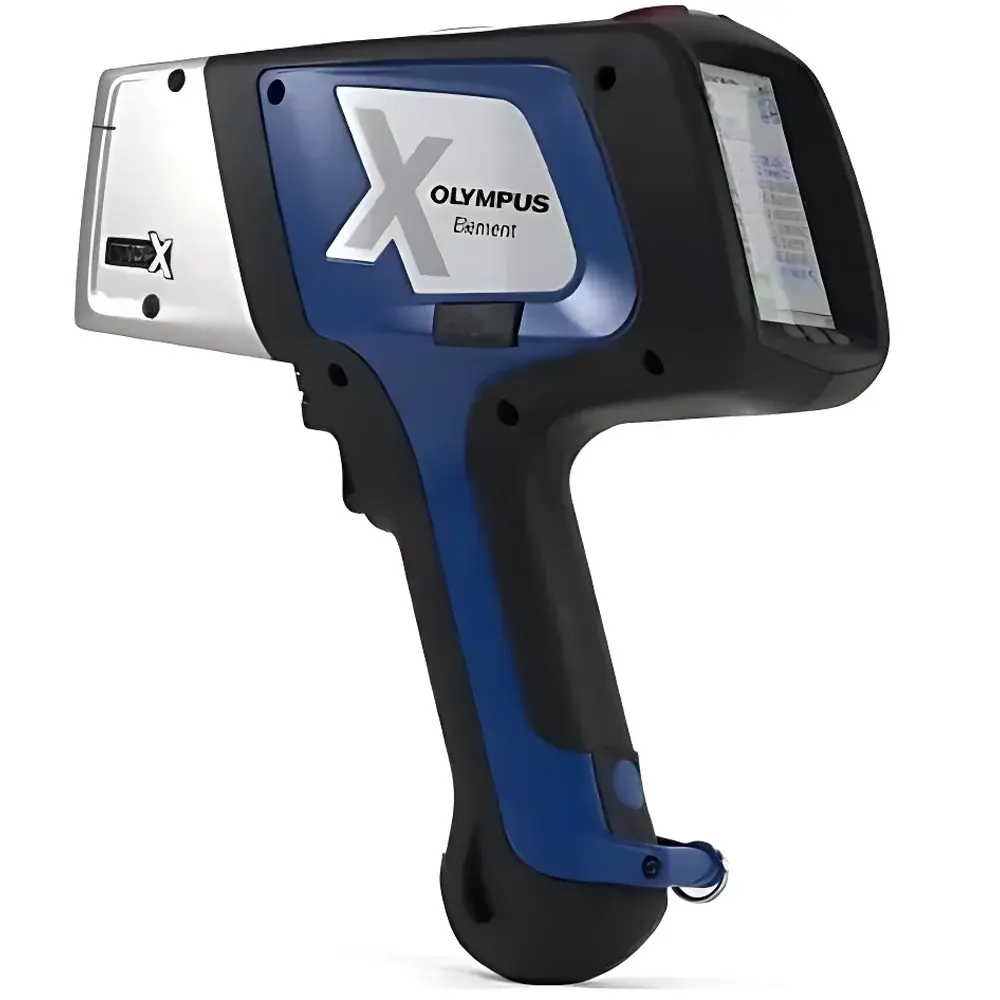
Olympus DELTA DE2000 Portable Energy Dispersive X-Ray Fluorescence (EDXRF) Analyzer
| Brand | Olympus |
|---|---|
| Origin | USA |
| Model | DELTA DE2000 |
| Application | Handheld / Portable |
| Industry Focus | Non-Ferrous Metals & Precious Metals |
| Elemental Detection Range | Mg to U |
| Quantification Range | 1 ppm – 100 wt% |
| Energy Resolution | <139 eV (at Mn Kα) |
| Repeatability | ≤0.1% RSD |
| Detector Type | Si-Pin Semiconductor Detector |
| Excitation Source | Ta/Au Target X-ray Tube, 4 W Max Power |
| Operating Voltage | Up to 35 kV |
| Cooling System | Peltier Thermoelectric Cooler (Operable down to −35 °C) |
| Battery | Dual Hot-Swappable Li-ion Batteries |
| Display | High-Resolution Blanview Transflective Color Touchscreen |
| Data Storage | Removable SD Card |
| Compliance | ISO 9001 Certified, NATO AQAPI Qualified |
Overview
The Olympus DELTA DE2000 is a field-deployable, handheld energy dispersive X-ray fluorescence (EDXRF) spectrometer engineered for rapid, non-destructive elemental analysis of precious and non-ferrous metals. Leveraging fundamental EDXRF physics—where primary X-rays from a micro-focus tube excite characteristic secondary (fluorescent) X-rays from sample atoms—the instrument delivers quantitative and qualitative compositional data in seconds. Its compact, ergonomic architecture integrates a high-stability Ta/Au-target X-ray source, a thermoelectrically cooled Si-Pin detector, and real-time spectral processing firmware optimized for alloy identification and precious metal assay. Designed for operation under ambient conditions ranging from −35 °C to 50 °C, the DE2000 meets the analytical rigor required in QA/QC laboratories, scrap yards, jewelry workshops, customs inspection points, and on-site mining surveys—without requiring sample preparation or vacuum environments.
Key Features
- Hot-swappable dual Li-ion battery system enabling continuous operation with <30-second battery replacement—no instrument shutdown required.
- Preloaded Delta Alloy Library containing >500 standardized alloy grades (e.g., ASTM, UNS, DIN, JIS), supporting customizable user-defined grade templates.
- One-touch trigger interface: single press initiates measurement; no sustained trigger hold needed—reducing operator fatigue during high-throughput screening.
- Self-balancing mechanical design ensures stable positioning on flat surfaces without manual support, improving measurement reproducibility across uneven or confined workspaces.
- Ruggedized aluminum chassis with passive thermal management enhances long-term detector stability and extends operational lifetime in high-heat environments.
- Blanview transflective touchscreen display maintains readability under direct sunlight and low-light conditions, with intuitive icon-driven navigation compliant with IEC 61000-4-2 ESD standards.
Sample Compatibility & Compliance
The DELTA DE2000 accommodates solid, irregular, and small-format samples—including jewelry items, coinage, catalytic converters, electronic connectors, and shredded scrap—without destructive sampling. Optional Flex Stand accessory provides a shielded sample chamber for controlled geometry and reduced background scatter during micro-area analysis. The system complies with international regulatory frameworks governing portable radiation-emitting devices: FDA 21 CFR Part 1020.40 (X-ray equipment safety), IEC 62495 (handheld XRF safety requirements), and EU RoHS Directive for restricted substances screening. All firmware and calibration files are traceable per ISO/IEC 17025:2017 guidelines, and audit logs support GLP/GMP documentation requirements where applicable.
Software & Data Management
Data acquisition, calibration, and reporting are managed via Olympus’ proprietary Delta PC Software Suite (v4.x), compatible with Windows 10/11. Each spectrum is timestamped, geotagged (via optional GPS module), and stored with full metadata—including tube parameters, live count rates, dead time correction, and peak deconvolution coefficients. Export formats include CSV, XML, PDF reports (with configurable templates), and ASTM E1621-compliant assay certificates. Firmware updates preserve historical calibration integrity and support remote diagnostics through secure HTTPS-based device management. For enterprise deployment, the software supports LDAP integration and role-based access control aligned with FDA 21 CFR Part 11 electronic record/electronic signature requirements.
Applications
- Precious metal grading (Au, Pt, Pd, Ag) in jewelry manufacturing and pawn appraisal—determining karat purity and detecting plating or cladding.
- Scrap metal sorting and valuation at recycling facilities—rapid discrimination between stainless steel grades, copper alloys, and nickel-based superalloys.
- Positive Material Identification (PMI) for piping, valves, and pressure vessels in oil & gas and power generation infrastructure—verifying ASME B16.5 compliance pre-installation.
- Environmental screening of catalysts, electronic waste (WEEE), and soil matrices for regulated elements (Pb, Cd, Hg, Cr⁶⁺) per EPA Method 6200 and EN 14385.
- Archaeometric provenance studies—non-invasive analysis of ancient coins, artifacts, and metallurgical residues without surface alteration.
FAQ
Is the DELTA DE2000 certified for use in regulated industries such as pharmaceuticals or aerospace?
Yes—when deployed with documented calibration protocols, traceable reference materials (e.g., NIST SRM 678b, 1250), and validated test methods, it satisfies ASTM E2857 and ISO 18115-1 requirements for elemental verification in GxP environments.
Can the instrument detect light elements such as magnesium or aluminum in gold alloys?
Yes—the Mg–U detection range includes Mg, Al, Si, and P, enabling accurate quantification of base-metal fillers in low-karat gold and platinum group alloys.
What is the typical measurement uncertainty for gold content at 18K purity?
Under optimized conditions (≥30 s counting time, clean surface, calibrated against matched matrix standards), expanded uncertainty (k=2) is ≤0.3 wt% for Au in Au–Cu–Ag ternary systems.
Does the DE2000 require annual recalibration by an authorized service center?
While routine performance verification using check standards is recommended daily or per shift, full recalibration is typically required only after detector replacement, major firmware upgrades, or exposure to extreme thermal shock—per Olympus Service Bulletin SB-EDXRF-2023-04.
How does the Peltier cooling system impact long-term detector resolution stability?
Maintaining the Si-Pin detector at −20 °C ± 0.5 °C minimizes thermal noise drift, preserving energy resolution (<139 eV) over 50,000+ spectra acquisitions without degradation—validated per IEC 61000-4-30 immunity testing.
Related Products




