
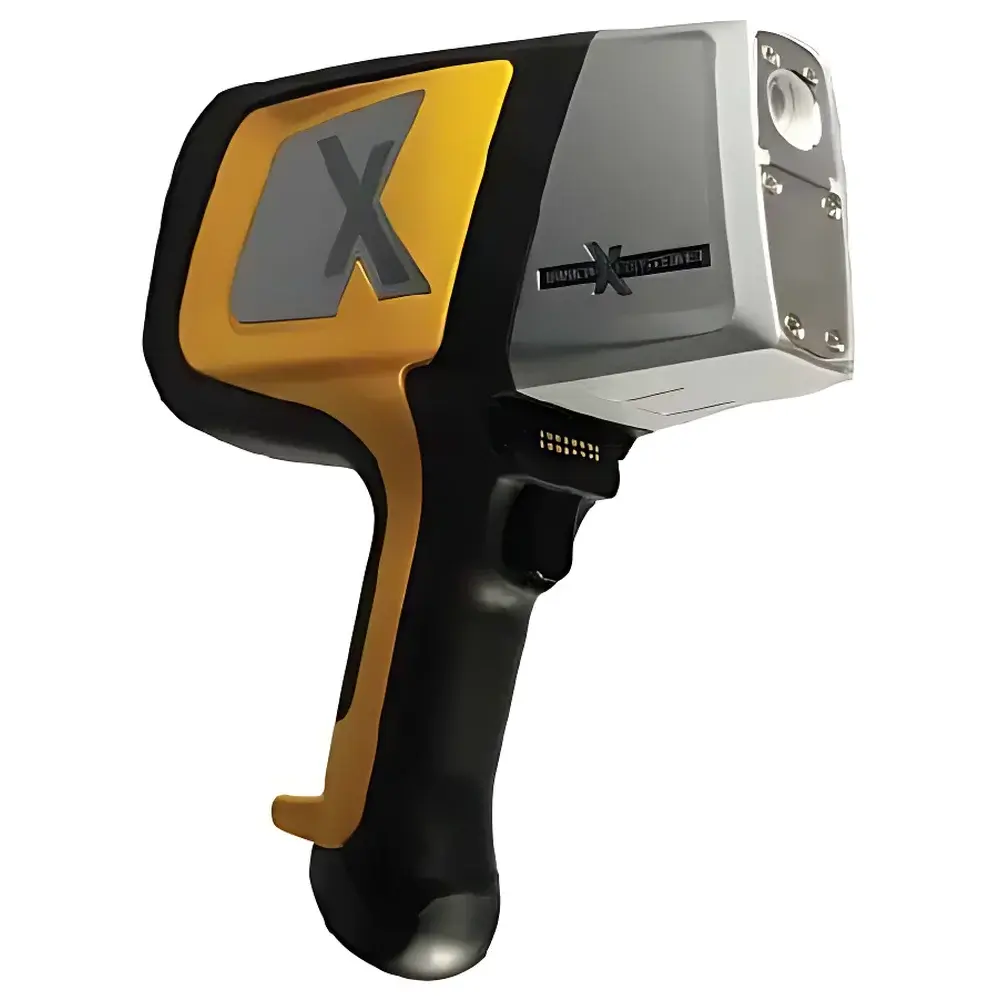
Olympus Delta DPO6500 Portable RoHS Analyzer
| Brand | Olympus |
|---|---|
| Origin | USA |
| Manufacturer Type | Authorized Distributor |
| Product Origin | Imported |
| Model | DPO6500 |
| Application | Handheld / Portable |
| Industry-Specific Use | Electronics |
| Elemental Range | Na (11) to U (92) |
| Quantification Range | 1 ppm – 99.99% |
| Energy Resolution | < 20 eV |
| Repeatability | ±0.1% RSD |
Overview
The Olympus Delta DPO6500 is a field-deployable, energy-dispersive X-ray fluorescence (EDXRF) spectrometer engineered for rapid, non-destructive elemental analysis of restricted substances in electronic components, plastics, coatings, and consumer goods. Operating on the fundamental principle of EDXRF—where primary X-rays excite atoms in a sample, causing emission of characteristic secondary (fluorescent) X-rays—the DPO6500 delivers quantitative and semi-quantitative data compliant with global regulatory frameworks governing hazardous substances. Its compact form factor (<1.5 kg), integrated Peltier-cooled silicon drift detector (SDD), and high-power micro-focus X-ray tube (15–40 kV, up to 200 µA) enable robust performance under variable ambient conditions, including low-light or confined industrial environments. Designed for on-site screening rather than laboratory-grade certification, the instrument supports real-time decision-making during incoming inspection, production line verification, and post-market compliance audits.
Key Features
- High-performance micro-focus X-ray tube with selectable voltage (15–40 kV) and current control (up to 200 µA), optimized for excitation of light elements (Na–Al) and heavy metals (Pb, Cd, Hg, Cr, Br) simultaneously.
- 25 mm² silicon drift detector (SDD) with Peltier thermoelectric cooling, maintaining stable spectral resolution (<20 eV at Mn Kα) across extended measurement cycles without liquid nitrogen.
- CMOS-based optical imaging system with 2 MP resolution and integrated crosshair overlay, enabling precise targeting of features as small as 3 mm diameter via optional micro-spot collimation.
- Short-working-distance detection window and real-time atmospheric pressure compensation algorithm—leveraging an onboard barometric sensor—to correct for air absorption effects on light-element fluorescence yield (e.g., Cl, S, P).
- Multi-beam excitation mode with 25 preconfigured analytical methods, each assigning optimized voltage/filtration/dwell-time parameters for specific matrices (e.g., PCB substrates, PVC cables, metal alloys).
- Dual hot-swappable lithium-ion battery system supporting continuous operation >8 hours; simultaneous charging of both battery and main unit via single AC adapter improves field logistics.
Sample Compatibility & Compliance
The DPO6500 accommodates heterogeneous solid samples—including printed circuit boards, molded plastic housings, solder joints, metal fasteners, and coated surfaces—without requiring homogenization or pelletization. Its non-contact, non-destructive measurement protocol preserves sample integrity for traceability and retesting. The instrument is validated against major international directives and standards, including EU RoHS Directive 2011/65/EU (Annex II limits), WEEE 2002/96/EC, China RoHS II (SJ/T 11364-2014), Korea RoHS (Act on Resource Circulation), Japan JIS C 0950, US CPSIA (HR 4040), California Proposition 65, ASTM F2617-23 (Standard Test Method for Determining Lead, Cadmium, Chromium, Mercury, and Bromine in Polymer Materials), and EPA Method 6200 for field screening of hazardous elements. While not certified for GLP/GMP-regulated release testing, its repeatability (±0.1% RSD) and inter-instrument agreement meet requirements for Tier 1 screening per IEC 62321-2:2017.
Software & Data Management
Running Windows CE 6.0 with a custom OEM interface, the DPO6500 provides intuitive touchscreen navigation, multi-language support (EN/DE/FR/ES/ZH/JP/KO), and context-aware method selection. All spectra, images, GPS coordinates (optional), operator ID, and environmental metadata (temperature, pressure, humidity) are timestamped and stored on removable SDHC cards with capacity for ≥100,000 records. Data export supports CSV, DXF, and proprietary .DPA formats. USB 2.0 and Bluetooth 4.0 interfaces allow secure transfer to LIMS or ERP systems; Bluetooth pairing follows Microsoft Generic Driver Profile for seamless integration into enterprise IT infrastructure. Audit trail functionality logs all user actions—including method changes, calibration updates, and result edits—with immutable timestamps, satisfying basic FDA 21 CFR Part 11 alignment for electronic record retention.
Applications
- Routine screening of electronic assemblies for RoHS-restricted elements prior to shipment or customs clearance.
- Verification of halogen-free status (Cl, Br ≤ 900 ppm) in cable insulation and connector housings per IEC 61249-2-21.
- On-line quality control of plating thickness and composition (e.g., Ni/Cu/Sn layers) on PCBs and connectors.
- Field assessment of legacy equipment for Pb-containing solder or Cd-plated hardware during facility decommissioning.
- Supporting due diligence documentation for conflict minerals reporting (3TG) where Sn, Ta, W, and Au quantification is required alongside RoHS screening.
- Environmental health & safety (EHS) surveys for heavy metal contamination in workplace dust, scrap metal lots, or recycled polymer streams.
FAQ
Is the DPO6500 compliant with ISO/IEC 17025 requirements?
The DPO6500 is not accredited as a standalone testing laboratory per ISO/IEC 17025; however, its measurement uncertainty profile and documented calibration procedures support its use within accredited labs that have incorporated it into their scope under method validation protocols.
Can it detect beryllium (Be) or lithium (Li)?
No. The DPO6500’s minimum detectable element is sodium (Na, Z=11); lighter elements (Z<11) fall below the detection threshold due to absorption in air and detector entrance window.
Does it require annual recalibration by Olympus service engineers?
While factory recalibration is recommended every 12 months or after 500 hours of operation, users may perform daily verification using supplied check standards (e.g., Cu/Ni/Fe alloy disk) and generate internal calibration reports per IEC 62321-3-1.
What is the typical detection limit for lead (Pb) in PVC?
Under standard 60-second measurement conditions, the practical detection limit for Pb in PVC matrix is approximately 3–5 ppm, depending on sample homogeneity and surface roughness.
Is Bluetooth data transmission encrypted?
Yes—Bluetooth communication uses AES-128 encryption when paired with enterprise-grade mobile devices configured with Microsoft Intune or equivalent MDM policies.




