
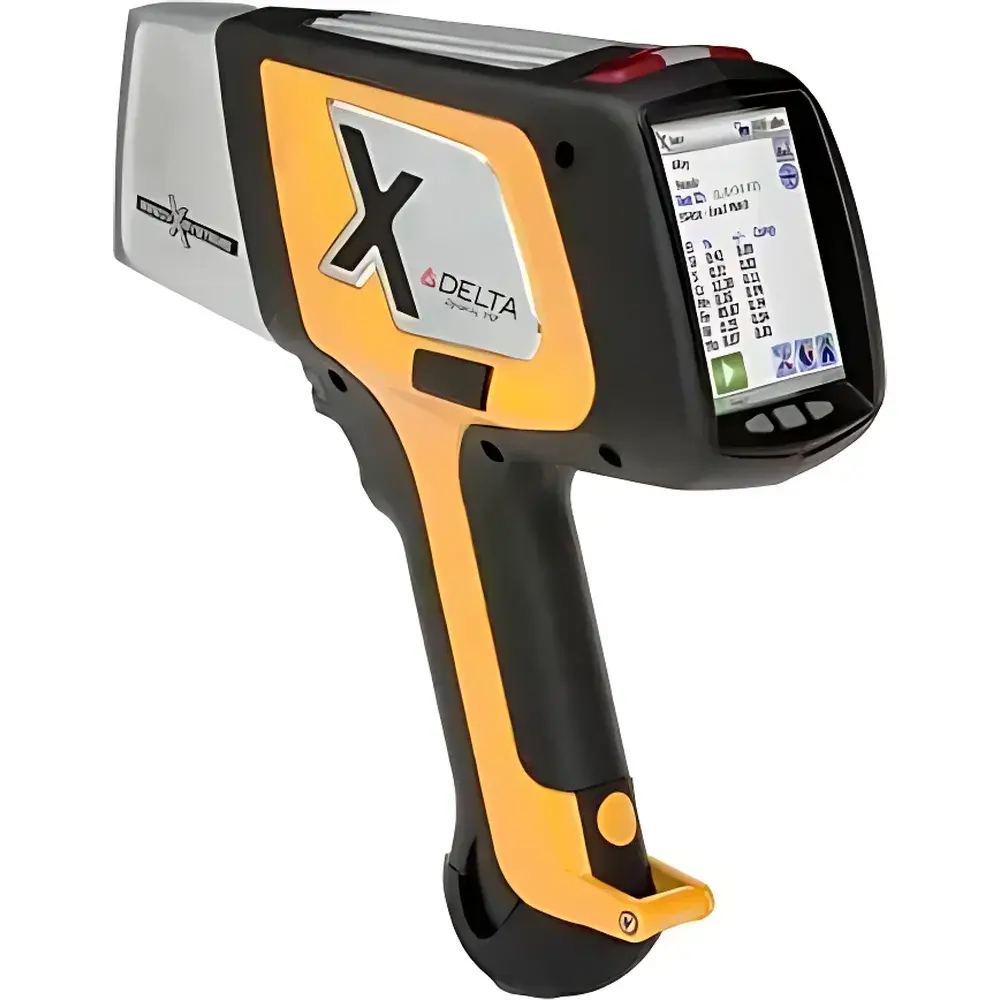
Olympus DELTA Premium DP4050 Handheld Soil Analyzer
| Brand | Olympus |
|---|---|
| Origin | USA |
| Manufacturer Type | Authorized Distributor |
| Import Status | Imported |
| Model | DP4050 |
| Application | Handheld/Portable |
| Industry-Specific Use | Soil & Environmental Monitoring |
| Elemental Range | Na (11) to U (92) |
| Detection Range | 1 ppm to 100% |
| Energy Resolution | <130 eV |
| Repeatability | ±0.1% |
Overview
The Olympus DELTA Premium DP4050 is a field-deployable, handheld energy dispersive X-ray fluorescence (EDXRF) spectrometer engineered for rapid, non-destructive elemental analysis of soil, sediment, sludge, core samples, and heterogeneous solid matrices. Leveraging a high-power microfocus X-ray tube (50 kV, 4 W) with gold anode target and a large-area silicon drift detector (SDD, 30 mm²), the DP4050 delivers laboratory-grade sensitivity in a rugged, ergonomic form factor. Its analytical principle relies on characteristic X-ray emission induced by primary X-ray excitation—elements present in the sample emit secondary photons at energies unique to their atomic structure, enabling quantitative and semi-quantitative determination across the periodic table from sodium (Na, Z=11) to uranium (U, Z=92). Designed specifically for environmental site assessment and regulatory compliance workflows, the DP4050 integrates triple-beam Soil Mode—a proprietary excitation geometry that enhances signal-to-noise ratio for low-Z elements (e.g., P, S, Cl, K, Ca) critical in soil nutrient and contaminant profiling.
Key Features
- Triple-beam Soil Mode optimized for enhanced detection of light elements (Na–Ca) and heavy metals (Pb, As, Cr, Cd, Hg) in complex, variable-matrix soils.
- Large-area 30 mm² silicon drift detector (SDD) delivering high count-rate capability and sub-130 eV energy resolution at Mn Kα (5.9 keV), ensuring precise peak deconvolution in multi-element spectra.
- Thermal management via aerospace-grade aluminum chassis, enabling sustained operation under ambient temperatures up to 50°C without performance degradation.
- Hot-swap battery system: replace or charge batteries in ≤30 seconds without powering down; dual-bay charger supports simultaneous instrument + spare battery charging with real-time state-of-charge display.
- Ergonomic one-button trigger interface—no sustained finger pressure required—reducing operator fatigue during high-throughput field surveys.
- Self-balancing design eliminates need for manual stabilization during measurement; integrated inertial sensors automatically compensate for minor hand motion.
Sample Compatibility & Compliance
The DP4050 is validated for direct analysis of unprepared or minimally homogenized soil, sediment, slurry, filter media, and composite waste samples. No pelletization, fusion, or acid digestion is required for screening-level quantification. It meets methodological requirements for EPA Method 6200 (field portable XRF for metals in soils), RCRA waste characterization, NIOSH Method 7702 (air filter Pb analysis), and OSHA OSSIDELTA protocols for surface coating lead screening. Instrument firmware and data handling architecture support audit-ready reporting aligned with GLP and ISO/IEC 17025 documentation practices. All spectral acquisition, calibration application, and result export are timestamped, user-logged, and traceable—facilitating 21 CFR Part 11–compliant data integrity when configured with optional secure authentication modules.
Software & Data Management
Powered by Olympus’ Delta PC Software Suite (v4.5+), the DP4050 supports offline calibration development, matrix-matched standardization, and empirical coefficient refinement using certified reference materials (CRMs). Spectral libraries include preloaded soil-specific calibrations (e.g., NIST SRM 2710a, 2711a, 1646a) and optional rare-earth element (REE) mode covering La, Ce, Nd, Pr, Nb, Ta, and Ba. Data export formats include CSV, XML, and PDF reports with embedded spectra, measurement metadata (GPS coordinates, humidity, temperature), and uncertainty estimates per element. Cloud synchronization via Olympus Connect enables centralized fleet management, remote calibration push, and automated QA/QC dashboard generation for multi-site environmental monitoring programs.
Applications
- Rapid on-site screening of contaminated sites (brownfields, landfills, agricultural fields) for As, Pb, Cd, Cr, Hg, and U.
- Regulatory compliance verification against EPA Regional Screening Levels (RSLs) and state-specific soil action levels.
- Nutrient mapping (K, P, Ca, Mg, S) in precision agriculture and land reclamation projects.
- Monitoring of remediation progress through time-series elemental profiling of excavated soils and backfill materials.
- Characterization of dredged sediments and industrial sludges for disposal classification per TCLP and SPLP protocols.
- Forensic geochemical fingerprinting of soil evidence in environmental litigation and regulatory enforcement.
FAQ
Does the DP4050 require daily calibration verification?
Yes—Olympus recommends running a check standard (e.g., stainless steel or soil CRM) at the start/end of each survey day and after any significant environmental shift (e.g., >10°C ambient change) to ensure measurement stability.
Can the DP4050 quantify total organic carbon (TOC) or moisture content?
No—EDXRF measures elemental composition only. TOC and moisture must be determined separately via loss-on-ignition (LOI) or NIR methods; however, elemental ratios (e.g., Ca/K, Fe/Mn) can serve as indirect proxies when correlated with lab-derived TOC data.
Is the DP4050 certified for use in intrinsically safe environments?
Not inherently—standard DP4050 units are not ATEX or IECEx certified. For hazardous locations, consult Olympus for explosion-proof enclosure options and third-party certification pathways.
What is the typical measurement time for reliable detection of 10 ppm Pb in clay-rich soil?
Under Triple-beam Soil Mode, 30–45 seconds provides RSD <5% at 10 ppm Pb in representative field conditions; longer dwell times (60–90 s) improve precision for sub-5 ppm quantification.
How does the DP4050 handle spectral interference from overlapping peaks (e.g., As Kα and Pb Lα)?
Advanced deconvolution algorithms in Delta PC Software apply iterative least-squares fitting with physical detector response modeling and inter-element correction matrices derived from fundamental parameters—enabling robust separation of overlapping lines even in complex matrices.




