
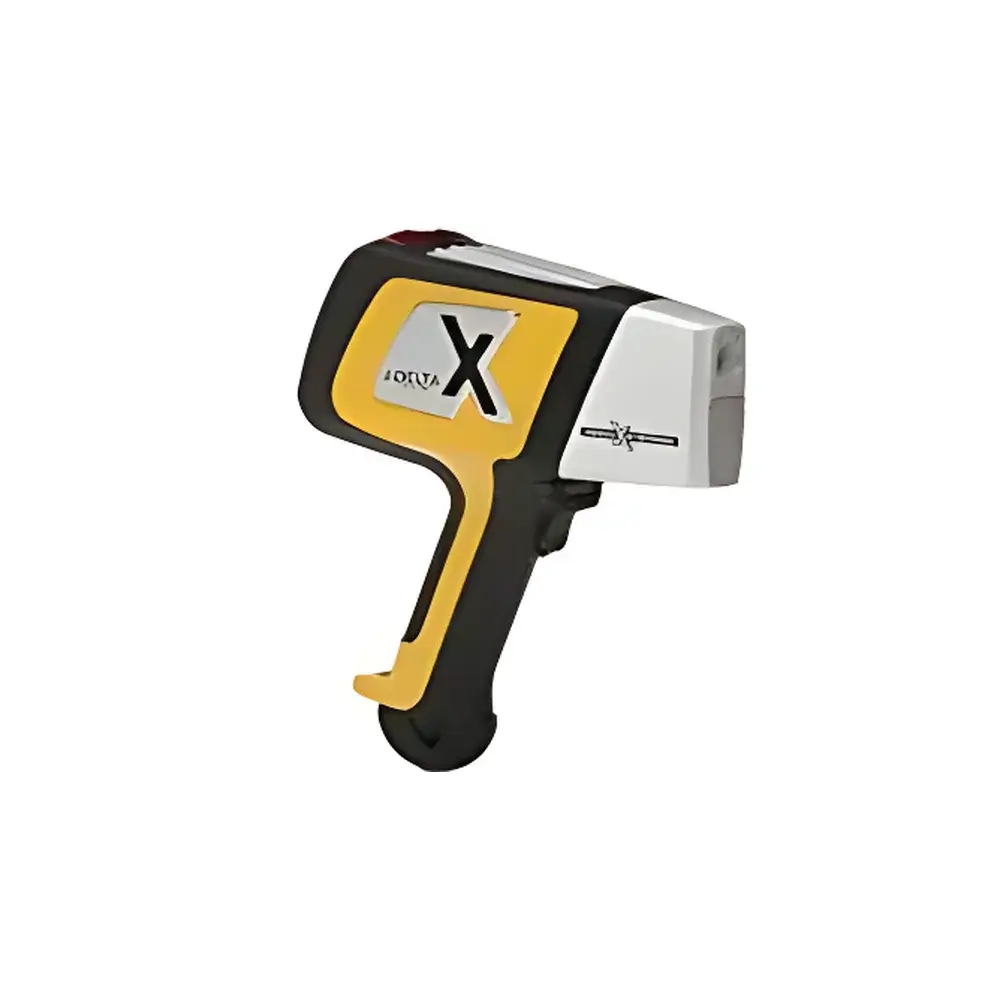
Olympus DELTA Premium DP6050 Handheld RoHS Analyzer
| Brand | Olympus |
|---|---|
| Origin | USA |
| Manufacturer Type | Authorized Distributor |
| Import Status | Imported |
| Model | DP6050 |
| Application | Handheld / Portable |
| Industry-Specific Use | Electronics |
| Elemental Range | Na (11) to U (92) |
| Quantification Range | 1 ppm to 99.9% |
| Energy Resolution | <130 eV |
| Repeatability | 0.1% |
Overview
The Olympus DELTA Premium DP6050 is a high-performance, handheld energy dispersive X-ray fluorescence (EDXRF) spectrometer engineered for rapid, non-destructive elemental analysis in field and production-line environments. Designed specifically for regulatory compliance screening—particularly RoHS, WEEE, CPSIA, and halogen-free material verification—the DP6050 leverages optimized X-ray excitation and silicon drift detector (SDD) technology to deliver laboratory-grade precision in a rugged, portable platform. Its measurement principle relies on primary X-ray irradiation of the sample surface, inducing characteristic secondary (fluorescent) X-ray emission; spectral deconvolution of these emissions enables quantitative and semi-quantitative determination of elemental composition from sodium (Na, Z=11) through uranium (U, Z=92). The instrument operates under fixed-tube geometry with selectable anode materials (Ta or Au), 4 W maximum tube power, and real-time spectrum processing firmware calibrated against certified reference materials traceable to NIST standards.
Key Features
- Ultra-fast thermal plug-and-play battery system: Hot-swap capability enables battery replacement within 30 seconds without powering down—critical for continuous shift operations or high-throughput inspection workflows.
- Single-button trigger interface: Eliminates need for sustained trigger pressure; initiates measurement with tactile feedback and visual confirmation, reducing operator fatigue and improving consistency.
- Self-balancing ergonomic design: Center-of-gravity optimization allows stable operation without hand support during extended use—enhancing repeatability in vertical or overhead sampling positions.
- High-efficiency 30 mm² SDD detector: Delivers superior peak-to-background ratio and low-energy sensitivity essential for detecting light elements (e.g., Cl, S, P) and regulated heavy metals (Cd, Pb, Hg, Cr, Br) at sub-ppm levels.
- Aluminum alloy chassis with passive thermal management: Ensures structural integrity and consistent detector performance across ambient temperatures ranging from –10 °C to 50 °C.
- Integrated 5-inch high-brightness touchscreen with glove-compatible UI: Supports multi-language interface and context-sensitive help overlays compliant with ISO/IEC 17025 documentation requirements.
Sample Compatibility & Compliance
The DP6050 accommodates heterogeneous solid samples including printed circuit boards (PCBs), solder joints, plastic housings, metal alloys, coatings, and composite components up to 10 cm in thickness. Surface geometry limitations are mitigated via automatic collimation adjustment and beam focus optimization. Regulatory alignment includes full method validation per ASTM F2617-23 (standard test method for determining lead, cadmium, mercury, chromium, and bromine in polymeric materials), EPA Method 6200 (field portable XRF for soil and sediment screening), and CPSC-CH-E1002-08 (lead in children’s products). Firmware includes preloaded RoHS/WEEE, Consumer, Alloy, and Halogen/Polymer modes—each configured with matrix-matched calibrations and interference correction algorithms validated against IEC 62321-5:2013 and EN 62321-5:2014. Instrument software maintains audit trails meeting FDA 21 CFR Part 11 and GLP/GMP data integrity requirements.
Software & Data Management
Olympus DeltaSync™ PC software provides secure, encrypted data synchronization, report generation (PDF/CSV/XLSX), and remote calibration update deployment. All spectra are stored with metadata including GPS coordinates, operator ID, time stamp, measurement duration, and environmental parameters (temperature/humidity). Cloud-enabled fleet management supports centralized configuration control, firmware version tracking, and usage analytics across multi-site deployments. Raw spectral files adhere to ASTM E1357-22 standard format, ensuring interoperability with third-party chemometric platforms for advanced multivariate analysis.
Applications
- Routine RoHS compliance verification of electronic assemblies and components prior to shipment or customs clearance.
- Supplier qualification audits for restricted substances in plastics, cables, connectors, and enclosures.
- On-site screening of scrap metal streams for hazardous element contamination in recycling facilities.
- Field-based verification of halogen content in flame-retardant polymers used in automotive interiors and aerospace wiring harnesses.
- QA/QC monitoring of plating bath chemistry and coating uniformity in electroplating lines.
- Forensic material identification in product safety investigations and counterfeit detection workflows.
FAQ
Does the DP6050 require annual recalibration?
No—factory calibration is traceable to NIST SRMs and remains valid for 12 months under normal operating conditions; however, daily verification using check standards is recommended per ISO/IEC 17025 clause 7.7.
Can the instrument analyze liquids or powders?
Yes—when placed in a sealed, X-ray-transparent container (e.g., polypropylene vial with Mylar film window) and measured in a stable holder; quantification accuracy depends on homogeneity and density matching of calibration standards.
Is radiation safety certification included?
Yes—the DP6050 complies with ANSI N43.3-2022 and IEC 62495:2010 for handheld XRF devices; it carries a Class I radiation-producing device registration and includes integrated dose monitoring with audible alert thresholds.
What accessories are required for routine operation?
A calibrated verification standard (e.g., Cu/Zn/Ni/Fe alloy disk), protective gloves rated for 30 kV X-rays, and optional benchtop test stand for reproducible positioning during high-volume testing.
How is data integrity ensured during wireless transfer?
All Bluetooth and Wi-Fi communications use TLS 1.2 encryption; DeltaSync™ enforces digital signature validation for firmware updates and prevents unauthorized parameter modification via role-based access control.






