
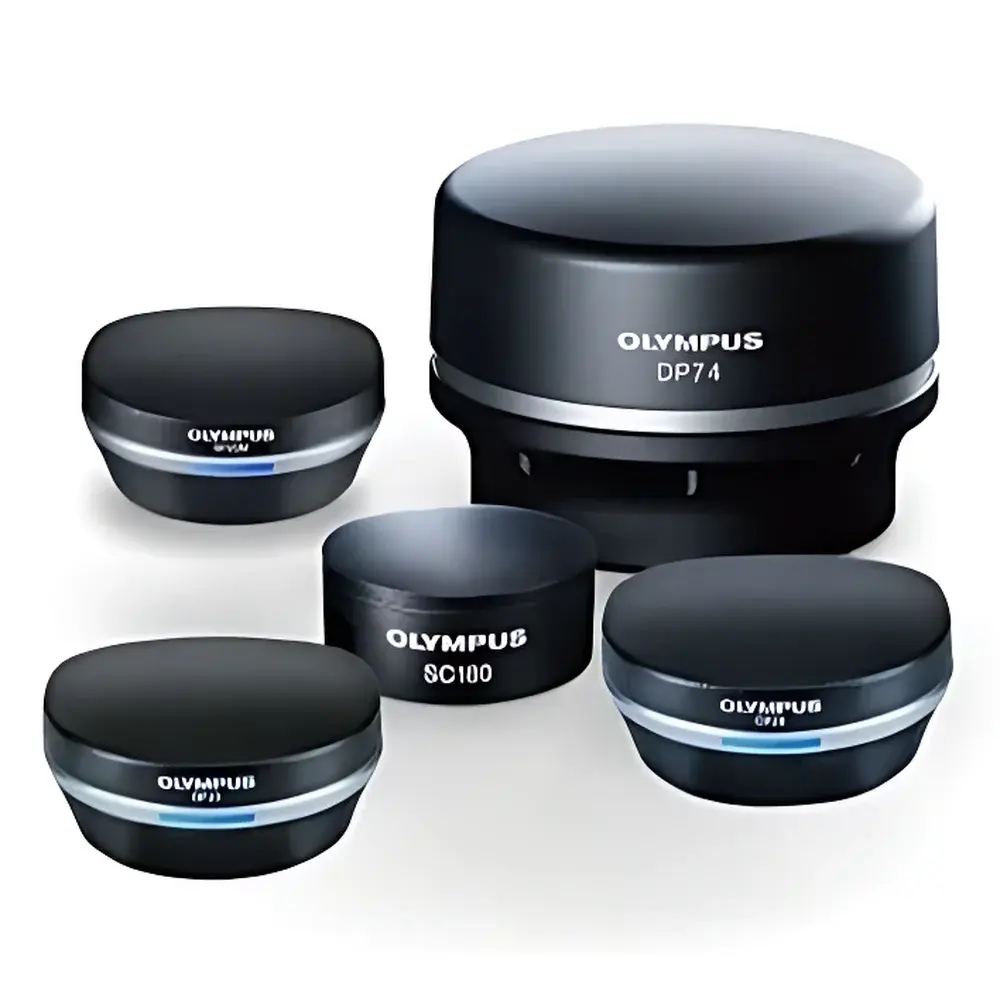
OLYMPUS DP28 and DP23 Digital Microscope Cameras
| Brand | OLYMPUS |
|---|---|
| Origin | Japan |
| Manufacturer Type | Original Equipment Manufacturer (OEM) |
| Product Origin | Imported |
| Model | DP28 / DP23 |
| Pricing | Available Upon Request |
Overview
The OLYMPUS DP28 and DP23 digital microscope cameras are purpose-engineered imaging solutions for industrial quality control, materials inspection, and routine microscopy in regulated manufacturing and R&D environments. Built upon OLYMPUS’ decades of optical expertise, both models integrate high-fidelity CMOS sensor technology with real-time image processing architecture to deliver metrologically reliable, color-accurate digital images—without reliance on eyepiece observation. The DP28 employs a 8.9-megapixel global-shutter CMOS sensor optimized for 4K (3840 × 2160) output, eliminating motion distortion during rapid stage movement or vibration-prone setups. The DP23 utilizes a 6.4-megapixel rolling-shutter CMOS sensor capable of full HD (1920 × 1080) acquisition at up to 60 fps—enabling high-throughput scanning of large-area samples across metallurgical, semiconductor, and PCB inspection workflows. Both cameras operate under the fundamental principle of digital photomicrography: precise photon capture through calibrated optical coupling (via C-mount or dedicated OLYMPUS trinocular tubes), followed by hardware-accelerated demosaicing, white balance correction, and gamma-linearized tone mapping—all traceable to sRGB and Adobe RGB color spaces per IEC 61966-2-1.
Key Features
- DP28: 8.9 MP global-shutter CMOS sensor; native 4K resolution (3840 × 2160); zero-skew imaging for dynamic sample handling
- DP23: 6.4 MP CMOS sensor; full HD @ 60 fps; field number (FN) up to 25 mm when paired with 0.35× TV adapter—maximizing visible area per frame
- Real-time Live View Mode: Maintains high temporal resolution (>30 fps) even under low-light conditions via adaptive gain control and noise-suppressed binning
- Focus Peaking: Real-time edge-enhanced overlay highlighting in-focus regions using spatial frequency analysis—reducing subjective focusing error in manual inspection
- Hardware-based Color Calibration: Factory-trimmed RGB channel response curves aligned to CIE 1931 chromaticity coordinates; supports user-defined LUTs for material-specific color fidelity (e.g., anodized aluminum, solder paste, polymer coatings)
- USB 3.0 interface with isochronous data transfer; compliant with USB Video Class (UVC) 1.5 specification for plug-and-play integration with third-party software
Sample Compatibility & Compliance
Both DP28 and DP23 support standard C-mount optical interfaces (17.52 mm flange distance) and are mechanically compatible with OLYMPUS BX, GX, and STM6 industrial microscope stands. They accommodate transmitted light (brightfield, darkfield), reflected light (epi-illumination), and polarized light configurations. Image metadata—including exposure time, gain, white balance settings, objective magnification, and calibration timestamp—is embedded in EXIF v2.31 headers for auditability. The cameras comply with IEC 61000-6-3 (EMC emission limits) and IEC 61000-6-2 (immunity), and meet RoHS Directive 2011/65/EU and REACH Regulation (EC) No. 1907/2006. When used with OLYMPUS Stream™ software (v2.4.4), image acquisition workflows support ALCOA+ principles (Attributable, Legible, Contemporaneous, Original, Accurate) and may be configured for 21 CFR Part 11-compliant electronic records—subject to site-specific validation protocols.
Software & Data Management
The DP28 and DP23 are fully supported by OLYMPUS Stream™ v2.4.4—a modular image analysis platform designed for GxP-aligned environments. Stream enables measurement traceability (ISO 17025-compatible calibration certificate import), multi-layer annotation (geometric, text, arrow), and batch report generation in PDF/A-1b or CSV formats. All acquired images retain embedded ICC profiles and DICOM-SR-compatible structured reporting metadata. Remote collaboration is facilitated via secure local network streaming (RTSP/H.264) or encrypted file export; however, real-time remote control of camera parameters or live feed sharing requires external VNC or TeamViewer deployment—as native Stream remote sharing functionality is intentionally disabled per security policy (per OLYMPUS Security Bulletin OL-2023-004). Raw image data is stored in 12-bit TIFF format with lossless compression, ensuring pixel-level integrity for post-acquisition quantitative analysis.
Applications
- Automotive component inspection: Surface defect detection (scratches, porosity, coating delamination) on castings, weld seams, and machined surfaces
- Semiconductor wafer metrology: Alignment mark verification, die-level contamination screening, and bond pad inspection
- PCB and flex-circuit QA: Solder joint integrity assessment, trace width measurement, and via inspection under oblique illumination
- Materials science: Grain structure analysis in metallography, phase identification in multiphase alloys, and fiber orientation mapping in composites
- Medical device manufacturing: Visual verification of microfluidic channel geometry, laser marking legibility, and surface roughness correlation studies
FAQ
What optical interfaces are supported?
Both models feature standard C-mount threading (1.0″–32 UNF) with optional adapters for OLYMPUS trinocular photo tubes (e.g., U-TRU, U-TRF).
Is hardware triggering available?
Yes—DP28 supports TTL-level external trigger input (rising-edge active) for synchronized acquisition with motorized stages or environmental chambers.
Can images be acquired in RAW format?
Yes—12-bit linear RAW data is accessible via OLYMPUS Stream SDK or third-party libraries supporting UVC raw payload mode.
Does the camera support time-lapse acquisition?
Yes—interval-based capture is programmable in Stream with timestamps logged to system clock (NTP-synchronized if configured).
Are firmware updates provided?
Yes—OLYMPUS releases validated firmware patches annually, distributed via the official support portal with version-controlled release notes and compatibility matrices.




