
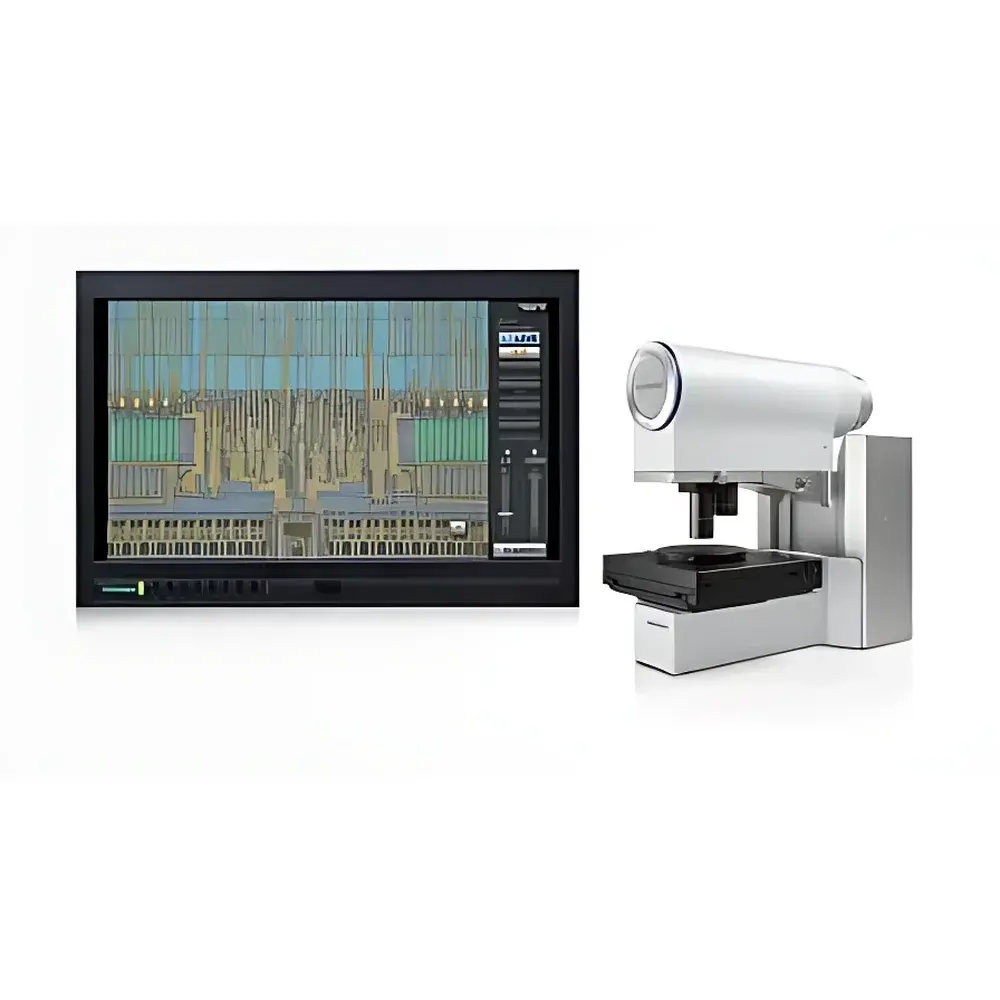
OLYMPUS DSX510 Digital Optical Microscope
| Brand | OLYMPUS |
|---|---|
| Origin | Japan |
| Manufacturer Type | Original Equipment Manufacturer (OEM) |
| Product Origin | Imported |
| Model | DSX510 |
| Pricing | Available Upon Request |
Overview
The OLYMPUS DSX510 is a high-performance digital optical microscope engineered for industrial inspection, materials science research, and quality assurance laboratories. Unlike conventional optical microscopes requiring eyepiece observation and manual focusing, the DSX510 employs a fully integrated digital imaging architecture with motorized zoom optics, precision Z-axis stepping, and real-time image processing algorithms. Its core measurement principle relies on extended-depth-of-field (EDF) synthesis and focus-stacking technology—capturing sequential focal planes across variable Z-heights and computationally fusing them into a single, fully focused 2D or pseudo-3D representation. This enables consistent visualization and metrology of topographically complex specimens—including machined surfaces, fracture sites, coatings, and electronic components—without physical repositioning or subjective operator interpretation.
Key Features
- Motorized zoom optics delivering continuous magnification from 20× to 9,000× (equivalent to 400× optical magnification with 22.5× digital zoom), calibrated against NIST-traceable standards.
- Integrated 5-megapixel CMOS sensor with 12-bit dynamic range and LED illumination system offering adjustable intensity, color temperature, and directional control (brightfield, darkfield, differential interference contrast [DIC], and oblique lighting modes).
- Touchscreen-based user interface (10.1-inch capacitive display) with intuitive icon-driven navigation—designed for rapid adoption by operators with minimal microscopy training.
- Automated panoramic stitching algorithm enabling seamless acquisition of large-area composite images up to 100 mm × 75 mm at micron-level registration accuracy.
- Real-time EDF rendering engine supporting both static and time-lapse capture of fully focused image stacks, compatible with export in TIFF, JPEG2000, and proprietary .DSX formats.
- Rugged aluminum-alloy chassis with vibration-damped base and ISO 10012-compliant mechanical stability for long-duration measurement repeatability.
Sample Compatibility & Compliance
The DSX510 accommodates specimens up to 210 mm × 210 mm × 150 mm (W × D × H) on its standard stage, with optional motorized XY stages supporting programmable coordinate mapping. It supports reflective, semi-transparent, and opaque samples—including metallographic mounts, PCBs, polymer films, and ceramic substrates—without requirement for conductive coating or vacuum environments. The system complies with IEC 61000-6-3 (EMC emission standards), IEC 61000-6-2 (immunity), and meets CE marking requirements for laboratory instrumentation. Measurement traceability aligns with ISO/IEC 17025 guidelines when operated under documented calibration protocols using certified reference standards (e.g., NIST SRM 2191a for lateral scale verification).
Software & Data Management
The bundled DSX Manager software provides comprehensive control, analysis, and reporting functionality. It includes audit-trail-enabled operation logging compliant with FDA 21 CFR Part 11 requirements—recording user ID, timestamp, parameter changes, and image metadata. Measurement functions support line, angle, radius, area, particle count, roughness (Ra, Rz per ISO 4287), and step-height quantification with statistical summary (mean, SD, Cp/Cpk). Reports are exportable in customizable PDF, Excel, or HTML templates; users may define corporate branding, header/footer content, and automated annotation overlays. Data integrity is preserved via SHA-256 hash generation for each acquired image set and encrypted local storage options.
Applications
- Failure analysis of solder joints, wire bonds, and thermal interface materials in electronics manufacturing.
- Surface roughness and defect characterization in automotive casting, additive manufacturing builds, and precision-machined aerospace components.
- Coating thickness assessment and delamination detection in biomedical device substrates.
- Particle morphology analysis in pharmaceutical tablet coatings and inhaler formulations per USP .
- Forensic toolmark comparison and fiber identification in accredited crime labs operating under ISO/IEC 17020 frameworks.
- Academic teaching of metallurgy, geology, and polymer science through annotated image libraries and collaborative annotation sharing.
FAQ
Does the DSX510 require external PC connectivity for basic operation?
No—the system operates as a standalone unit with embedded Linux-based controller and integrated touchscreen interface.
Can measurement data be exported directly to LIMS or MES platforms?
Yes, via configurable CSV/XML output with field-mapped metadata, supporting integration with common laboratory informatics systems.
Is calibration verification supported out-of-the-box?
Yes—built-in calibration wizard guides users through stage movement verification and pixel-size validation using certified graticules.
What is the minimum resolvable feature size at maximum magnification?
Under optimal lighting and sample contrast conditions, the system resolves features down to approximately 0.3 µm laterally (per Rayleigh criterion at 550 nm wavelength).
Are DIC and polarized light modules available as factory-installed options?
Yes—both are offered as optional accessories with factory alignment and software integration.





