
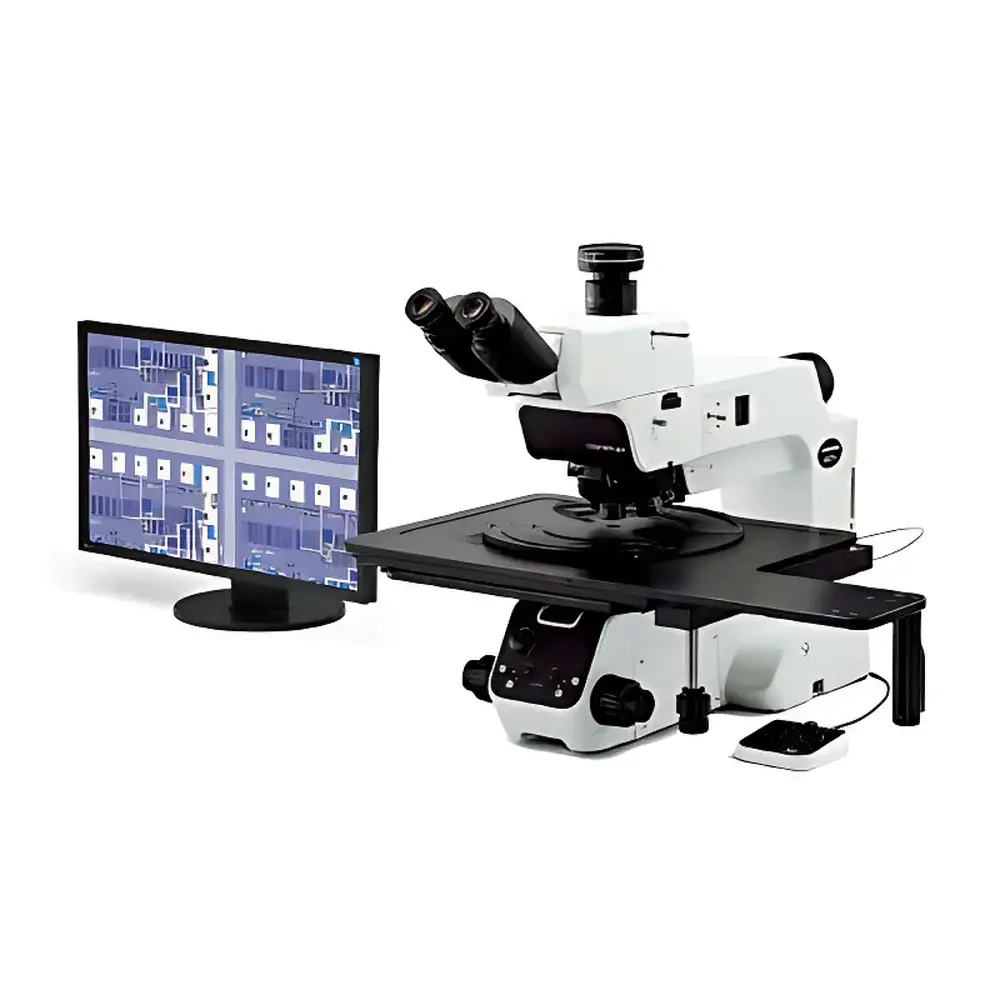
Olympus MX63/MX63L Semiconductor Inspection Tooling Microscope
| Brand | Olympus |
|---|---|
| Origin | Japan |
| Manufacturer Type | Original Equipment Manufacturer (OEM) |
| Product Category | Imported Instrument |
| Model | MX63 / MX63L |
| Pricing | Upon Request |
Overview
The Olympus MX63 and MX63L are high-precision, modular tooling microscopes engineered specifically for non-destructive dimensional metrology and defect inspection in semiconductor fabrication, flat panel display (FPD) manufacturing, and printed circuit board (PCB) quality control. These systems operate on the fundamental principles of transmitted and reflected light microscopy combined with advanced optical contrast enhancement techniques—including brightfield, darkfield, polarization, fluorescence, and the proprietary MIX (Multi-Illumination eXtended) observation mode. Unlike conventional single-mode microscopes, the MX63/MX63L integrates multiple illumination paths simultaneously via a motorized turret and beam combiner optics, enabling real-time overlay of complementary contrast mechanisms. This capability is critical for visualizing sub-micron surface anomalies—such as scratches, particle residues, edge chipping, or thin-film interference patterns—that remain indiscernible under standard illumination. The system’s optical architecture complies with ISO 10110-7 (optical element surface quality) and JIS B 7153 (microscope performance testing), ensuring traceable measurement fidelity across production environments.
Key Features
- Proprietary MIX illumination technology: Synchronizes brightfield, darkfield, polarized, and fluorescent illumination in real time to maximize defect contrast and surface feature resolution.
- Long-life, color-stable white LED illumination: Delivers consistent 5700 K correlated color temperature (CCT) over >20,000 hours, eliminating thermal drift and enabling repeatable colorimetric analysis per ASTM E308 and CIE 15:2018 standards.
- Dual-platform scalability: MX63 supports wafers up to 200 mm (8-inch); MX63L accommodates full 300 mm (12-inch) wafers with optional vacuum chuck and auto-leveling stage.
- Cleanroom-ready engineering: Fully compliant with SEMI S2 (safety) and SEMI S8 (ergonomics) standards; all structural components—including stage, objective nosepiece, and focusing mechanism—are electrostatically dissipative (ESD-safe) per ANSI/ESD S20.20.
- Ergonomic operator interface: Front-mounted aperture diaphragm and objective revolver controls allow continuous ocular observation during setup; motorized nosepiece achieves <0.3 s index-to-index switching for rapid magnification changes.
- Shielded electromechanical architecture: All motorized axes (Z-focus, XY-stage, illumination turret) are housed within grounded metal enclosures to suppress electromagnetic interference (EMI) in sensitive fab environments.
Sample Compatibility & Compliance
The MX63/MX63L accommodates rigid planar substrates ranging from silicon wafers (bare, patterned, or oxide-coated), glass substrates (LCD/OLED panels), ceramic substrates (LTCC), and FR-4 PCBs. Sample thickness tolerance spans 0.2–25 mm, with optional high-NA long-working-distance objectives (e.g., LMPLFLN 20×/0.40 WD = 15.5 mm) supporting inspection through cover glasses or encapsulation layers. The system meets CE marking requirements under the EU Machinery Directive 2006/42/EC and UL 61010-1 safety certification. Electrical safety and EMC performance are validated per IEC 61326-1 for industrial measurement equipment. For regulated environments, optional audit-trail-enabled software modules support 21 CFR Part 11 compliance when paired with Olympus cellSens™ Digital Imaging Software.
Software & Data Management
Olympus cellSens software (v3.1 or later) provides calibrated measurement tools—including line, angle, radius, area, and particle counting—with NIST-traceable calibration using certified stage micrometers. Measurement data export supports CSV, XML, and PDF formats compatible with MES (Manufacturing Execution Systems) and SPC (Statistical Process Control) platforms. Image metadata includes timestamp, objective ID, illumination mode, exposure parameters, and user authentication logs. Optional “Auto-Report” module generates GLP/GMP-compliant inspection reports with digital signatures, revision history, and electronic audit trails aligned with ISO/IEC 17025 clause 7.8.
Applications
- Semiconductor front-end process control: Mask alignment verification, photolithography residue inspection, CMP scratch detection, and bond pad integrity assessment.
- Backside wafer inspection: Cracking, delamination, and contamination analysis prior to dicing or packaging.
- Fab-wide metrology: Critical dimension (CD) verification on test structures, overlay error quantification, and film thickness estimation via interference fringe analysis.
- Flat panel display QA: TFT array defect mapping, touch sensor electrode continuity checks, and polarizer alignment validation.
- Advanced packaging: Flip-chip solder bump height uniformity, underfill void detection, and substrate warpage measurement using focus variation algorithms.
FAQ
What wafer sizes does the MX63L support?
The MX63L accommodates full 300 mm (12-inch) silicon wafers with optional vacuum chucks and automated leveling stages.
Is MIX illumination compatible with quantitative image analysis?
Yes—MIX modes generate registered multi-channel images that retain pixel-level spatial correspondence, enabling pixel-ratio analysis, spectral unmixing, and machine learning–based defect classification.
Can the system be integrated into a factory automation environment?
Yes—RS-232, Ethernet/IP, and Modbus TCP interfaces enable bidirectional communication with SECS/GEM hosts; optional PLC-triggered auto-capture sequences support inline inspection workflows.
Does Olympus provide calibration documentation for metrology use?
Each system ships with a Certificate of Conformance and optional UKAS-accredited calibration certificate (traceable to NPL or PTB standards) upon request.
Are ESD-safe accessories available for Class 10 cleanrooms?
All standard components meet ANSI/ESD S20.20 requirements; custom ionized air purge kits and grounded anti-vibration tables are available for ISO Class 3 (Class 10) environments.



