
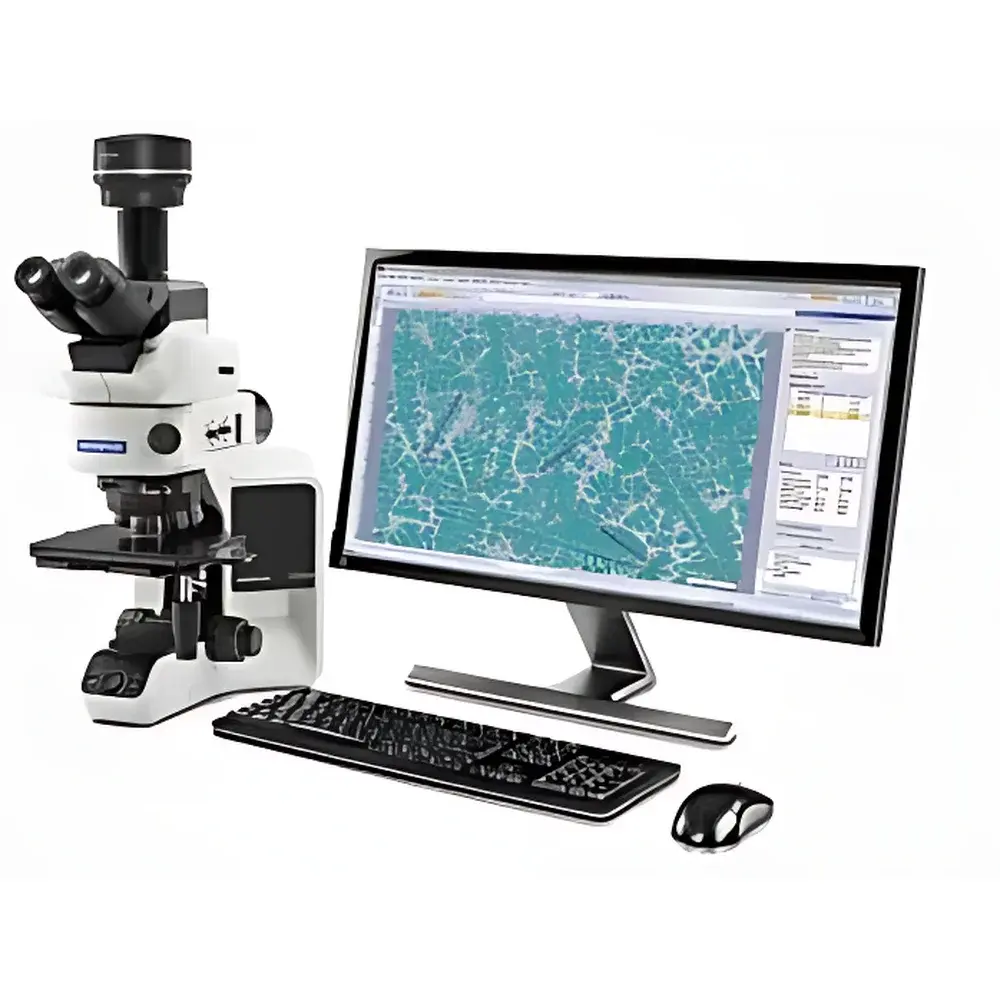
OLYMPUS Stream Image Analysis Software
| Brand | OLYMPUS |
|---|---|
| Origin | Japan |
| Manufacturer | OLYMPUS Corporation |
| Product Type | Imported |
| Model | OLYMPUS Stream |
| Pricing | Upon Request |
Overview
OLYMPUS Stream is a comprehensive, hardware-integrated image analysis software platform engineered for precision microscopy workflows across industrial quality control, materials science research, and semiconductor process development. Built on a modular architecture, it implements standardized digital imaging protocols compliant with ISO/IEC 17025–aligned laboratory practices and supports audit-ready data handling per GLP and GMP requirements. The software employs calibrated pixel-to-physical-unit mapping, geometric correction algorithms (including lens distortion compensation), and real-time gamma/white-balance optimization to ensure metrological traceability in quantitative image analysis. Its core acquisition engine synchronizes with OLYMPUS optical microscopes—including upright, inverted, metallurgical, stereo, LEXT 3D laser scanning, and DSX digital microscope systems—enabling consistent, repeatable image capture under variable illumination, magnification, and focus conditions.
Key Features
- Step-by-step guided workflow interface designed for operators of all experience levels—from novice technicians to senior metallurgists—without requiring prior programming or scripting knowledge.
- Real-time high-fidelity imaging with HDR (High Dynamic Range) synthesis and proprietary MIX observation mode for enhanced surface topography contrast without physical stage movement.
- Automated acquisition presets with recallable configuration profiles (e.g., brightfield, darkfield, DIC, fluorescence) that preserve exposure time, gain, white balance, and focus parameters across sessions.
- Extended depth-of-field (EDF) and panoramic stitching modules enabling seamless reconstruction of large-area or thick-section samples while maintaining sub-pixel registration accuracy.
- Color fidelity calibration using OLYMPUS-specific sRGB and Adobe RGB color spaces, validated against NIST-traceable reference targets for cross-instrument reproducibility.
- Built-in measurement validation tools including stage micrometer verification logs, pixel size calibration history tracking, and timestamped metadata embedding (EXIF + custom XML schema).
Sample Compatibility & Compliance
OLYMPUS Stream natively supports image data from all OLYMPUS digital microscope cameras (e.g., UC90, DP74, SC50) and third-party IEEE 1394/GigE Vision-compliant sensors via standardized drivers. It processes multi-channel, z-stack, time-lapse, and hyperspectral datasets while preserving original bit-depth (up to 16-bit). The software conforms to ISO 9276-2 (particle size analysis), ASTM E112 (grain size determination), ASTM E2283 (nonmetallic inclusion rating), and ISO 16232 (automotive component cleanliness). All measurement algorithms are documented in accordance with ISO/IEC 17025 Clause 7.2.2 for method validation, and raw image archives support FDA 21 CFR Part 11-compliant electronic signatures when deployed with OLYMPUS-certified authentication servers.
Software & Data Management
Data integrity is enforced through hierarchical user access controls (administrator, analyst, reviewer), immutable audit trails recording every image annotation, measurement edit, or report export event, and optional integration with enterprise LIMS or MES platforms via RESTful API. Reports are exportable in PDF/A-1b (ISO 19005-1), TIFF (with embedded calibration metadata), and CSV formats compatible with statistical process control (SPC) software. Version-controlled project files include embedded instrument configuration snapshots, enabling full retraceability of analytical conditions. A dedicated database module supports relational storage of sample IDs, batch numbers, operator credentials, and environmental sensor logs (temperature/humidity) synchronized with acquisition timestamps.
Applications
- Metallurgy & Casting: Grain size quantification (intercept and planimetric methods), graphite nodule spheroidization rating (ASTM A247), nonmetallic inclusion classification (ASTM E45, ISO 4967), phase fraction analysis in multiphase alloys.
- Automotive & Mechanical Engineering: Weld seam geometry assessment (width, penetration depth, undercut), porosity mapping in cast components, particle size distribution in wear debris analysis.
- Semiconductor & Electronics: Critical dimension (CD) measurement on photomasks and wafers, solder joint voiding analysis, die attach inspection, interconnect line width uniformity evaluation.
- Thin-Film & Coating Industries: Calotest-based thickness estimation of metallic coatings, pore density quantification in anodized layers, film homogeneity assessment via grayscale variance mapping.
- Research & Development: Time-resolved morphological evolution studies (e.g., corrosion propagation, recrystallization kinetics), multi-modal correlation between optical contrast and SEM/EDS data via registered coordinate overlays.
FAQ
Is OLYMPUS Stream compatible with non-OLYMPUS microscopes?
Yes—when paired with OLYMPUS-certified camera adapters or GigE Vision–compliant sensors; however, full hardware integration (e.g., motorized stage control, objective turret recognition, auto-illumination adjustment) is guaranteed only with OLYMPUS microscope systems.
Does the software support automated reporting for ISO/IEC 17025 accreditation?
Yes—built-in report templates include mandatory fields for uncertainty estimation, equipment calibration status, environmental conditions, and analyst signature; all editable within configurable Word/PDF frameworks.
Can measurement results be exported directly to SPC or Minitab?
Yes—CSV exports include column headers aligned with common SPC field definitions (e.g., “Sample_ID”, “Measurement_Value”, “Tolerance_Upper”, “Operator_Name”) and support batch import into Minitab, JMP, or custom Python/R analytics pipelines.
What is the duration and scope of the free trial license?
A fully functional 30-day evaluation license is available upon request; it includes all modules (EDF, panorama, 3D profiling, grain analysis) with no feature restrictions or watermarking.
How is data security maintained during network deployment?
All client-server communications use TLS 1.2+ encryption; local installations store encrypted SQLite databases with AES-256 at rest; optional Active Directory integration enforces domain-level group policy enforcement for password complexity and session timeout.



