
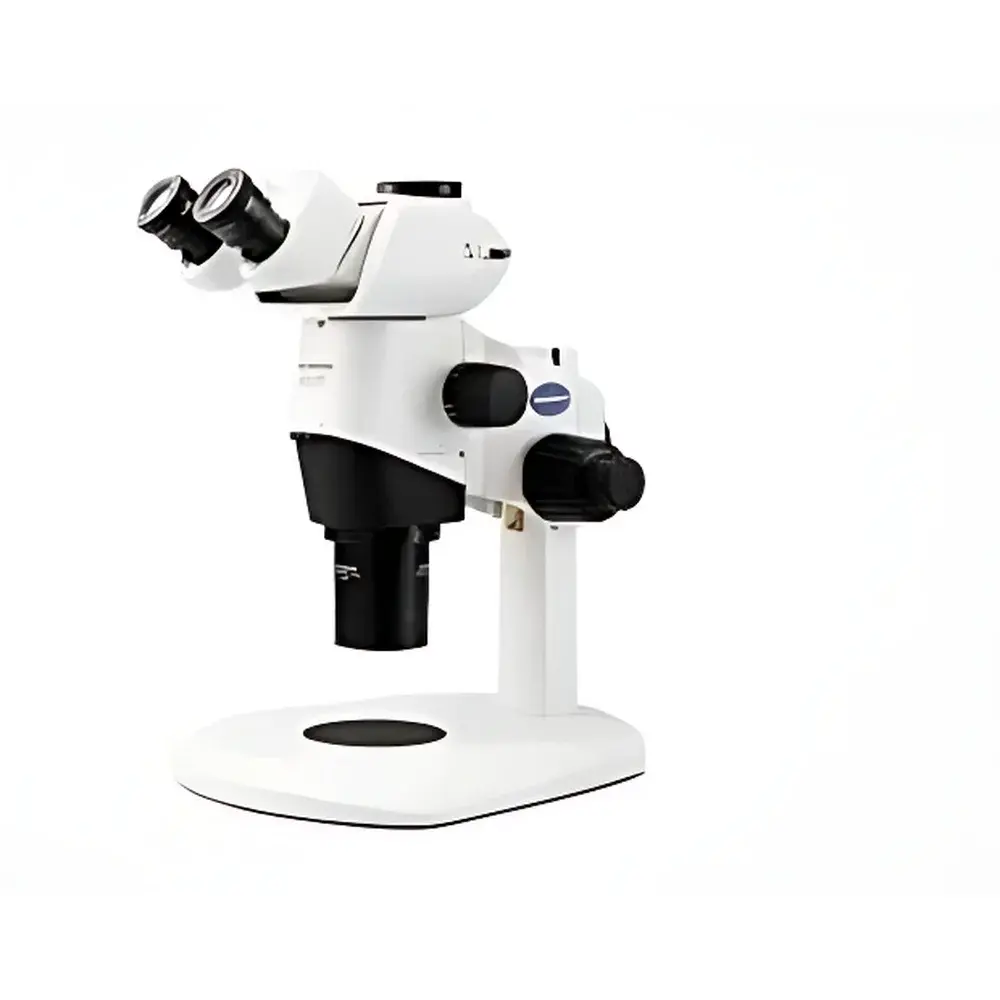
Olympus SZX16 Stereo Microscope
| Brand | Olympus |
|---|---|
| Origin | Japan |
| Manufacturer | Olympus Corporation |
| Product Type | Imported Stereo Microscope |
| Model | SZX16 |
| Total Magnification Range | 2.1× to 690× |
| Zoom Ratio | 16.4× (0.7× to 11.5×) |
| Objective Lens Options | Six interchangeable SDF-corrected objectives (including 0.5×, 1×, 1.25×, 1.6×, 2×, and zoom-compatible variants) |
| Working Distance | Up to 60 mm (with 1× objective) |
| Illumination | Integrated LED transmitted and reflected light systems (including thin-profile transmitted base, ring light, coaxial illuminator, and quarter-ring LED) |
| Depth of Field | Optimized for stereo observation across full zoom range |
| Numerical Aperture | Up to 0.12 (with 2× objective) |
| Resolution | Up to 900 line pairs/mm (at Nyquist limit, with 2× objective and optimal illumination) |
Overview
The Olympus SZX16 Stereo Microscope is an advanced, research-grade inverted and upright-capable stereomicroscope engineered for high-fidelity 3D visualization in industrial inspection, life science research, microelectronics assembly, and quality control laboratories. Based on the principle of Greenough optical design—dual independent optical paths with convergent viewing angles—the SZX16 delivers true stereoscopic depth perception without optical prisms or beam-splitting compromises. Its 16.4:1 continuous zoom system (0.7×–11.5×) enables seamless transition from macro overview to sub-10 µm structural detail without objective lens swapping, while maintaining parfocality and telecentricity across magnifications. The system’s modular architecture supports both transmitted and reflected illumination pathways, enabling simultaneous brightfield, darkfield, and polarization contrast modes—all compliant with ISO 10934-1 (stereomicroscope performance standards) and aligned with GLP documentation requirements for traceable visual inspection workflows.
Key Features
- High-resolution SDF (Super Depth of Field) corrected objectives—including 2× plan-apochromatic optics delivering up to 900 lp/mm resolution at Nyquist-limited sampling—minimize astigmatism and curvature of field for edge-to-edge sharpness.
- Ergonomic tilting binocular tube adjustable from 5° to 45° vertical inclination, accommodating diverse operator statures and reducing cervical strain during extended sessions; compatible with wide-field eyepieces (WF10×/22, WF15×/16) supporting prolonged 3D observation with minimal eye fatigue.
- Motorized focus drive unit enables Extended Focus Imaging (EFI), automatically acquiring z-stack image sequences for synthetic depth-of-field reconstruction and pseudo-3D surface rendering—fully compatible with Olympus cellSens software for automated focus map generation and DIC-like depth encoding.
- Thin-profile LED transmitted illumination base reduces overall instrument height by 50%, lowering sample placement plane and improving hand–eye coordination during micromanipulation tasks; power consumption reduced by ~50% versus halogen predecessors.
- Modular reflected-light options include coaxial illuminator (for glare-free specular surface inspection), four-quadrant LED ring light (for directional shadow control), and dual-branch fiber-optic guides—enabling application-specific contrast optimization per ASTM E2822 (standard guide for stereomicroscopy in failure analysis).
Sample Compatibility & Compliance
The SZX16 accommodates specimens ranging from intact biological tissues (e.g., zebrafish embryos, plant meristems) to PCB assemblies, solder joints, and MEMS devices. Its maximum 60 mm working distance (with 1× objective) permits integration with micromanipulators, patch-clamp rigs, or laser microdissection platforms. All optical components comply with JIS B 7151 and ISO 8578 for stereomicroscope calibration traceability. Illumination modules meet IEC 62471 photobiological safety Class 1 requirements. When paired with Olympus DP74 or DP27 cooled CCD cameras and cellSens Dimension software, the system supports FDA 21 CFR Part 11-compliant audit trails, electronic signatures, and secure image metadata embedding—fulfilling GMP documentation standards for regulated manufacturing environments.
Software & Data Management
Olympus cellSens software provides native support for EFI acquisition, multi-channel fluorescence overlay (when equipped with optional filter cubes), and calibrated 2D/3D morphometric analysis—including area, angle, radius, and step-height measurements referenced to stage-encoded position data. Batch processing pipelines enable automated report generation with embedded scale bars, annotation layers, and EXIF-compliant metadata export (TIFF, JPEG2000, or Olympus OIR format). Raw image stacks are stored in open-format HDF5 containers for third-party interoperability with ImageJ/Fiji, MATLAB, or Python-based analysis frameworks—ensuring long-term data accessibility beyond proprietary ecosystem lock-in.
Applications
- Electronics: Solder joint void analysis, wire bond integrity assessment, conformal coating thickness estimation via focus-variance profiling.
- Materials Science: Fracture surface topography mapping, inclusion identification in metallurgical samples, grain boundary delineation in polycrystalline thin films.
- Life Sciences: Embryo staging, microinjection guidance, histological section screening, and live-tissue explant monitoring under controlled environmental chambers.
- Forensics & Document Examination: Ink differentiation, paper fiber analysis, latent fingerprint enhancement via oblique illumination sequencing.
- Quality Assurance: First-article inspection per AS9102, defect triage in medical device packaging, and weld seam evaluation per AWS D1.1 guidelines.
FAQ
Does the SZX16 support motorized Z-axis control for automated focusing?
Yes—the optional motorized focus drive enables programmable Z-stacking, EFI acquisition, and repeatable focus positioning synchronized with stage movement.
Can I integrate third-party digital cameras with the trinocular port?
Yes—the C-mount adapter (F.N. 22.5 mm) supports industry-standard 1″ and 4/3″ sensors; however, optimal color fidelity and real-time frame rates require Olympus DP-series cameras with proprietary pixel binning and white-balance algorithms.
Is the LED illumination intensity adjustable and stable over time?
Yes—constant-current drivers maintain ±0.5% intensity stability over 8-hour operation; dimming is digitally controlled via front-panel encoder or software interface with 0.1% resolution.
What calibration standards are recommended for routine verification?
Olympus recommends NIST-traceable stage micrometers (e.g., Graticule 100 µm pitch) and resolution test targets conforming to ISO 19228 for magnification and resolving power validation.
How does the SZX16 handle vibration-sensitive applications?
The rigid cast-aluminum main body and optional anti-vibration table mounting kit reduce resonant coupling below 15 Hz; combined with passive damping feet, it achieves <0.5 µm RMS displacement at 50 Hz—suitable for microsurgery simulation and nanomanipulation alignment.





