
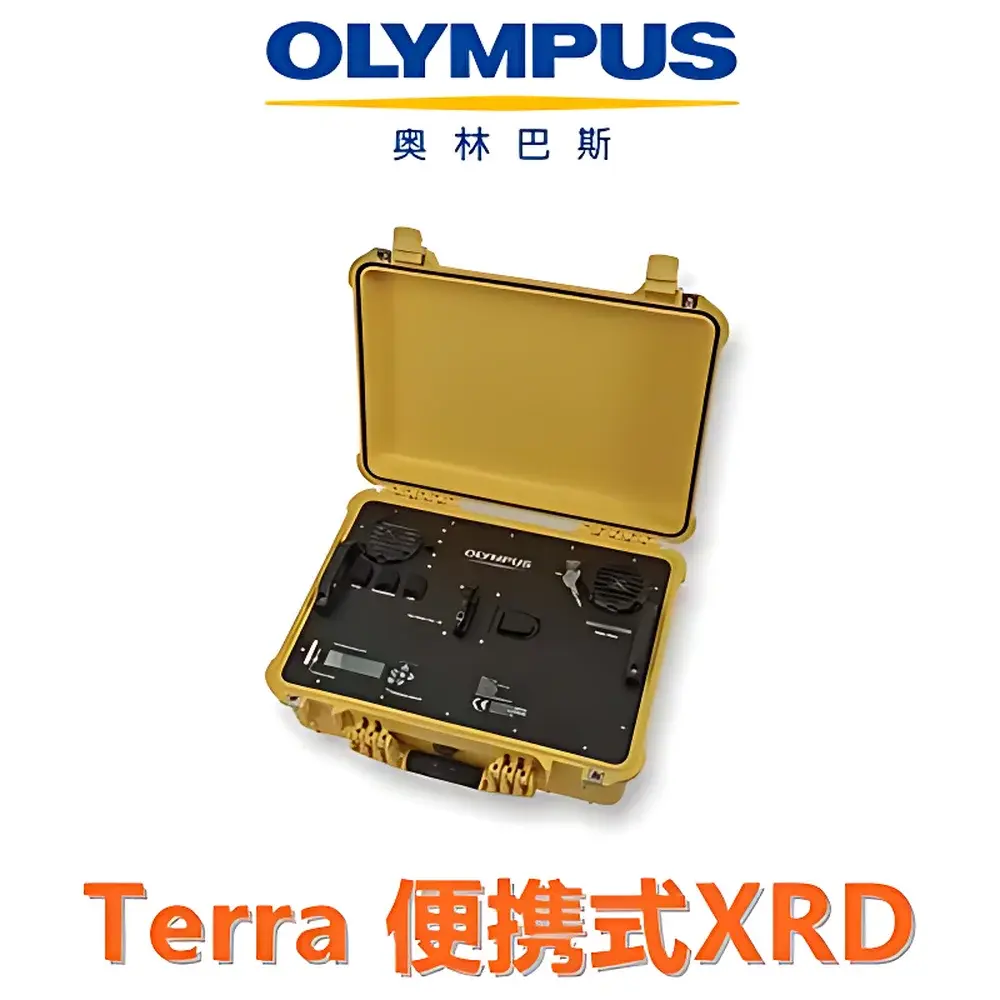
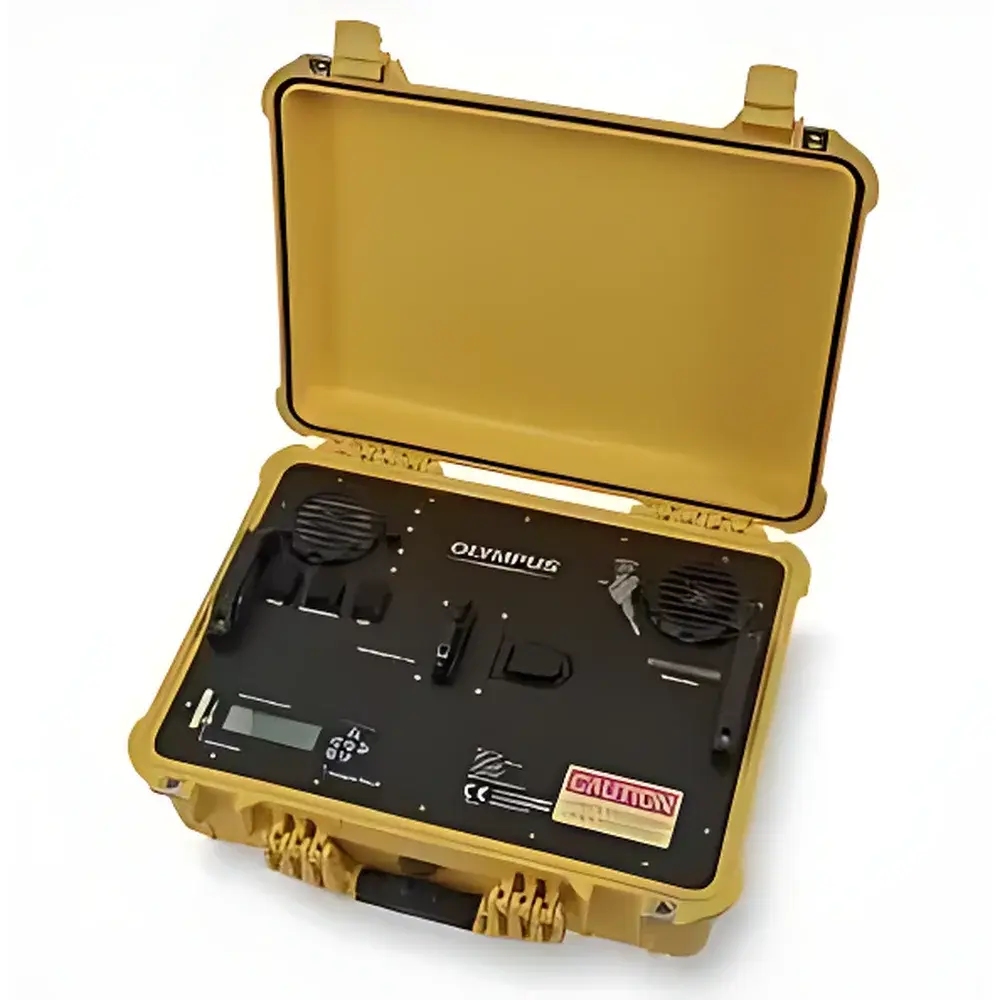
Olympus Terra Portable X-ray Diffractometer (XRD) and X-ray Fluorescence (XRF) Analyzer
| Brand | Olympus |
|---|---|
| Origin | USA |
| Model | Terra |
| XRD Range | 5–55° 2θ |
| XRD Resolution | 0.25° 2θ FWHM |
| Detector | 1024 × 256-pixel, 2D Peltier-cooled CCD |
| XRF Energy Resolution | 250 eV at 5.9 keV |
| XRF Energy Range | 3–25 keV |
| X-ray Tube Anode | Cu (standard), Co optional |
| Tube Voltage | 30 kV |
| Tube Power | 10 W |
| Sample Mass | ~15 mg |
| Particle Size | <150 µm (100 mesh) |
| Operating Temperature | –10 °C to 35 °C |
| Weight | 14.5 kg (with 4 hot-swappable batteries) |
| Dimensions | 48.5 × 39.2 × 19.2 cm |
| Enclosure Rating | IP67, MIL-STD-810G compliant |
| Battery Life | ~4 hours |
| Internal Storage | 40 GB ruggedized HDD |
| Wireless Connectivity | IEEE 802.11b/g |
Overview
The Olympus Terra Portable X-ray Diffractometer (XRD) and X-ray Fluorescence (XRF) Analyzer is a field-deployable, dual-mode analytical instrument engineered for simultaneous phase identification and elemental composition analysis in real-world environments. Developed from patented technology co-created by Olympus and NASA for the Mars Science Laboratory (MSL) mission, the Terra integrates XRD and XRF modalities within a single, compact architecture—enabling crystalline phase quantification and elemental profiling without requiring laboratory infrastructure. Its measurement principle relies on Bragg diffraction (for XRD) and characteristic X-ray emission spectroscopy (for XRF), both interrogated via a custom-designed, direct-excitation, two-dimensional charge-coupled device (CCD) detector. This detector captures both photon position and energy simultaneously, eliminating the need for sequential or mechanically scanned acquisitions. The system operates with a fixed Cu (or optional Co) anode X-ray tube (30 kV, 10 W), delivering high signal-to-noise diffraction patterns across a 5–55° 2θ range with 0.25° FWHM resolution, while maintaining XRF energy resolution of 250 eV at Mn Kα (5.9 keV) over a 3–25 keV detection window.
Key Features
- Patented vibration-based sample chamber eliminates conventional powder grinding, pressing, and orientation correction—enabling representative XRD patterns from only ~15 mg of unprepared material (<150 µm particle size).
- Single-shot, simultaneous XRD/XRF data acquisition using a 1024 × 256-pixel, thermoelectrically cooled 2D CCD detector—no moving goniometer or mechanical angle encoder required.
- Ruggedized, IP67- and MIL-STD-810G-certified enclosure designed for operation in harsh field conditions, including dust, moisture, shock, and thermal extremes (–10 °C to 35 °C).
- Hot-swappable battery system supporting up to four Li-ion modules, delivering approximately four hours of continuous operation per full charge.
- Integrated 40 GB industrial-grade solid-state storage and IEEE 802.11b/g wireless interface for remote browser-based control, live data streaming, and secure file transfer.
- Fixed geometry optical path with no alignment-sensitive optics—minimizing calibration drift and reducing maintenance requirements typical of benchtop diffractometers.
Sample Compatibility & Compliance
The Terra accepts heterogeneous solid samples—including ores, soils, slags, geological cores, construction materials, and pharmaceutical intermediates—without pelletization or dilution. Its vibration-assisted sample presentation ensures statistically robust grain orientation distribution, mitigating preferred orientation artifacts common in traditional powder XRD. The system complies with ISO 17025:2017 general requirements for competence of testing and calibration laboratories, and supports audit-ready workflows aligned with GLP and GMP principles. Data integrity is preserved through timestamped acquisition logs, user authentication, and exportable metadata conforming to ASTM E1361 (Standard Guide for X-ray Diffraction Analysis) and ASTM E2421 (Standard Practice for XRF Elemental Analysis). While not FDA 21 CFR Part 11–certified out-of-the-box, the Terra’s software architecture permits integration with validated third-party LIMS platforms supporting electronic signatures and audit trails.
Software & Data Management
The Terra ships with XPowder™—a dedicated, Windows-based software suite for XRD data processing, phase identification, and semi-quantitative RIR (Reference Intensity Ratio) analysis. XPowder includes the AMSCD mineralogical database and supports import of ICDD PDF-4+ reference patterns. It enables peak search, background subtraction, pattern indexing, and multi-phase refinement using fundamental parameter-based profile fitting. XRD patterns are exportable in standard formats (XYE, CSV, CIF, and MDI) for compatibility with third-party tools such as TOPAS, GSAS-II, or HighScore Plus. XRF spectra are processed using integrated deconvolution algorithms and quantified against factory-calibrated standards; results can be cross-referenced with XRD phase models for combined mineralogical-elemental interpretation. All raw and processed datasets—including acquisition parameters, detector gain settings, and environmental metadata—are archived in a structured directory hierarchy on the internal drive and accessible remotely via HTTPS-enabled web interface.
Applications
- Field-based mineralogical mapping in mining exploration and resource evaluation (e.g., clay speciation, sulfide/oxide ratio, alteration zone characterization).
- On-site cement and slag phase analysis for quality assurance in construction materials manufacturing and recycling operations.
- Rapid identification of corrosion products, scale deposits, and unknown crystalline contaminants in power generation, oil & gas, and chemical process facilities.
- Regulatory compliance screening for heavy metals (Pb, As, Cd, Cr) and crystalline silica (quartz, cristobalite) in occupational health and environmental monitoring programs.
- Forensic geology and cultural heritage studies requiring non-destructive, in-situ phase and elemental characterization of pigments, ceramics, and archaeological sediments.
- Academic and industrial research where portability, speed, and dual-mode capability outweigh the need for ultra-high angular resolution or microfocus beam conditioning.
FAQ
Does the Terra require external cooling or vacuum systems?
No. The detector uses Peltier thermoelectric cooling, and all measurements are performed under ambient atmospheric conditions—no pump, purge gas, or chilled water supply is needed.
Can Terra distinguish between polymorphs such as anatase and rutile TiO₂?
Yes. With 0.25° 2θ resolution over 5–55° 2θ and low-background CCD detection, Terra reliably resolves diagnostic peaks for common polymorphs, including TiO₂, SiO₂ (quartz/cristobalite/tridymite), and CaSO₄ phases.
Is sample preparation truly zero-step?
Minimal preparation is required: particles must pass a 100-mesh (150 µm) sieve, and ~15 mg is loaded into the vibration chamber. No grinding, pressing, or binder addition is necessary.
How is data security handled during wireless transmission?
Wireless sessions use WPA2-PSK encryption; HTTP traffic is served over TLS when connected to authenticated enterprise networks. Raw data files are stored locally and do not auto-upload unless explicitly configured via IT-managed policy.
What regulatory standards does Terra support for QA/QC reporting?
It supports ASTM E1361 (XRD), ASTM E2421 (XRF), ISO 17025-compliant documentation, and provides traceable calibration records, uncertainty estimates, and metadata required for ISO/IEC 17025 accreditation.





