
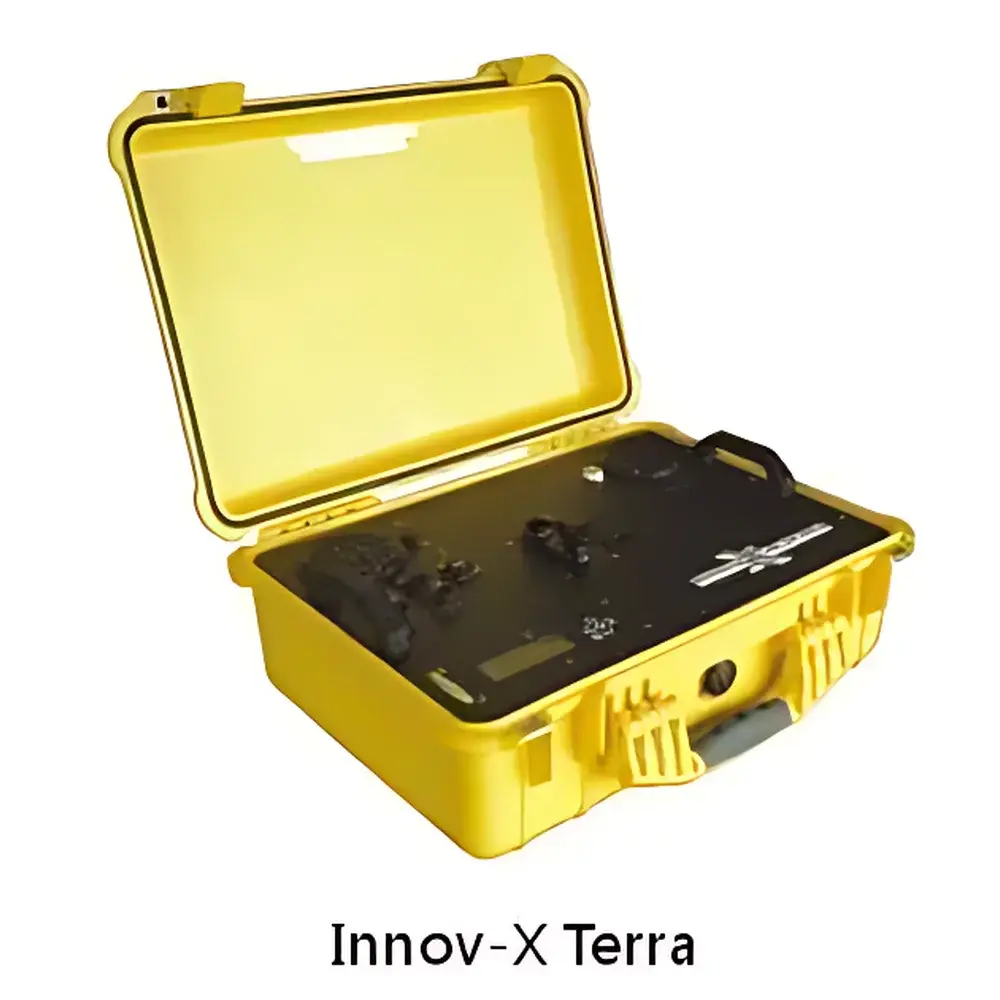
Olympus XRD-Terra Portable X-ray Diffractometer
| Brand | Olympus |
|---|---|
| Origin | USA |
| Model | XRD-Terra |
| Instrument Type | Powder X-ray Diffractometer |
| Power Stability | < 0.0001 (unitless relative stability) |
| Dimensions | 485 × 392 × 192 mm |
| Weight | 14.5 kg (including integrated battery pack) |
| Sample Mass Requirement | ~15 mg |
| Measurement Time | ≤ 3 minutes per sample |
| Detector | 2D CCD-based area detector |
| Geometry | Transmission-mode XRD |
| Integrated Capability | Simultaneous XRD and XRF analysis |
| Cooling | Peltier electronic cooling |
| Environmental Rating | IP54-equivalent (dust- and splash-resistant), shock-damped chassis |
| Compliance | NASA Patent US7113265B2 |
| Software Interface | WiFi-enabled remote acquisition and real-time data streaming |
Overview
The Olympus XRD-Terra Portable X-ray Diffractometer is an engineered solution for in situ crystalline phase identification and quantitative mineralogical analysis under field-deployable conditions. Designed originally for NASA’s Mars Exploration Rover missions—including Spirit and Opportunity—the instrument employs transmission-mode X-ray diffraction (XRD) geometry, enabling high-fidelity structural characterization without reliance on goniometric sample rotation or fixed-angle Bragg-Brentano optics. Its core measurement principle leverages monochromatic Cu-Kα radiation (λ = 1.5418 Å) incident upon a vibrating powder sample, with scattered intensity captured by a two-dimensional charge-coupled device (CCD) detector. This configuration yields full Debye–Scherrer ring patterns in a single exposure, permitting rapid lattice parameter extraction, phase quantification via Rietveld refinement, and detection limits compatible with trace-phase identification (< 1 wt% for well-crystallized phases). Unlike conventional benchtop diffractometers, the XRD-Terra operates independently of external power grids, water-cooling infrastructure, or climate-controlled laboratories—making it suitable for geotechnical surveys, forensic residue analysis, cultural heritage diagnostics, and industrial corrosion product screening.
Key Features
- True field-portable architecture: Compact footprint (485 × 392 × 192 mm), mass of 14.5 kg including four integrated rechargeable Li-ion batteries providing ≥ 4 hours of continuous operation.
- Vibration-assisted sample presentation: Eliminates need for precision goniometers; ensures homogeneous powder orientation and mitigates preferred orientation effects without manual grinding or pressing.
- Simultaneous XRD/XRF capability: Dual-spectrum acquisition enables concurrent crystallographic phase identification and elemental composition profiling (Z ≥ 11) from a single measurement position.
- Electronic Peltier cooling: Maintains detector thermal stability without liquid nitrogen or recirculating chillers—critical for consistent peak shape reproducibility across ambient temperature ranges from −10 °C to +50 °C.
- Wireless data handling: IEEE 802.11n WiFi interface supports remote instrument control, live pattern preview, and secure transfer of raw 2D frames and processed *.xye or *.csv outputs to networked workstations.
- Ruggedized mechanical design: Aluminum-magnesium alloy housing with silicone-sealed apertures and internal shock absorption mounts compliant with MIL-STD-810G for transport vibration and drop resistance.
Sample Compatibility & Compliance
The XRD-Terra accepts loose powders, scraped residues, thin sections (≤ 0.5 mm thickness), and minimally prepared drill cuttings. Sample mass requirement is typically 10–20 mg—ideal for irreplaceable specimens such as archaeological pigments, explosive residues, or pipeline corrosion coupons. No dilution, binder addition, or pelletization is required. The system complies with IEC 61000-6-3 (EMC emission standards) and IEC 61000-6-2 (immunity), and meets FDA 21 CFR Part 11 requirements for audit-trail-enabled software operations when used with certified Olympus TerraSuite v4.x firmware. All diffraction data are traceable to NIST SRM 640e silicon standard for 2θ calibration verification. Instrument operation adheres to ISO 17892-12 (geotechnical investigation — laboratory testing of soils — determination of mineral composition by XRD) and ASTM E975 (standard practice for X-ray diffraction analysis of metals and alloys).
Software & Data Management
TerraSuite software provides fully automated workflow management—from instrument alignment and background subtraction to phase library matching (using ICDD PDF-4+ database), semi-quantitative Rietveld refinement, and report generation in PDF/HTML formats. Each measurement session logs operator ID, GPS coordinates (when connected to external GNSS module), environmental sensor readings (temperature, humidity, pressure), and full metadata per ASTM E1421. Raw 2D frames are stored in TIFF format with embedded EXIF tags; processed results include uncertainty estimates for lattice parameters (±0.002 Å) and weight fractions (±2% RSD at >5 wt%). Data export supports LIMS integration via ODBC-compliant drivers and conforms to ISA-88 batch record structures for regulated QA/QC environments.
Applications
- Planetary science field analogs: In situ mineralogical mapping of regolith simulants and basaltic breccias under Mars-relevant atmospheric conditions.
- Forensic science: Identification of clandestine explosives (e.g., RDX, PETN), illicit drug salts (e.g., cocaine HCl, methamphetamine sulfate), and gunshot residue (GSR) components including PbCrO4, Ba(NO3)2, and Sb2O3.
- Industrial corrosion monitoring: Phase-specific analysis of rust layers (lepidocrocite vs. goethite vs. magnetite), sulfide scales (pyrrhotite, mackinawite), and carbonate deposits in oil & gas infrastructure.
- Cultural heritage conservation: Non-invasive pigment stratigraphy in frescoes, identification of degradation products in ancient glass, and authentication of ceramic glazes.
- Environmental geochemistry: Rapid screening of clay mineral assemblages (smectite/illite/kaolinite ratios), heavy metal-bearing precipitates (e.g., anglesite, cerussite), and asbestos analogs (e.g., chrysotile, tremolite).
FAQ
Does the XRD-Terra require external cooling or compressed air?
No. It uses solid-state Peltier cooling for the detector and passive heat-sink thermal management for the X-ray tube—eliminating dependency on water chillers, LN2 dewars, or pneumatic systems.
Can it perform quantitative phase analysis without reference standards?
Yes. Internal calibration against NIST SRM 640e and use of fundamental parameter-based intensity modeling allow semi-quantitative Rietveld analysis without matrix-matched standards.
Is the instrument compliant with GLP/GMP documentation requirements?
When operated with TerraSuite v4.3+ and enabled audit-trail mode, it satisfies 21 CFR Part 11 electronic record integrity criteria—including user authentication, change logging, and immutable result archiving.
What is the minimum detectable crystallite size using the XRD-Terra?
Scherrer analysis of peak broadening supports estimation of coherent scattering domain sizes down to ~3 nm, assuming optimal signal-to-noise ratio and absence of microstrain contributions.
How is radiation safety managed during field deployment?
The system incorporates dual interlock mechanisms (mechanical shutter + beam-enable logic), dose-rate monitoring (integrated Geiger-Müller sensor), and automatic beam termination upon lid opening—meeting ANSI N43.3 Class II cabinet requirements for portable X-ray devices.
Related Products






