
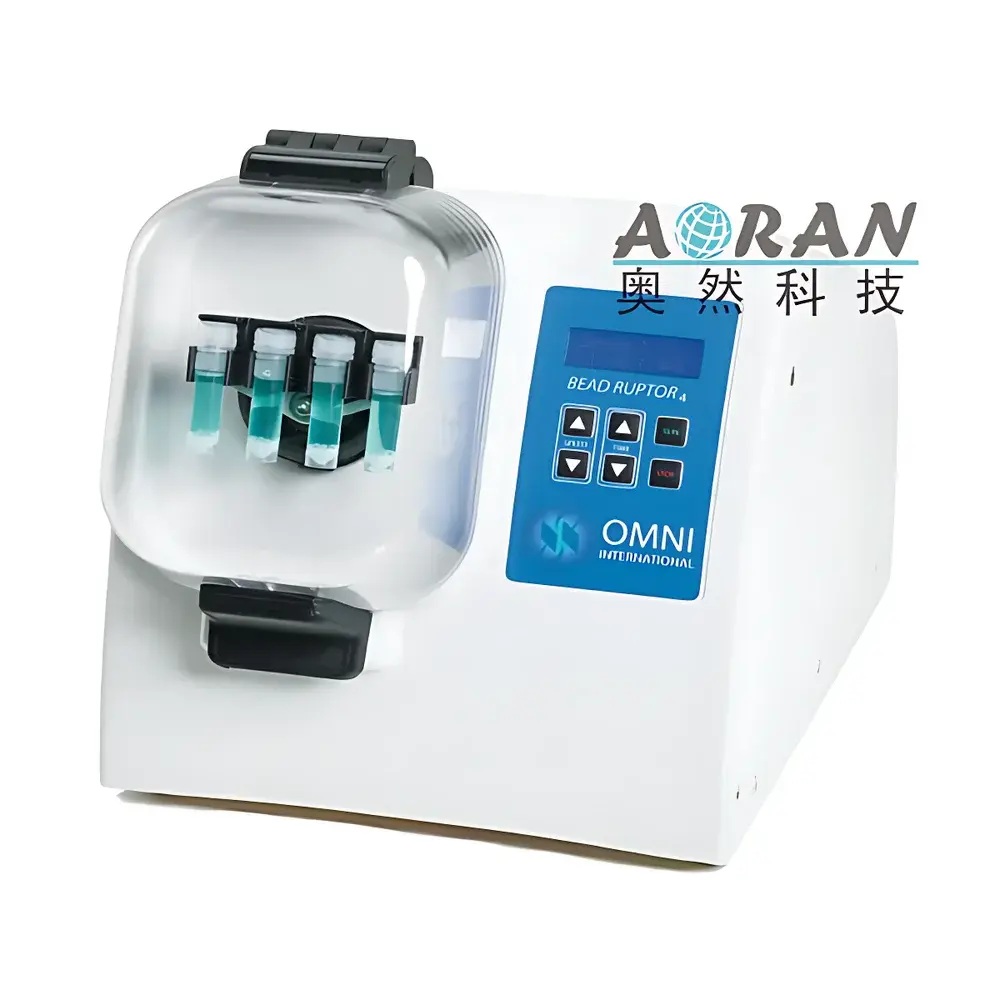
OMNI Bead Ruptor 4 Benchtop Bead Mill Homogenizer
| Brand | OMNI International |
|---|---|
| Origin | USA |
| Model | Bead Ruptor 4 |
| Instrument Type | Bead-Based Mechanical Homogenizer |
| Dimensions (W×D×H) | 254 × 215 × 292 mm |
| Sample Volume Range | 0.25–5 mL |
| Operating Speed | 1–5 m/s (adjustable in 1 m/s increments) |
| Cycle Time | 1 s–5 min (adjustable in 1 s increments) |
| Safety Features | Over-Temperature Protection, Lid-Interlock Safety Switch |
| Power Supply | 100–230 VAC, 50–60 Hz |
| Weight | 7.48 kg |
Overview
The OMNI Bead Ruptor 4 is a compact, high-efficiency benchtop bead mill homogenizer engineered for rapid, reproducible mechanical lysis of diverse biological samples. It operates on the principle of high-frequency horizontal oscillation—transferring kinetic energy from ceramic, steel, or silica beads to samples contained within sealed tubes. This shear-intensive mechanism disrupts cellular and subcellular structures—including tough Gram-positive bacteria, fungal cell walls, plant tissues, bone fragments, soil matrices, and keratin-rich materials—without requiring enzymatic pretreatment or thermal denaturation. Designed specifically for low-volume applications (0.25–5 mL), the Bead Ruptor 4 delivers consistent lysis performance across heterogeneous sample types while minimizing thermal buildup—a critical factor for preserving labile biomolecules such as native proteins, intact RNA, and high-molecular-weight DNA.
Key Features
- Simultaneous processing of up to four 0.5 mL, 1.5 mL, or 2 mL microcentrifuge tubes—or one 7 mL tube—enabling parallel sample preparation without cross-contamination.
- Direct compatibility with standard 1.5 mL conical microcentrifuge tubes (with optional adapter), eliminating the need for proprietary consumables and reducing per-sample cost.
- Precise digital control over both oscillation speed (1–5 m/s, 1 m/s increments) and cycle duration (1 s–5 min, 1 s increments), supporting method optimization for sensitive analytes.
- Front-hinged lid design facilitates rapid tube loading/unloading and improves ergonomics during high-throughput workflows.
- Integrated safety interlocks automatically halt operation upon lid opening; over-temperature protection prevents motor overheating during extended use.
- Compact footprint (254 × 215 × 292 mm) supports integration into biosafety cabinets, cold rooms, or space-constrained core facilities.
- No tube balancing required—tubes are secured in rigid, vibration-dampened holders ensuring stable operation at all speeds.
- Immediate restart capability after cycle completion eliminates cooldown delays, enhancing throughput in time-sensitive protocols.
Sample Compatibility & Compliance
The Bead Ruptor 4 is validated for lysis of mammalian and avian tissues, yeast, filamentous fungi, bacterial cultures (including Mycobacterium and Bacillus spores), hair, bone powder, fecal pellets, and environmental soil samples. Its mechanical action preserves epitope integrity and nucleic acid length—supporting downstream applications including qPCR, RNA-Seq, ChIP, and functional proteomics. The instrument complies with IEC 61000-6-2 (EMC immunity) and IEC 61000-6-4 (EMC emissions) standards. When operated under controlled environmental conditions and paired with traceable calibration records, it meets GLP documentation requirements for preclinical biomarker studies. While not FDA 21 CFR Part 11–validated out-of-the-box, its parameter logging and user-accessible settings support integration into Part 11–compliant laboratory information management systems (LIMS) when combined with appropriate audit trail software.
Software & Data Management
The Bead Ruptor 4 operates via an intuitive front-panel interface with LED display and tactile push-button controls—no external computer or driver installation required. All method parameters (speed, time, repeat cycles) are stored in non-volatile memory and can be recalled instantly. Optional RS-232 serial output enables connection to external data loggers or custom LabVIEW/Python scripts for automated protocol execution and timestamped event recording. For regulated environments, users may implement manual logbooks or electronic notebooks (e.g., LabArchives, Benchling) to document operator ID, lot numbers of beads/tubes, and observed lysis efficiency—fulfilling ALCOA+ data integrity principles (Attributable, Legible, Contemporaneous, Original, Accurate, Complete, Consistent, Enduring, Available).
Applications
- Routine extraction of genomic DNA from fibrous plant leaves or root nodules.
- High-yield recovery of total RNA from Candida albicans biofilms with minimal degradation (RIN > 8.5).
- Preparation of soluble protein lysates from E. coli inclusion bodies using stainless-steel beads and optimized buffer conditions.
- Metabolite extraction from mouse brain tissue for LC-MS untargeted metabolomics.
- Microbial community disruption in fecal microbiota transplant (FMT) research prior to 16S rRNA gene sequencing.
- Lysis of calcified tissue sections for phosphoproteomic profiling.
FAQ
Can the Bead Ruptor 4 process cryogenic samples?
Yes—samples may be pre-chilled and processed at ambient temperature without ice baths; however, for thermolabile targets, users should pre-cool tubes and employ chilled bead stocks.
What bead materials are compatible?
Standard configurations include zirconium oxide (ZrO₂), stainless steel, and silica glass beads in diameters ranging from 0.1 mm to 2.8 mm. Selection depends on sample toughness and desired fragment size.
Is validation support available for GMP environments?
OMNI provides IQ/OQ documentation templates and performance qualification protocols aligned with ISO/IEC 17025 and ASTM E2500 guidance for instrument verification.
How often does the instrument require maintenance?
No scheduled maintenance is required beyond periodic cleaning of the chamber and inspection of the rubber gasket; the brushless DC motor has a rated service life exceeding 20,000 hours.
Does it support multi-step lysis protocols?
Yes—users can program sequential cycles with variable speed/time settings to accommodate staged lysis (e.g., gentle initial disruption followed by aggressive shearing).



