
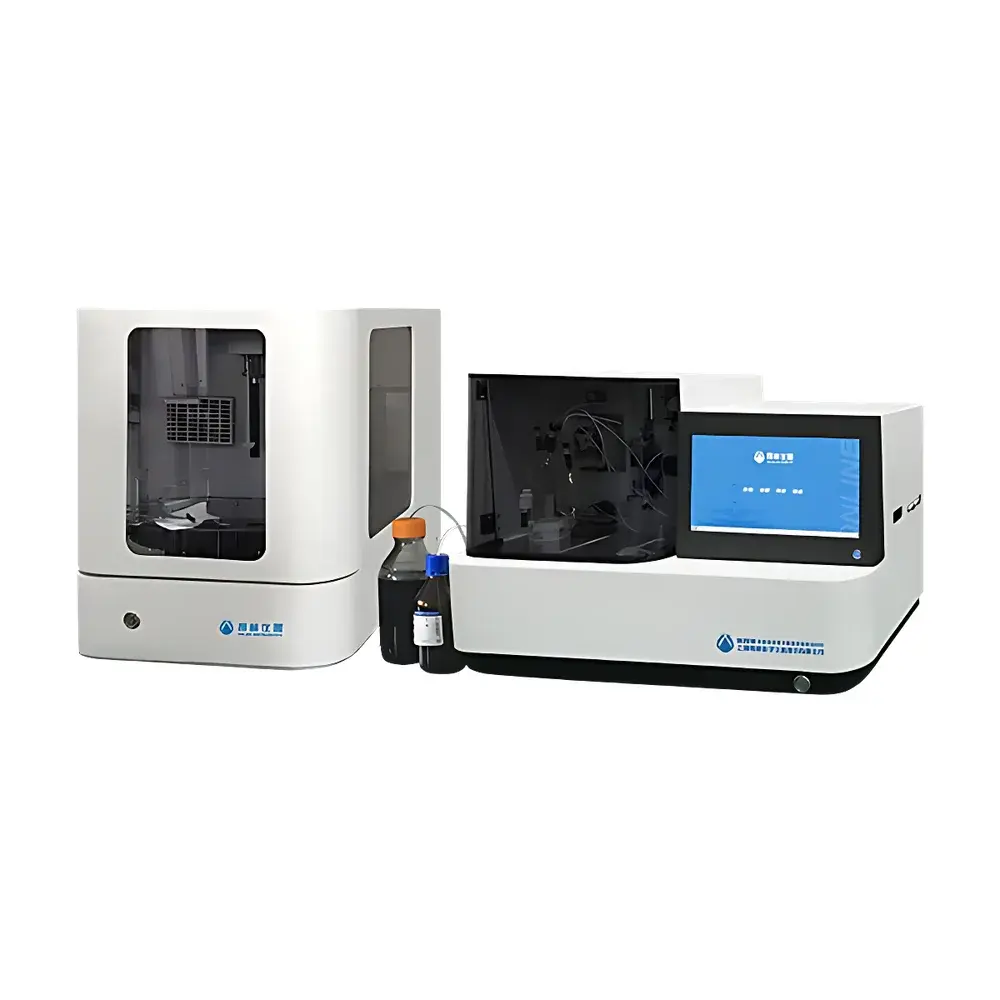
Online Instrument OL2010 Automated Anionic Surfactant Analyzer for Water Quality Testing
| Brand | Online Instrument |
|---|---|
| Origin | Shanghai, China |
| Manufacturer Type | Direct Manufacturer |
| Product Category | Domestic (China-Made) |
| Model | OL2010 |
| Instrument Type | Laboratory-Based Water Quality Analyzer |
| Analyte | Anionic Surfactants (e.g., LAS, SDS, AES) |
| Compliance Standards | GB 7494–1987, GB/T 5750.4–2023, GB 17378.4–2007, GB 8538–2023, GB/T 39302–2020 |
| Sample Capacity | 25 / 50 / 55 positions (field-upgradable) |
| Extraction Method | Multi-stage chloroform-based liquid–liquid extraction and back-extraction |
| Recovery Rate | ≥95% |
| Automation Level | Fully Automated (reagent dispensing, extraction, phase separation, sample introduction, calibration, waste handling) |
| Data Interface | LIMS-compatible (ASTM E1467-compliant data export, audit trail ready) |
| Safety System | Closed-loop reagent handling, activated carbon exhaust treatment, automated hazardous waste containment |
Overview
The Online Instrument OL2010 is a fully automated, laboratory-grade anionic surfactant analyzer engineered for precise, reproducible quantification of anionic surfactants—including linear alkylbenzene sulfonates (LAS), sodium dodecyl sulfate (SDS), and alcohol ether sulfates (AES)—in diverse aqueous matrices. It implements the standardized methylene blue active substances (MBAS) spectrophotometric principle per national Chinese standards (GB 7494–1987 and updated variants), relying on selective ion-pair formation between anionic surfactants and methylene blue dye in chloroform phase, followed by UV-Vis absorbance measurement at 652 nm. Unlike manual or semi-automated workflows, the OL2010 integrates fluidic control, phase separation mechanics, and environmental safety engineering into a single platform—eliminating operator exposure to chlorinated solvents while ensuring strict adherence to GLP-aligned procedural integrity.
Key Features
- Fully automated multi-step extraction protocol: programmable chloroform addition, vigorous mixing, gravity-assisted phase separation, aqueous-phase back-extraction, and organic-phase transfer—all executed without manual intervention.
- Modular sample carousel accommodating 25, 50, or 55 vials; upgrade path available for higher-throughput configurations via firmware and hardware expansion kits.
- Dual-mode liquid handling: high-precision syringe pumps for reagent metering and low-pulsation peristaltic pumps for bulk phase transfer—optimized for viscosity-invariant delivery across wastewater, seawater, and drinking water samples.
- Integrated separation module with self-cleaning capability: post-extraction organic phase passes through a hydrophobic membrane-based separator; automated reverse-flush with fresh chloroform prevents carryover and maintains inter-sample reproducibility (RSD < 3.2% at 0.1 mg/L LAS).
- Onboard calibration engine: automatic serial dilution of stock standard, generation of 5–7-point calibration curves, and real-time curve validation using NIST-traceable reference materials.
- Closed-system safety architecture: all chloroform handling occurs within sealed PTFE-lined pathways; spent solvent is collected in dedicated containment vessels; volatile emissions are routed through replaceable activated carbon cartridges compliant with ISO 10156.
Sample Compatibility & Compliance
The OL2010 is validated for use with raw and treated waters spanning wide physicochemical variability: potable water (GB 5749–2022), surface water (GB 3838–2002), seawater (GB 17378.4–2007), municipal wastewater (CJ/T 51–2018), industrial effluents (HJ 91.1–2019), and reclaimed water (GB/T 18920–2020). Its extraction efficiency remains stable across turbidity levels up to 100 NTU and total suspended solids ≤ 200 mg/L. All operational sequences conform to GB/T 5750.4–2023 (Standard Methods for Examination of Drinking Water – Organic Indicators), with full traceability to metrological references certified by CNAS-accredited laboratories. The system supports 21 CFR Part 11–ready electronic signatures and audit trails when operated under validated LIMS integration.
Software & Data Management
Controlled via a ruggedized 10.1-inch capacitive touchscreen running embedded Linux OS, the OL2010’s software suite provides method editor, run scheduler, real-time status dashboard, and QC charting (Levey-Jennings, moving range). Raw absorbance data, extraction logs, reagent consumption records, and calibration history are stored in SQLite databases with SHA-256 hashing. Export formats include CSV (ASTM E1467), PDF analytical reports (with digital signature), and XML (for direct ingestion into LIMS platforms such as Thermo Fisher SampleManager or LabVantage). Remote access is enabled via TLS 1.2–secured web interface—allowing instrument monitoring, method deployment, and data retrieval from off-site locations using standard browsers or mobile clients.
Applications
This analyzer serves environmental testing laboratories, municipal water utilities, pharmaceutical manufacturing QA/QC units, detergent R&D facilities, and academic research groups conducting ecotoxicological assessments. Typical use cases include regulatory compliance monitoring of LAS discharge limits per local environmental protection bureau requirements; evaluation of surfactant removal efficiency in tertiary wastewater treatment plants; verification of rinse-water cleanliness in semiconductor fab tool validation; and baseline characterization of surfactant contamination in coastal aquifers. Its robustness against matrix interference makes it suitable for routine analysis in ISO/IEC 17025–accredited laboratories performing accredited testing under scope item “Anionic Surfactants in Water.”
FAQ
What extraction solvents does the OL2010 use, and are alternatives supported?
Chloroform is the primary extraction solvent per GB 7494–1987 and related standards. While the system is optimized for chloroform, method adaptation for dichloromethane is possible under qualified user protocols—subject to revalidation of recovery, precision, and detection limit performance.
Can the OL2010 quantify non-MBAS-active anionic surfactants?
No. The assay is specific to MBAS-reactive species. Non-reactive anionic surfactants (e.g., certain phosphonates or sulfosuccinates) require orthogonal techniques such as LC-MS/MS or ion chromatography.
Is method validation documentation provided with the system?
Yes. A comprehensive validation package—including system suitability criteria, LOD/LOQ determination (0.02 mg/L and 0.06 mg/L respectively), intermediate precision data, and cross-contamination studies—is supplied as part of the IQ/OQ documentation set.
How frequently must the activated carbon filter be replaced?
Under typical operation (≤ 40 samples/day), replacement is required every 90 days or after 1,200 extraction cycles—whichever occurs first—as tracked automatically by the onboard maintenance scheduler.
Does the OL2010 support unattended overnight operation?
Yes. With full reagent and waste reservoir capacity, the system can execute pre-scheduled batches of up to 55 samples continuously, including automatic shutdown, solvent priming, and system flush upon completion.
Related Products







