
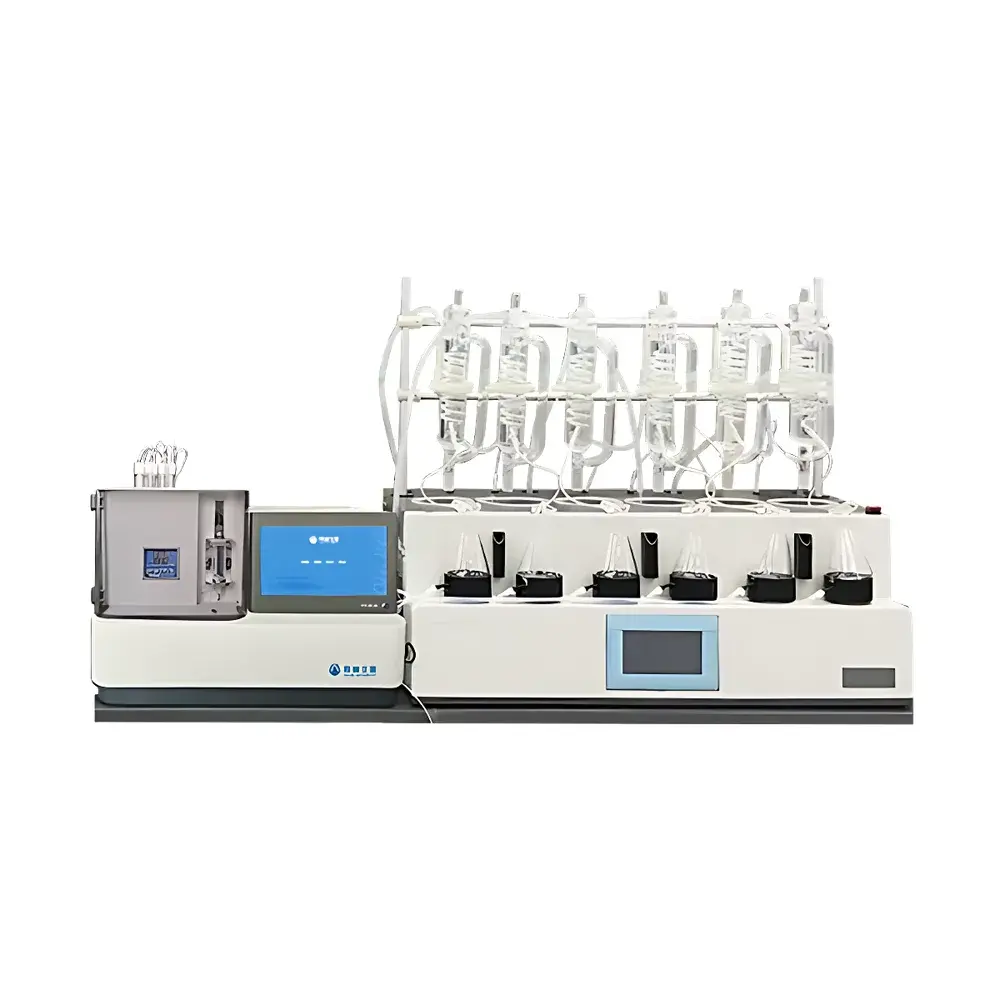
Online Instrument OL2050 Fully Automated Cyanide Analyzer
| Brand | Online Instrument |
|---|---|
| Origin | Shanghai, China |
| Manufacturer Type | Direct Manufacturer |
| Product Category | Domestic (China-Made) |
| Model | OL2050 |
| Instrument Type | Laboratory-Grade Analyzer |
| Pricing | Upon Request |
Overview
The Online Instrument OL2050 Fully Automated Cyanide Analyzer is a laboratory-grade, EPA- and ISO-compliant analytical system engineered for the precise, reproducible quantification of total and free cyanide in aqueous environmental matrices. It implements the standardized colorimetric method based on the isonicotinic acid–barbituric acid (or isonicotinic acid–pyrazolone) reaction—fully aligned with ISO 6703-1:1984, ASTM D4374-21, and China’s HJ 484-2009 standard methods. The instrument integrates automated distillation interface capability with in-line spectrophotometric detection at 638 nm, ensuring metrological traceability to reference cyanide standards. Its closed-system architecture eliminates manual handling of toxic distillates and reagents, thereby complying with occupational health and safety requirements (e.g., OSHA 29 CFR 1910.1200) and minimizing operator exposure to hydrogen cyanide vapor. Designed for regulatory-grade water quality laboratories, the OL2050 delivers data integrity through hardware-level process synchronization, real-time fault logging, and full audit trail generation.
Key Features
- Fully automated workflow: integrated auto-sampling, reagent dispensing, distillate transfer (via optional or third-party distillation module), colorimetric reaction, photometric measurement, and post-run cleaning—all under synchronized microcontroller coordination.
- Closed-loop fluidic architecture: all reagent delivery, reaction, and waste handling occur within sealed PTFE/PEEK tubing paths; exhaust gases are continuously scrubbed via integrated NaOH absorption trap.
- Dual-mode operation: supports both standalone analysis (when paired with external automated distillation units) and direct distillate injection (bypassing manual transfer), eliminating intermediate handling steps.
- Precision liquid handling: combines high-accuracy syringe pumps (±0.5% volumetric repeatability) with corrosion-resistant peristaltic pumps for robust reagent metering across variable viscosity and pH conditions.
- Intelligent reagent management: real-time level monitoring with low-reagent alerts, automatic dilution series preparation for multi-point calibration curves, and programmable reagent expiry tracking.
- Embedded temperature control: maintains distillation water bath and reaction block temperatures within ±0.3 °C of setpoint per HJ 484-2009 specifications, with PID-regulated heating elements and NIST-traceable RTD sensors.
Sample Compatibility & Compliance
The OL2050 is validated for use with raw and pretreated samples from surface water, municipal wastewater, industrial effluents (including electroplating, mining, and chemical manufacturing discharges), and groundwater. It accommodates sample volumes of 50–500 mL (adjustable via method configuration) and detects cyanide concentrations from 0.5 µg/L to 1.0 mg/L with demonstrated linearity (R² ≥ 0.999) across the dynamic range. All operational protocols conform to Good Laboratory Practice (GLP) principles and support 21 CFR Part 11 compliance when deployed with validated software configurations—including electronic signatures, audit trails, and data immutability controls. Method validation reports (including precision, recovery, LOD/LOQ, and inter-laboratory reproducibility) are available upon request per ISO/IEC 17025:2017 Annex A.2 requirements.
Software & Data Management
The OL2050 runs on an embedded Linux-based control platform with a 10.1-inch capacitive touchscreen HMI, supporting intuitive method setup, real-time process visualization, and immediate result review. Data export options include CSV, PDF analytical reports, and XML-formatted raw spectra. Native LIMS integration is achieved via ASTM E1394-compliant HL7 or ASTM E2500-22-compliant RESTful API interfaces, enabling bidirectional sample assignment, result push, and instrument status polling. Remote access is enabled through TLS-encrypted web portal (HTTPS) and mobile-responsive dashboard—allowing authorized users to initiate runs, monitor progress, retrieve historical datasets, and trigger diagnostic routines from any network-connected device. All data files are timestamped, digitally signed, and stored with SHA-256 checksums to ensure forensic integrity.
Applications
This analyzer serves as a primary or confirmatory tool in environmental compliance laboratories performing routine cyanide monitoring under national discharge permits (e.g., China’s GB 8978-1996, U.S. NPDES), drinking water safety verification (e.g., WHO Guidelines, EU Directive 98/83/EC), and industrial pretreatment program audits. It is routinely deployed by municipal water utilities, environmental testing service providers, regulatory agencies (e.g., provincial ECAs), and R&D facilities engaged in wastewater treatment optimization, cyanide destruction kinetics studies, and speciation method development (e.g., CN⁻ vs. metal-cyanide complexes). Its modularity supports method adaptation for sulfide interference mitigation and matrix-matched calibration strategies.
FAQ
Does the OL2050 require a dedicated distillation unit?
No—the system is designed for flexible integration: it can accept distillate directly from any commercially available automated distiller (e.g., Buchi K-435, Gerhardt Vapodest 45) via standardized tubing interface, or operate in “distillate-only” mode using pre-collected fractions.
How does the instrument ensure reagent stability during long-term unattended operation?
Reagents are stored in light-shielded, temperature-stabilized reservoirs; azide-free formulations are recommended for extended shelf life, and the system logs ambient storage temperature and usage frequency to flag potential degradation.
Can method parameters be customized beyond HJ 484-2009?
Yes—users may define custom reaction times, temperature profiles, dilution factors, and wavelength settings via the advanced method editor, subject to internal validation protocols.
Is remote firmware update supported?
Firmware updates are delivered via secure SFTP or USB import; all updates undergo cryptographic signature verification prior to installation to maintain system integrity.
Related Products







