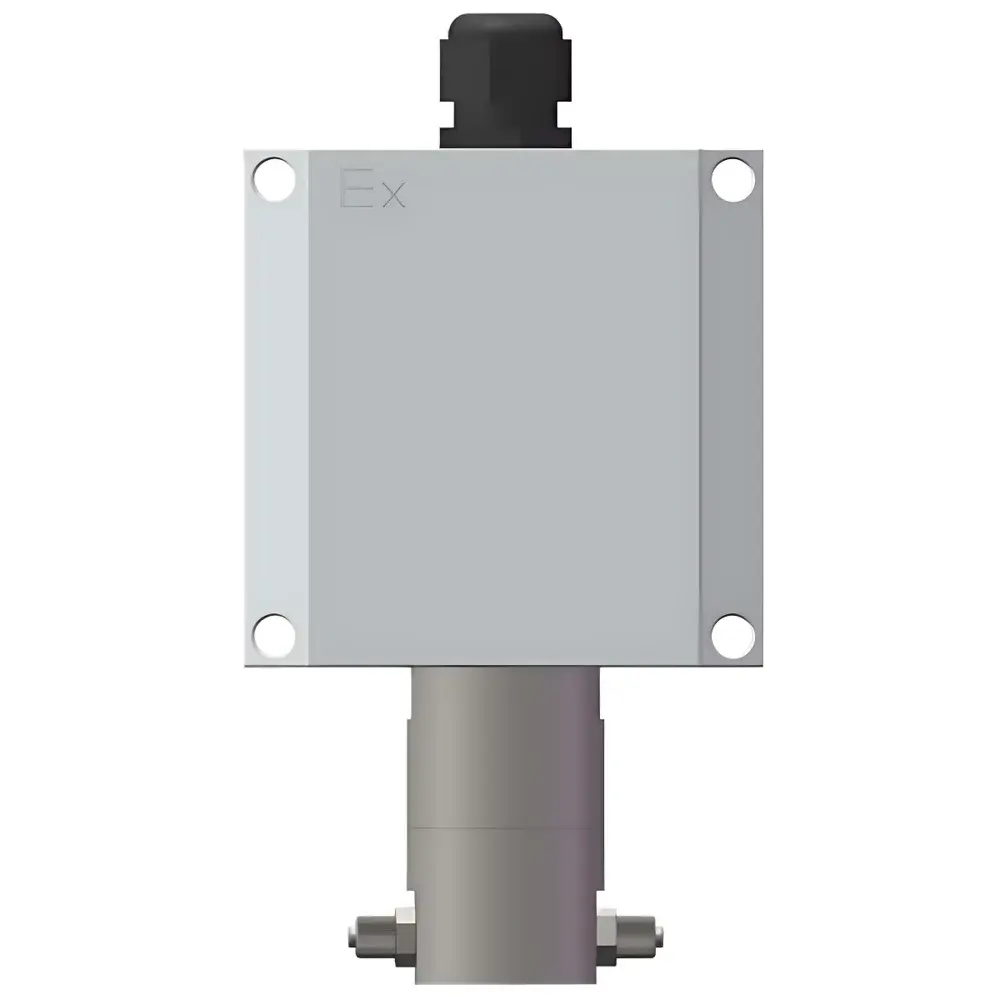
ONUEE UYI-U51/U52/U59 Series Intrinsically Safe Online Gas Detectors
| Brand | ONUEE |
|---|---|
| Origin | Guangdong, China |
| Manufacturer Type | Authorized Distributor |
| Product Origin | Domestic (China) |
| Model | UYI-U51 / UYI-U52 / UYI-U59 |
| Linear Error | ≤±1% |
| Repeatability | ≤±1% |
| Response Time | ≤20 s (T90) |
| Explosion Protection Rating | Ex d II CT6 (Flameproof) |
Overview
The ONUEE UYI-U51/U52/U59 Series are industrial-grade, flameproof online gas detectors engineered for continuous, real-time monitoring of combustible and toxic gases in hazardous process environments. These analyzers employ non-dispersive infrared (NDIR) sensing technology for hydrocarbon detection (e.g., CH₄), electrochemical cells for toxic species (e.g., H₂S, CO, NH₃), and metal oxide semiconductor (MOS) or photoionization (PID) modules for odorant or volatile organic compound (VOC) quantification—depending on model configuration. Designed to meet the operational rigor of petrochemical plants, biogas facilities, wastewater treatment stations, and confined-space entry systems, the series delivers stable, drift-compensated measurements under fluctuating ambient conditions. Its architecture conforms to IEC 60079-0 and IEC 60079-1 standards for explosion-protected equipment, with certified Ex d II CT6 enclosure integrity ensuring safe operation in Zone 1/2 classified areas where flammable vapors or gases may be present.
Key Features
- Industrial 2.4-inch color TFT display (320 × 240 resolution) with real-time concentration, temperature, humidity (optional), status flags, and alarm history
- Low-power 32-bit ARM Cortex-M microcontroller enabling firmware-upgradable functionality and embedded diagnostics
- Dual-stage alarm logic with configurable thresholds (high/low, band-limited, latching/non-latching) and user-defined relay actions
- Multi-protocol analog and digital outputs: isolated 4–20 mA (16-bit DAC, 1 km range), RS485 Modbus RTU (2 km), 0–5 V / 0–10 V voltage outputs, pulse/frequency output, and two SPDT relays (220 VAC / 24 VDC, 3 A)
- Comprehensive electrical protection: reverse polarity, overvoltage, short-circuit, ESD (±15 kV air, ±8 kV contact), EMI/RFI shielding, and lightning surge suppression (IEC 61000-4-5 Level 3)
- Optional integrated temperature and humidity sensor (−40 to +120 °C; 0–100 %RH) for environmental compensation and data contextualization
- Full software-based calibration suite supporting up to six-point span calibration per sensor, zero drift correction, and factory-reset recovery
Sample Compatibility & Compliance
The UYI-U51 is optimized for combustible gas detection in LEL (Lower Explosive Limit) units (0–100 %LEL), typically deployed for methane, propane, and other hydrocarbons. The UYI-U52 supports low-concentration toxic gas measurement across multiple ranges (e.g., 0–10 ppm NH₃, 0–5000 ppm CO), while the UYI-U59 offers dual-range capability (0–100 %LEL and 0–100 %Vol) for versatile applications including oxygen-deficient atmosphere monitoring. All models utilize diffusion-sampling methodology, suitable for ambient air or duct-mounted installation (M40×1.5 mm threaded port). The devices comply with GB 15322.1–2019 (Chinese standard for combustible gas detectors), CE marking requirements (EN 61000-6-2/-6-4), and carry ATEX and IECEx certification documentation upon request. Mechanical construction meets IP66 ingress protection and features die-cast aluminum housing with sandblasted anodized or fluorocarbon coating for corrosion resistance in aggressive chemical environments.
Software & Data Management
Configuration, calibration, and diagnostic functions are accessible via intuitive bilingual (English/Chinese) menu navigation without external PC tools. Optional PC-based configuration software enables batch parameter setting, firmware updates, and historical log export (CSV format). When equipped with TCP/IP or GPRS modules, the detector supports MQTT or Modbus TCP protocols for integration into SCADA, DCS, or cloud-based IIoT platforms (e.g., Siemens Desigo, Honeywell Experion, or custom AWS IoT Core deployments). Audit trails—including calibration events, alarm triggers, and configuration changes—are timestamped and stored locally (non-volatile memory) for GLP/GMP-aligned traceability. Remote access complies with TLS 1.2 encryption when enabled, satisfying baseline cybersecurity requirements for industrial control system (ICS) edge devices.
Applications
- Continuous monitoring of flare gas composition and methane slip in upstream oil & gas facilities
- Biogas quality assurance in anaerobic digesters (CH₄/CO₂ ratio tracking)
- Toxic gas surveillance in municipal wastewater lift stations (H₂S, NH₃)
- Odor emission compliance monitoring at landfill leachate treatment plants (OU index estimation)
- Confined space entry pre-check and ventilation verification (O₂ depletion, CO buildup)
- Process safety interlock signaling for emergency shutdown systems (ESD) in chemical reactors
FAQ
What certifications does the UYI-U59 hold for use in North American hazardous locations?
The base unit carries IECEx and ATEX certifications for Zone 1/2 use. For UL/cUL Class I Div 1 compliance in the U.S. and Canada, a separate UL-listed version (UYI-U59-UL) is available upon order.
Can the device operate reliably in high-humidity or condensing environments?
Yes—the IP66-rated enclosure and internal conformal coating protect against moisture ingress; however, prolonged exposure to saturated vapor or direct condensation on optical windows requires optional heated sampling head or Nafion® dryer integration.
Is third-party calibration validation supported?
All models support NIST-traceable span gas verification using standard test gases (e.g., 50 %LEL CH₄ in air); calibration certificates issued by CNAS-accredited labs are accepted for regulatory audits.
How is firmware updated in field-deployed units?
Firmware updates are performed via USB-C interface or remotely via Modbus TCP or MQTT when connected to a secure enterprise network—no physical disassembly required.
Does the device support HART communication protocol?
No—HART is not natively implemented; however, 4–20 mA output can be interpreted by HART-enabled host systems using analog input cards with discrete alarm contact mapping.