
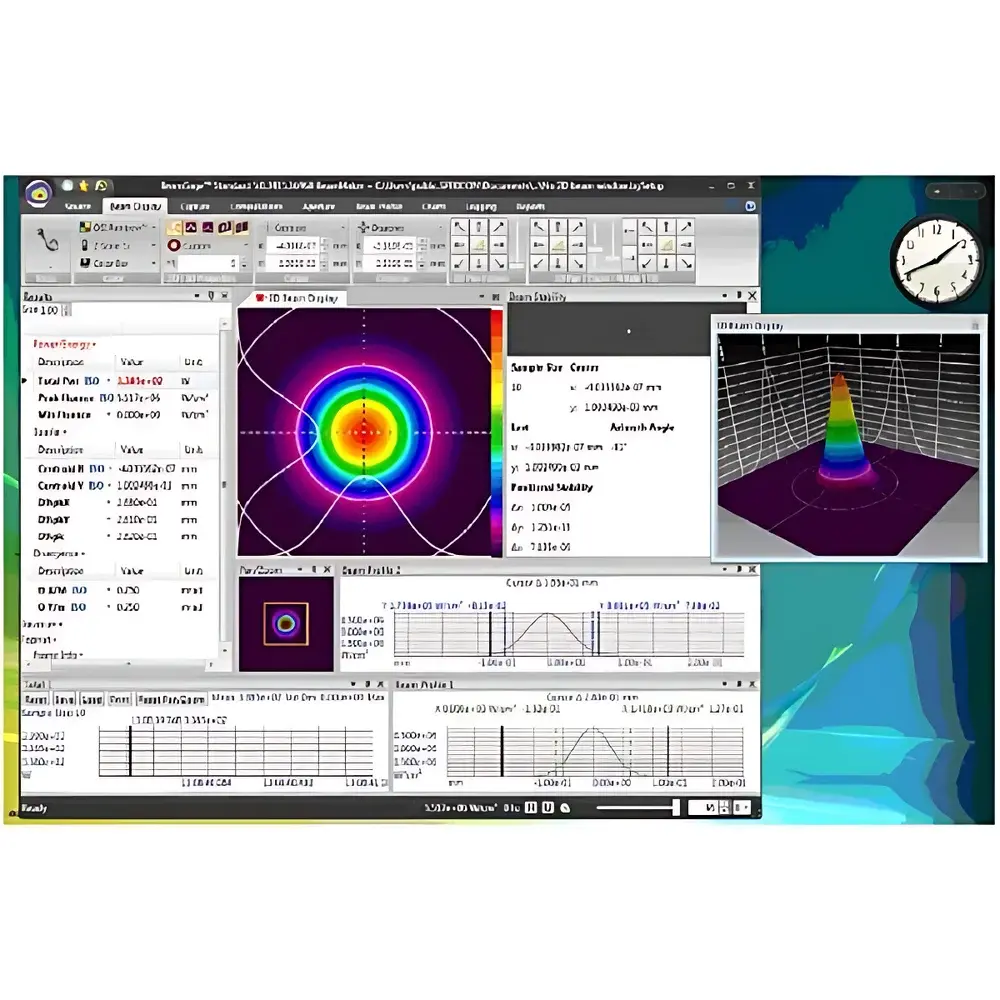
Ophir BeamGage Software
| Brand | Ophir |
|---|---|
| Origin | Israel |
| Manufacturer Type | Authorized Distributor |
| Origin Category | Imported |
| Model | BeamGage |
| Pricing | Upon Request |
| Core Integration | Compatible with Free-Electron Laser (FEL) Imaging Systems |
Overview
BeamGage Software is a high-precision, standards-compliant laser beam analysis platform developed by Ophir (a Newport Corporation company) for quantitative characterization of spatial intensity distributions in continuous-wave (CW), pulsed, and ultrafast laser systems. Building upon four decades of legacy from Spiricon’s LBA and BeamStar software generations, BeamGage implements ISO 11146-1:2019 and ISO 11146-3:2004 compliant algorithms for beam width (D4σ, 1/e², knife-edge), centroid position, ellipticity, M² estimation (when paired with compatible beam propagation hardware), and pointing stability tracking. It operates as a real-time acquisition and post-processing engine for CCD/CMOS, pyroelectric, and InGaAs-based beam profiling cameras—enabling rigorous metrology in R&D, manufacturing QC, and laser safety compliance workflows.
Key Features
- Ultracal™ background subtraction: A single-point, ISO 11146-3 traceable baseline calibration method that eliminates ambient stray light and sensor offset, ensuring measurement fidelity across varying environmental conditions.
- Multi-dimensional visualization: Simultaneous 1D cross-sections, 2D false-color heatmaps, and interactive 3D surface plots—with dual orthogonal projection views for enhanced spatial interpretation of beam morphology.
- BeamMaker™ simulation module: Enables algorithm validation via synthetic beam generation—including Gaussian, top-hat, donut, and user-defined profiles—with configurable noise, clipping, and aberration models.
- Multi-region analysis (MRA): Splits a single camera frame into up to 64 independent regions-of-interest (ROIs), enabling concurrent analysis of multiple beams (e.g., fiber array outputs or multi-channel amplifiers) without hardware duplication.
- Real-time pointing stability assessment: Time-series plotting of centroid displacement (X/Y) with statistical summary (RMS, peak-to-valley, standard deviation) and scatter plot overlays—exportable in CSV or MATLAB-compatible formats.
- Pass/Fail thresholding: Configurable criteria per parameter (e.g., beam diameter ±5%, centroid drift <2 µm over 60 s) with automated pass/fail flagging and PDF report generation.
- Cross-platform camera support: Native integration with Ophir Pyrocam, NanoScan, and BeamWatch systems; also supports third-party GigE Vision, USB3 Vision, and GenICam-compliant sensors—including networked and shared-camera configurations.
Sample Compatibility & Compliance
BeamGage supports beam profiling across UV–FIR spectral ranges (190 nm – 16 µm), contingent on detector type and optical attenuation. It accommodates pulse energies from nJ to J-level and repetition rates up to 100 kHz (dependent on camera frame rate and exposure control). All core beam metrics comply with ISO 11146-1:2019 (laser beam widths, divergence, and propagation parameters) and ISO 13694:2001 (laser beam profile measurements). The software architecture supports audit-ready operation under GLP and GMP environments, with optional FDA 21 CFR Part 11-compliant electronic signature and audit trail modules available via licensed add-ons.
Software & Data Management
The application features a modular, dockable UI supporting multi-monitor deployment and dynamic window resizing. Data acquisition, processing, and reporting are decoupled into discrete pipelines—allowing batch analysis of stored .bmg files or live streaming from multiple synchronized sensors. Measurement results export to PDF (with embedded metadata and ISO-conformance statements), CSV, XML, HDF5, and MATLAB .mat formats. All reports include timestamped instrument configuration, calibration history, and operator ID fields. Version-controlled project templates ensure method reproducibility across lab sites and regulatory submissions.
Applications
- Laser resonator optimization and cavity alignment verification
- Fiber-coupled system coupling efficiency analysis
- Ultrafast amplifier beam quality monitoring (e.g., Ti:sapphire, Yb-doped fiber)
- Free-electron laser (FEL) diagnostics and pulse-to-pulse stability assessment
- Industrial laser cutting/welding head beam delivery validation
- Medical laser device certification per IEC 60825-1 and ANSI Z136.1
- Academic ultrafast optics research requiring M², BPP, and Strehl ratio quantification
FAQ
Does BeamGage support real-time M² measurement?
No—M² requires propagation data at multiple z-positions; BeamGage calculates M² offline when imported with a calibrated z-stack dataset acquired using compatible motorized stages and beam profilers.
Is Ultracal compliant with ISO 11146-3:2004 or the updated 2019 version?
Ultracal implements the fundamental baseline correction methodology defined in ISO 11146-3:2004, which remains normative in the 2019 revision for background subtraction protocols.
Can BeamGage analyze beams from multiple cameras simultaneously?
Yes—via Network Camera mode or shared memory buffers, provided cameras are synchronized externally (e.g., via TTL trigger) and configured with identical exposure/gain settings.
What file format does BeamGage use for native project storage?
Proprietary .bmg (BeamGage Binary) format, preserving raw pixel data, metadata, analysis settings, and calibration state for full method traceability.
Is BeamGage validated for use in regulated pharmaceutical manufacturing?
With the optional 21 CFR Part 11 Module enabled, BeamGage supports electronic signatures, role-based access control, and immutable audit trails—meeting baseline requirements for IQ/OQ/PQ documentation in FDA-regulated environments.






