
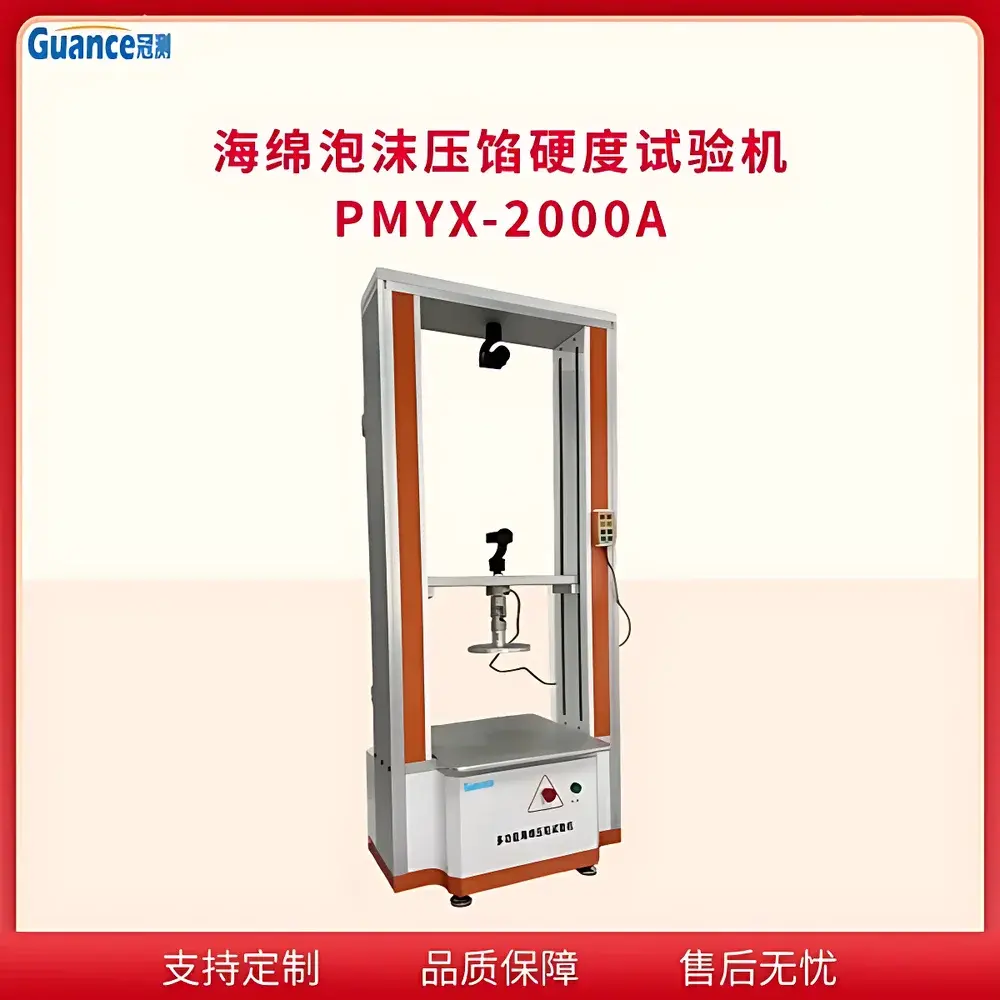
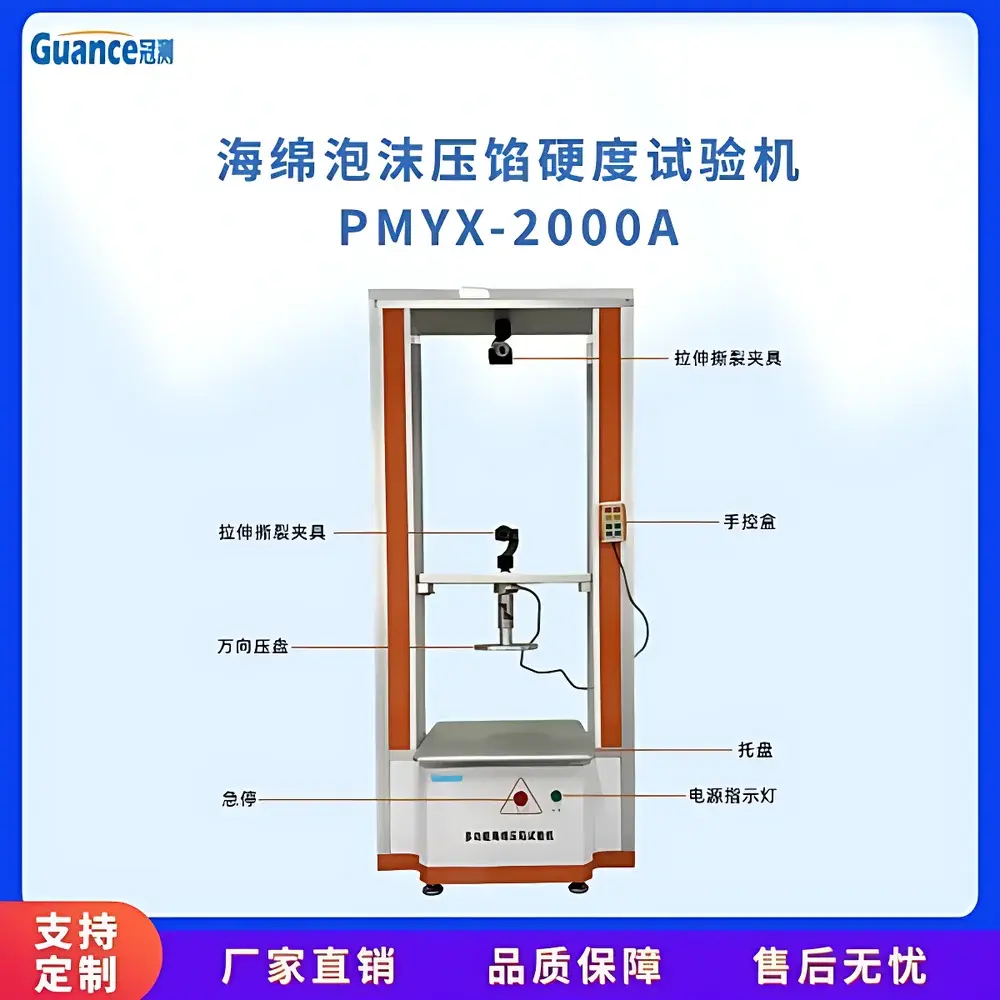
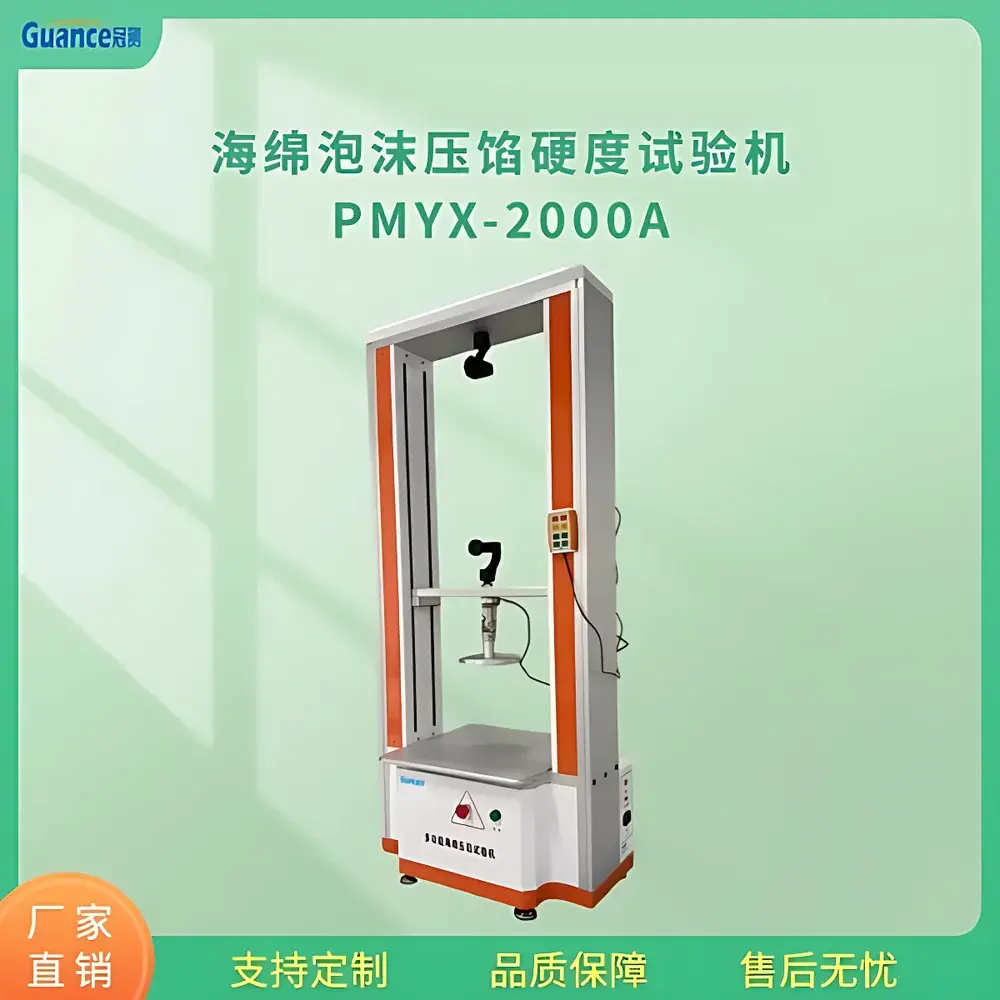
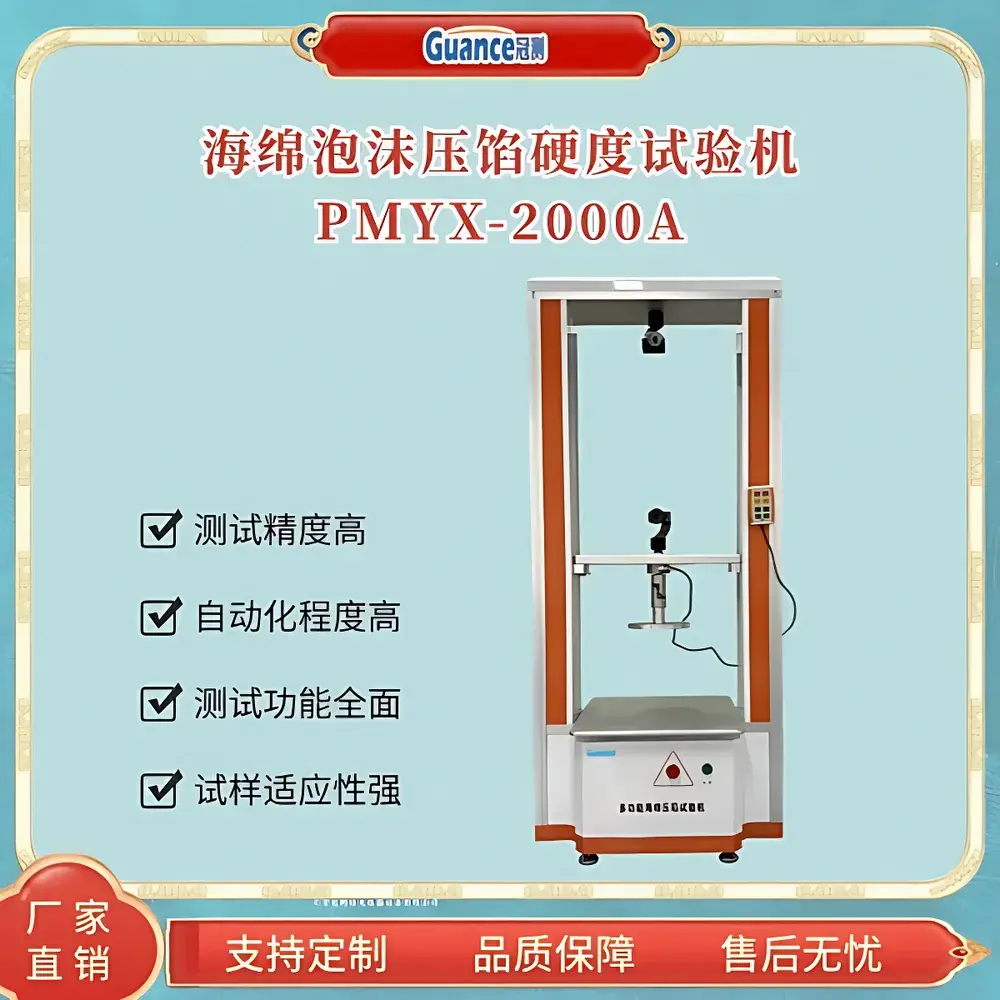
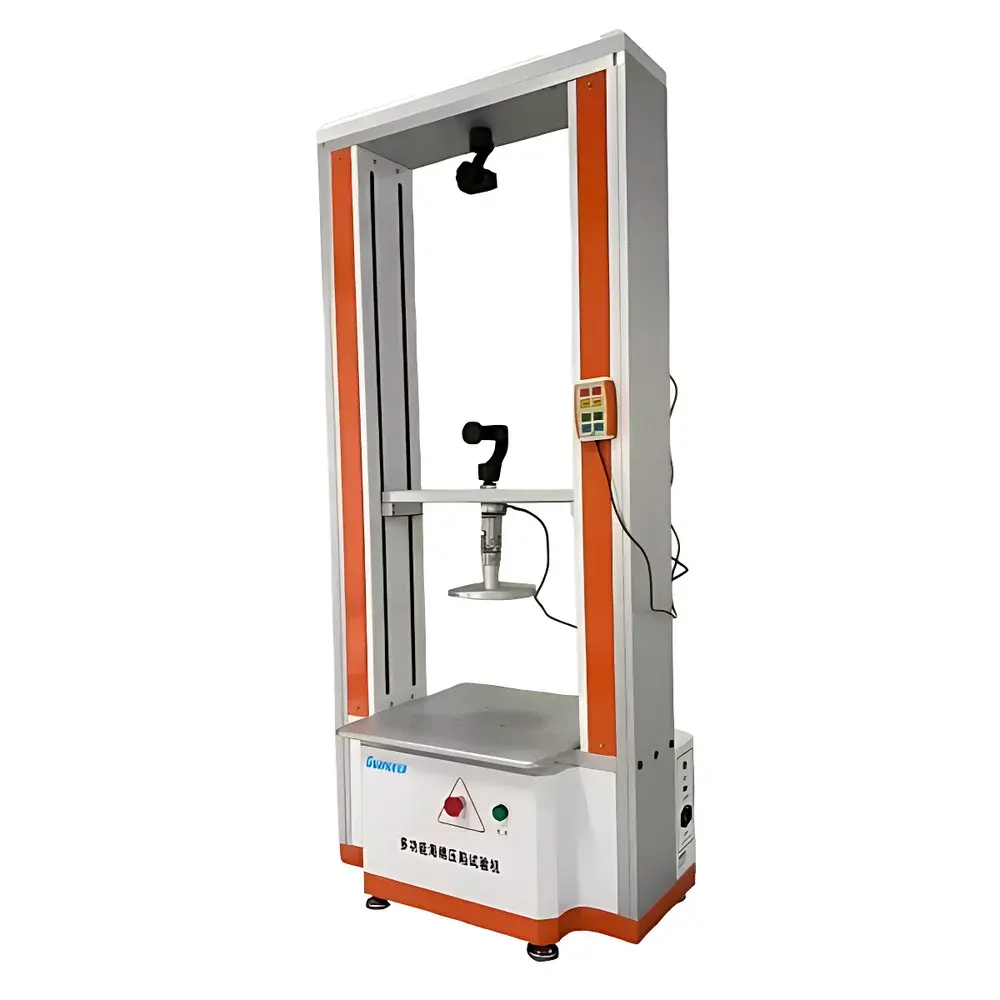
GuanCe PMYX-2000A Fully Automated Foam Indentation Hardness Tester
| Brand | GuanCe Instruments |
|---|---|
| Origin | Beijing, China |
| Model | PMYX-2000A |
| Test Speed | 50–300 mm/min (adjustable) |
| Preload Force | 5 N |
| Indentation Depth Control | ±0.1 mm accuracy |
| Force Resolution | 0.01 N |
| Thickness Measurement Range | 0–150 mm |
| Compliance Standards | GB/T 10807-2006, GB/T 12825-2003, GB/T 18942.1-2003, ASTM D3574, GB/T 26392-2011 |
Overview
The GuanCe PMYX-2000A Fully Automated Foam Indentation Hardness Tester is an electromechanical testing system engineered for precision measurement of indentation hardness, compression stress–strain behavior, and recovery characteristics of flexible polymeric foams—including polyurethane (PU), slow-recovery viscoelastic foams, and other porous elastomeric materials. Based on the standardized indentation method (also known as the “impression” or “dent” method), the instrument applies controlled vertical displacement to a conditioned foam specimen using a rigid, flat-ended indenter plate under defined preload, rate, depth, and dwell conditions. The resulting force response is captured in real time via high-fidelity load cell transduction, enabling calculation of key mechanical indices including indentation hardness index (IHI), indentation force deflection (IFD) ratios, and compression modulus—parameters critical for quality assurance, material specification compliance, and formulation development in cushioning, bedding, automotive seating, and medical support applications.
Key Features
- Fully computer-controlled operation with intuitive Windows-based software interface supporting method-driven test sequencing and real-time parameter monitoring.
- Precision ball-screw actuation system ensuring smooth, low-noise displacement with positional repeatability better than ±0.1 mm.
- Adjustable crosshead speed from 50 to 300 mm/min, covering standard rates (e.g., 100 mm/min per GB/T 10807-2006) and custom protocols aligned with international specifications.
- Integrated thickness measurement module that automatically detects initial specimen height prior to preloading—eliminating manual caliper input and reducing operator-induced variability.
- Multi-stage indentation logic supporting all major national and industry-standard test modes: Method A (IFD40), Method B (IFD25/IFD40/IFD65 with ratio derivation), Method C (instantaneous peak force at 40% deflection), and user-defined multi-cycle sequences.
- Real-time synchronized plotting of time–force–displacement curves; interactive cursor tool enables point-specific readout of force (N), depth (mm), and elapsed time (s).
- Comprehensive data management: automatic timestamped storage of raw test files (.csv/.xlsx), reusable method templates, audit-ready test logs, and exportable reports compliant with internal QA documentation requirements.
Sample Compatibility & Compliance
The PMYX-2000A is validated for use with standard rectangular foam specimens (typically 380 mm × 380 mm × 50 mm, per ASTM D3574 and GB/T 10807-2006), though fixtures accommodate alternative dimensions within the 150 mm maximum thickness range. It meets essential metrological criteria for routine QC environments—including linearity, hysteresis, and repeatability performance consistent with ISO/IEC 17025 guidance for mechanical testing equipment. All programmed test routines map directly to clauses in GB/T 10807-2006 (Method A/B/C), GB/T 12825-2003 (indentation hardness by depth ratio), GB/T 18942.1-2003 (low-density compression), and ASTM D3574 (Sections 4–7 for slab, molded, and bonded foams). For regulated industries, the system supports GLP-aligned data integrity practices, including electronic signatures, version-controlled method libraries, and tamper-evident file archiving—facilitating alignment with FDA 21 CFR Part 11 readiness when deployed with validated software configurations.
Software & Data Management
The proprietary control software provides deterministic test execution with full traceability: each test session records operator ID, environmental notes (e.g., conditioning temperature/humidity), calibration status, and hardware configuration metadata. All force–displacement datasets are saved in open-format CSV files, compatible with third-party statistical analysis tools (e.g., JMP, Minitab) and LIMS integration. The software includes built-in calculation engines for standardized outputs—such as IFD25/IFD40 ratio (a proxy for firmness balance) and IFD65/IFD40 ratio (indicative of progressive load-bearing capacity)—and permits user-defined formula fields for proprietary metrics. Audit trails log every parameter change, test initiation, and data export event, satisfying internal quality system requirements for instrument qualification (IQ/OQ/PQ) and periodic revalidation.
Applications
This tester serves laboratories engaged in raw material acceptance testing, batch release verification, comparative benchmarking of competing foam formulations, and R&D validation of new polymer blends or blowing agent systems. Typical use cases include: verifying conformance of PU slabstock to OEM seating specifications; quantifying slow-recovery kinetics per GB/T 26392-2011; evaluating compression set resistance in mattress cores; assessing consistency across production rolls in furniture manufacturing; and supporting technical documentation for ISO 9001-certified quality management systems. Its flexibility in speed, depth, and dwell programming also makes it suitable for academic research into viscoelastic constitutive modeling of cellular solids.
FAQ
What standards does the PMYX-2000A natively support?
It implements test logic for GB/T 10807-2006 (Methods A–C), GB/T 12825-2003, GB/T 18942.1-2003, ASTM D3574 (Types A–F), and GB/T 26392-2011—all accessible via preloaded method templates.
Can test methods be customized beyond the standard protocols?
Yes. The software allows creation and saving of fully parametric multi-step cycles—including variable speeds, dwell times, compression depths, and return profiles—as demonstrated in Method D examples.
Is thickness measurement automated or manual?
Fully automated: the system detects initial specimen thickness after applying 5 N preload, then calculates deflection relative to that baseline without operator intervention.
What level of force resolution and displacement accuracy is achieved?
Force resolution is 0.01 N; displacement control accuracy is ±0.1 mm over the full 0–150 mm travel range, verified per manufacturer’s calibration certificate.
Does the system support networked data export or LIMS connectivity?
Raw data exports to CSV/XLSX formats; API-level integration requires optional middleware configuration—contact GuanCe Technical Support for enterprise deployment options.



