
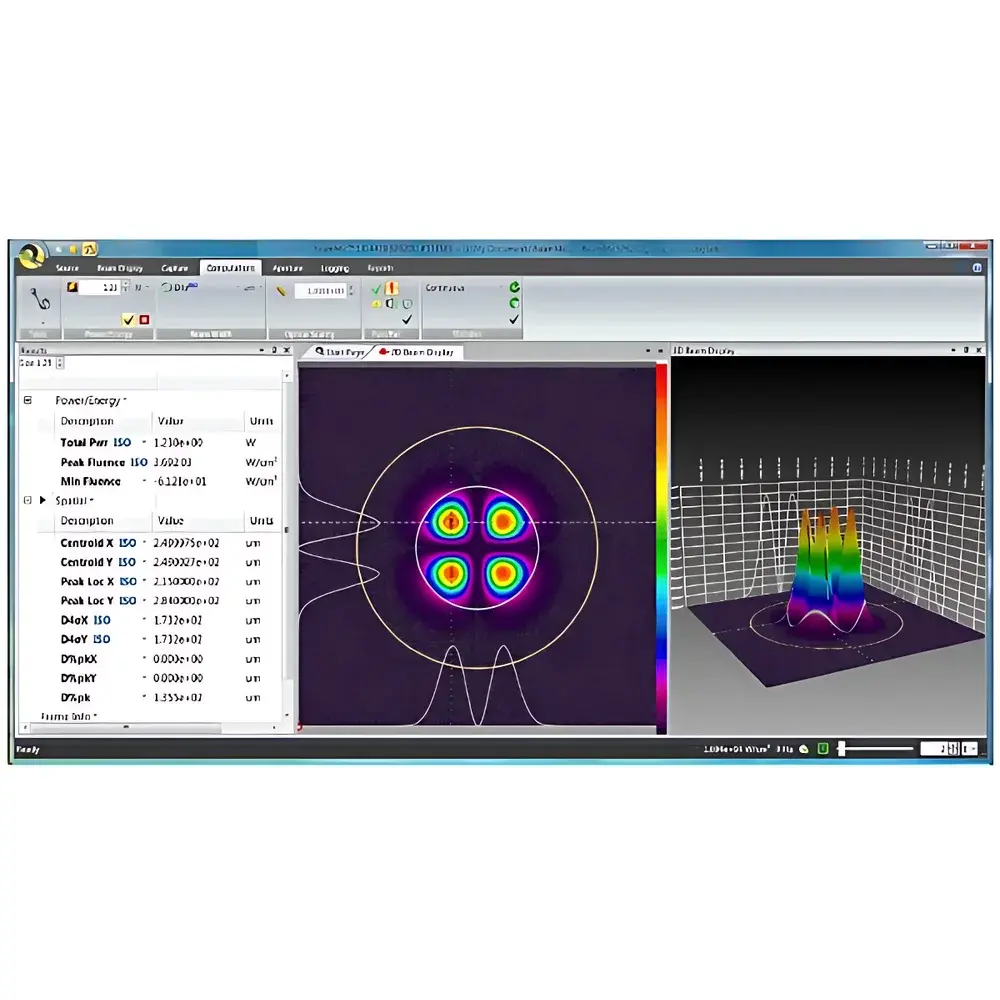
Ophir BeamMic Beam Analysis Software
| Brand | Ophir |
|---|---|
| Origin | Israel |
| Model | BeamMic |
| Category | Entry-Level Laser Beam Profiling Software |
| Compatible Detectors | Ophir Pyroelectric & Photodiode-Based Beam Profilers (e.g., NanoScan, BeamWatch, StarLite, Juno) |
| Compliance | ISO 11146-1:2005, ISO 13694:2000, ISO 11554:2017 |
| Data Export | PDF, CSV, BMP, PNG, TIFF |
| Background Correction | Ultracal™ Single-Point Dynamic Background Subtraction |
| Measurement Standards | 4σ, D4σ, Knife-Edge, 1/e², FWHM, Flatness (Top-Hat), Centroid (Peak & Geometric), Pass/Fail Thresholding |
| Multi-Monitor Support | Yes |
| UI Scalability | Fully Resizable Windows, DPI-Aware Interface |
| Software Architecture | Windows 10/11 x64, .NET Framework 4.8, DirectShow & Ophir SDK Integration |
Overview
Ophir BeamMic is an entry-level, cost-optimized beam analysis software engineered for rapid, standardized characterization of continuous-wave (CW) and pulsed laser beams in industrial QA, academic teaching labs, and R&D prototyping environments. Built upon Ophir’s proven measurement engine and calibrated against traceable NIST-traceable reference standards, BeamMic implements the core physical principles defined in ISO 11146-1 (laser beam widths, divergence, and propagation parameters) and ISO 13694 (laser beam profile measurements). Unlike high-throughput research-grade platforms, BeamMic prioritizes operational simplicity without compromising metrological integrity—leveraging direct hardware integration with Ophir’s family of pyroelectric array sensors (e.g., StarLite, Juno) and scanning-slit profilers (e.g., NanoScan) to deliver repeatable, ISO-compliant beam parameter extraction including M² estimation (when used with compatible beam propagation kits), beam width (D4σ), centroid position, flatness ratio, and ellipticity.
Key Features
- ISO-Compliant Beam Parameter Extraction: Calculates beam diameter per D4σ, 1/e², FWHM, and knife-edge methods; supports both peak-intensity and geometric centroid localization with sub-pixel interpolation accuracy.
- Ultracal™ Dynamic Background Subtraction: A single-point, real-time background calibration algorithm that eliminates ambient stray light and sensor offset drift—critical for low-contrast or low-power beam measurements under non-darkroom conditions.
- Integrated 2D + 3D Visualization: Simultaneous display of intensity cross-sections (horizontal/vertical), 2D heatmaps, and rotatable 3D surface plots—including orthogonal side projections (XZ/YZ planes) for spatial insight into beam asymmetry and near-field structure.
- Pass/Fail Thresholding Engine: Configurable tolerance bands for beam width, centroid stability, flatness deviation, and power uniformity—enabling automated go/no-go decisions aligned with internal QC protocols or customer-facing specifications.
- Multi-Monitor & UI Flexibility: Native support for extended desktop configurations; all windows—including live view, histogram, profile traces, and statistics panels—are independently resizable, dockable, and DPI-aware for high-resolution displays.
- Regulatory-Ready Reporting: One-click export of measurement sessions—including raw image data, calculated parameters, pass/fail status, timestamped metadata, and operator ID—to encrypted PDF reports compliant with GLP documentation requirements.
Sample Compatibility & Compliance
BeamMic is validated for use with Ophir’s certified beam profiling hardware, including pyroelectric array cameras (StarLite, Juno), scanning-slit systems (NanoScan v2/v3), and line-imaging sensors (BeamWatch IR/UV). It does not support third-party detectors outside the Ophir SDK ecosystem. All measurement algorithms adhere to ISO 11146-1:2005 (determination of beam widths and divergences), ISO 13694:2000 (beam profile measurement techniques), and ISO 11554:2017 (laser and laser-related equipment—test methods for laser beam parameters). The software architecture is designed to operate within FDA 21 CFR Part 11–aligned environments when deployed with audit trail-enabled enterprise license options (available separately).
Software & Data Management
BeamMic runs natively on Windows 10/11 (64-bit) with .NET Framework 4.8 and integrates via Ophir’s proprietary SDK using DirectShow and vendor-specific device drivers. Data acquisition is synchronized at hardware frame rate (up to 60 Hz for array sensors; kHz-range for scanning slits). All measurement sessions are stored locally in a structured binary format (.bms) containing raw frames, calibration metadata, user annotations, and calculation history. Export functions support CSV (for statistical post-processing in MATLAB or Python), PDF (with embedded digital signatures and time-stamped headers), and lossless image formats (TIFF, PNG, BMP). Batch processing of archived datasets is supported through command-line interface scripting (PowerShell/Python wrappers available upon request).
Applications
- Laser diode and fiber-coupled module alignment verification during manufacturing
- QC screening of CO₂, Nd:YAG, and ultrafast Ti:Sapphire oscillator output stability
- Teaching laboratory exercises on Gaussian vs. top-hat beam propagation theory
- Pre-calibration validation prior to M² measurement campaigns using ISO 11146-2 compliant setups
- Flat-top homogenizer performance assessment in micromachining and medical laser systems
- Field service diagnostics for OEM integrators requiring portable, lightweight beam analysis tools
FAQ
Is BeamMic compatible with non-Ophir detectors?
No. BeamMic exclusively supports Ophir-branded beam profiling hardware connected via USB or Ethernet and recognized through the official Ophir SDK driver stack.
Does BeamMic support M² measurement?
M² calculation requires multi-distance beam propagation data and is not included in the base BeamMic license. It is available as an add-on module when used with Ophir’s BeamRazor or BeamWatch propagation kits and compliant z-stage control.
Can BeamMic generate FDA 21 CFR Part 11–compliant audit trails?
The standard BeamMic edition does not include electronic signature or audit trail functionality. These capabilities are provided in the enterprise-tier BeamGage IQ variant, which shares the same UI framework but adds role-based access control, session logging, and digital certificate integration.
What is the update policy for BeamMic?
Minor version updates (e.g., bug fixes, driver compatibility patches) are provided free of charge for the duration of the maintenance period included with purchase. Major version upgrades require renewal of the annual support contract.





