
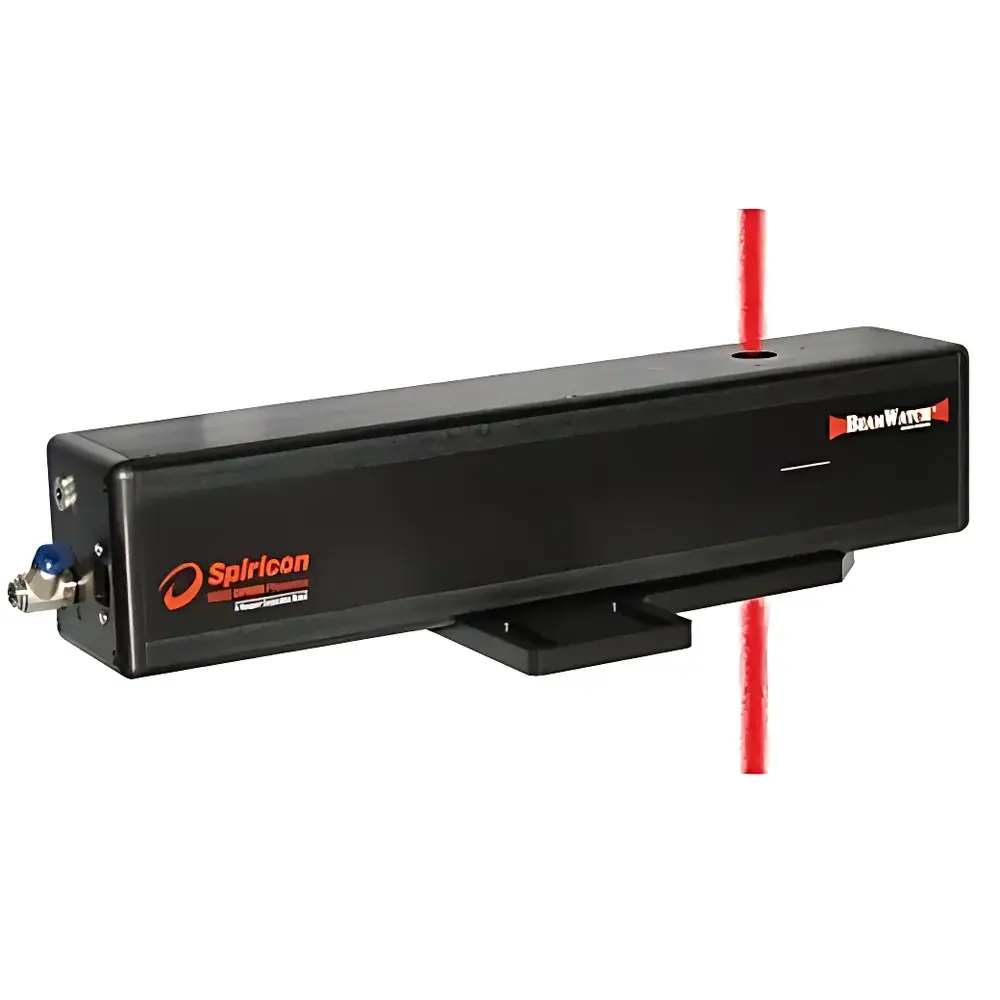
OPHIR BeamWatch High-Power Laser Beam Profiler
| Brand | OPHIR |
|---|---|
| Origin | USA |
| Model | BeamWatch |
| Wavelength Range | 980–1080 nm |
| Power Range | ≥400 W (no upper limit, non-contact, no attenuation required) |
| Minimum Spot Size | 55 µm |
| Maximum Spot Size | 12.5 mm |
| Minimum Power Density | 2 MW/cm² |
| Waist Position Accuracy | ±125 µm |
| Waist Diameter Accuracy | ±5% |
| Focus Drift Resolution | ±50 µm |
| Divergence Angle Accuracy | ±3.5% RMS |
| M² Accuracy | ±3.5% RMS |
| Interface | GigE Ethernet |
| Measurement Outputs | Waist X/Y, Waist Position X/Y, Focus Drift X/Y, Centroid X/Y, Spot Size & Ellipticity at Cursor, Rayleigh Length, M² (X/Y/avg), K-factor (X/Y/avg), BPP (X/Y/avg), Divergence (X/Y/avg) |
Overview
The OPHIR BeamWatch is a non-intrusive, real-time laser beam profiler engineered for quantitative characterization of high-power industrial and scientific lasers operating in the near-infrared spectrum (980–1080 nm). Unlike conventional scanning-slit or camera-based profilers, BeamWatch employs proprietary Rayleigh scattering tomography to reconstruct the full 3D intensity distribution of the beam without optical attenuation, beam splitting, or thermal damage risk—making it uniquely suited for kW-class continuous-wave (CW) and high-repetition-rate pulsed laser systems used in metal processing, additive manufacturing, and laser source development.
By capturing volumetric beam data along the propagation axis, BeamWatch delivers traceable, spatially resolved metrics including beam waist location and diameter, focus drift over time, Rayleigh length, centroid trajectory, and full second-moment-derived beam quality parameters (M², BPP, K-factor, divergence). Its design eliminates calibration drift associated with thermal lensing in absorptive sensors and avoids signal saturation common in CMOS/CCD detectors at multi-hundred-watt power levels.
Key Features
- Zero-Attenuation Operation: Measures beams from 400 W up to multi-kilowatt levels without neutral density filters, wedges, or beam dumps—preserving beam integrity and eliminating alignment-induced measurement uncertainty.
- Real-Time Volumetric Reconstruction: Acquires >100 axial cross-sections per second across the Rayleigh range, enabling dynamic monitoring of thermal lensing effects, mode instability, and focus shift during extended operation.
- Sub-100 µm Spatial Resolution: Supports minimum detectable spot sizes down to 55 µm (BW-NIR-1-55 variant), with axial resolution better than 1 mm over typical working distances (up to 1.5 m).
- GigE Vision–Compliant Interface: Integrates seamlessly into factory automation environments via standard Gigabit Ethernet; supports GenICam-compliant configuration, streaming, and metadata embedding for traceable data acquisition.
- Robust Industrial Architecture: Sealed aluminum housing rated IP54; operational ambient temperature range: 15–35 °C; designed for integration into laser cutting heads, welding cabins, and OEM laser engine test benches.
Sample Compatibility & Compliance
BeamWatch is validated for use with fiber-coupled and free-space Nd:YAG, Yb-doped fiber, and direct-diode lasers emitting in the 980–1080 nm band. It meets mechanical and electromagnetic compatibility requirements per IEC 61326-1 (industrial environment) and conforms to laser safety standards IEC 60825-1:2014 (Class 1 during operation). While BeamWatch itself is a passive diagnostic tool (no Class 3B/4 emission), its deployment requires adherence to ANSI Z136.1–2022 for alignment and operational safety protocols when installed in open-beam paths. Data outputs comply with ISO 11146-1:2019 (laser beam widths, divergence, and M² determination) and support audit-ready reporting for ISO 9001 and AS9100 quality management systems.
Software & Data Management
BeamWatch ships with OPHIR’s BeamStudio software (v4.2+), a Windows-based application supporting real-time visualization, automated pass/fail thresholding, batch report generation (PDF/CSV/XML), and export of calibrated intensity matrices for third-party analysis (MATLAB, Python, Zemax). All measurements include embedded timestamping, instrument serial number, environmental sensor readings (ambient temperature/humidity), and user-defined metadata tags. Software enforces role-based access control and maintains full audit trails—including parameter changes, calibration events, and export history—in compliance with FDA 21 CFR Part 11 requirements for electronic records and signatures. Raw scattering data is stored in HDF5 format for long-term archival and reprocessing.
Applications
- Process validation and in-line monitoring of high-power laser cutting and welding systems (e.g., automotive body-in-white production lines)
- Qualification of fiber laser sources prior to integration into medical device manufacturing platforms
- Development and aging studies of high-brightness diode laser stacks and tapered amplifiers
- Verification of beam delivery optics performance (collimators, focus lenses, scan heads) under thermal load
- Support for ISO/IEC 17025-accredited calibration labs performing beam parameter certification per ISO 11146
FAQ
Does BeamWatch require beam attenuation for safe operation?
No—BeamWatch uses non-contact Rayleigh scattering detection and is rated for direct exposure to beams ≥400 W with no optical attenuation.
Can BeamWatch measure pulsed lasers?
Yes, provided pulse repetition rate exceeds 10 kHz and average power remains within specification; single-pulse profiling is not supported.
Is M² calculation compliant with ISO 11146?
Yes—BeamStudio implements the second-moment method defined in ISO 11146-1:2019, including full correction for background noise and pixel response non-uniformity.
What is the minimum measurable beam diameter?
The BW-NIR-1-55 model resolves spots down to 55 µm (1/e² intensity width); resolution is hardware-configured and cannot be improved via software interpolation.
How is calibration maintained over time?
BeamWatch includes an integrated reference scatterer and self-diagnostic routine; annual verification against NIST-traceable beam standards is recommended for GMP/GLP environments.



