
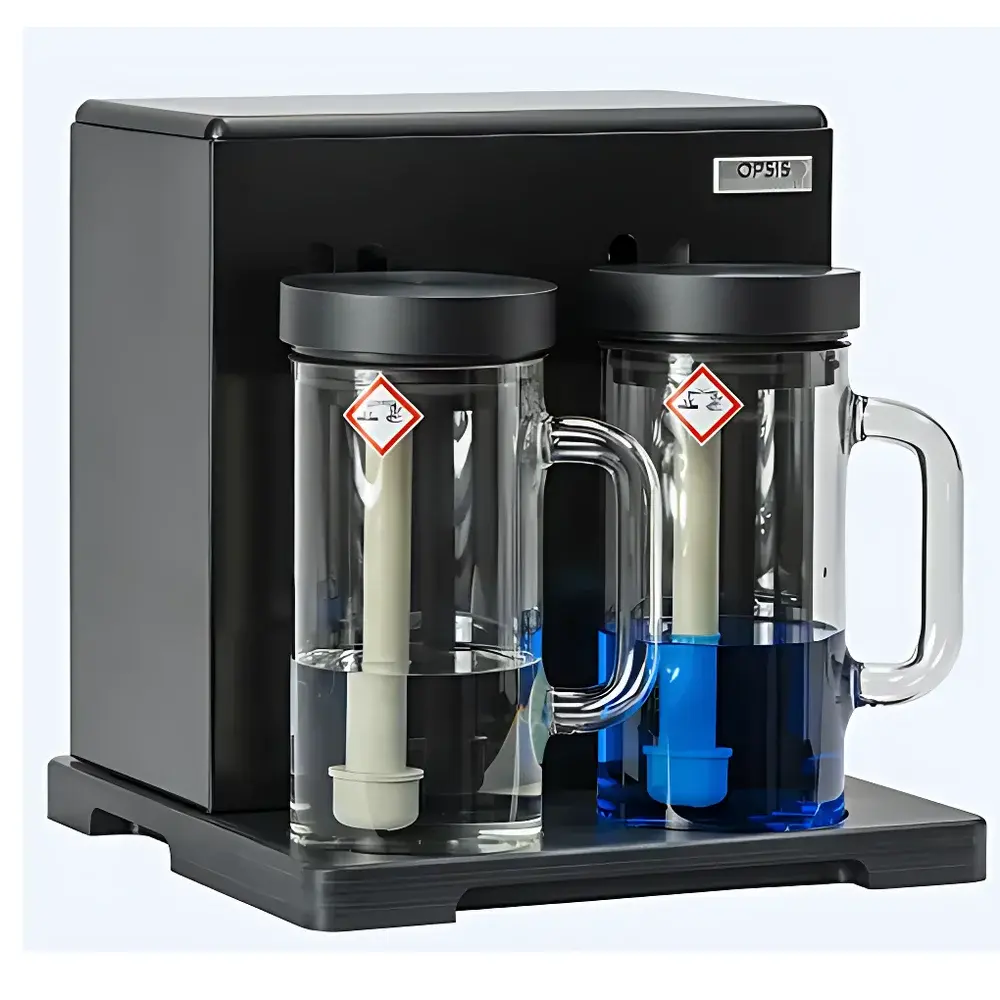
OPSIS DI-110 Exhaust Gas Absorption System
| Brand | OPUS/OPSIS |
|---|---|
| Origin | Sweden |
| Manufacturer Type | Authorized Distributor |
| Origin Category | Imported |
| Model | DI-110 |
| Instrument Type | Electric Heating Digestion System |
| Automation Level | Fully Automatic |
| Reagent Reservoir Capacity | 2 L |
| Construction Materials | Borosilicate Glass Condenser & Vessel, Fluoroelastomer (FKM) Tubing |
| Vacuum Source | Integrated Acid-Resistant Negative-Pressure Pump |
| Footprint | Compact Design for Benchtop Integration Adjacent to Digestion Units |
| Control Interface | 6-Step Programmable Suction Profile |
| Compliance | Designed for ASTM D3682, ISO 11733, and EPA Method 3050B-Compatible Sample Prep Environments |
Overview
The OPUS/OPSIS DI-110 Exhaust Gas Absorption System is an engineered solution for the safe, efficient, and water-conserving capture and neutralization of acidic fumes generated during high-temperature acid digestion processes—particularly those involving HNO₃, HCl, HF, and H₂SO₄. Unlike conventional reflux-based or water-cooled condensation systems, the DI-110 operates on a closed-loop, dry-absorption principle: it utilizes controlled negative pressure to draw evolved gases through a borosilicate glass scrubbing column packed with porous ceramic elements, where they undergo rapid diffusion-controlled contact with a continuously recirculated alkaline reagent (e.g., NaOH or Na₂CO₃ solution). This design eliminates dependency on municipal water supply for condenser cooling—a critical advantage in laboratories located in arid regions or operating under strict water stewardship protocols. The system integrates seamlessly with electric heating digestion instruments, enabling synchronized operation without requiring external vacuum manifolds or chilled water infrastructure.
Key Features
- Fully automated suction control via a 6-step programmable profile—each step independently configurable for flow rate, duration, and pressure setpoint—to match evolving gas evolution kinetics across digestion stages (e.g., low-flow pre-digestion purge, high-flow peak-acid release phase, post-digestion residual gas scavenging).
- Integrated vacuum pump constructed with chemically resistant materials (PTFE-coated diaphragm, FKM seals, stainless-steel housing), rated for continuous duty under pH 0–2 corrosive vapor exposure and capable of sustaining stable −85 kPa minimum vacuum at 2 L/min free-air displacement.
- Borosilicate glass (Duran®-grade, 3.3 expansion coefficient) absorption vessel and condenser assembly—resistant to thermal shock up to 500 °C and compatible with all common mineral acids at elevated temperatures.
- 2-liter reagent reservoir fabricated from Class A borosilicate glass with calibrated volume markings, minimizing operator intervention frequency while supporting ≥48 hours of uninterrupted operation under typical batch digestion loads (e.g., 12-sample batches at 180 °C, 2-hour ramp).
- High-surface-area porous ceramic diffuser (Al₂O₃-based, 10–25 µm pore size) mounted at the base of the absorption column to maximize gas–liquid interfacial area and ensure >95% HCl/HF removal efficiency per pass at standard laboratory ambient conditions (23 °C, 50% RH).
- Modular footprint (W × D × H: 280 × 320 × 510 mm) optimized for direct side-mounting adjacent to electric heating digestion blocks—no dedicated utility cabinet required.
Sample Compatibility & Compliance
The DI-110 is validated for use with open-vessel and block-heated digestion protocols compliant with ISO 11733 (wastewater sludge digestion), ASTM D3682 (combustion residue analysis), and EPA Method 3050B (acid digestion of sediments and soils). It accommodates sample matrices including environmental solids (soils, sediments, fly ash), biological tissues, polymers, and catalysts—provided digestate acidity remains within the neutralization capacity of the selected reagent (typical NaOH loading: 0.5–2.0 mol/L). All wetted components meet USP Class VI biocompatibility requirements and are non-reactive toward analytes of interest in trace metal determination (e.g., As, Cd, Cr, Pb, Hg by ICP-MS or ICP-OES). The system supports GLP-compliant documentation when paired with optional digital logging modules (not included) that record timestamped suction profiles, reagent level trends, and vacuum pressure stability—enabling full auditability per FDA 21 CFR Part 11 Annex 11 requirements.
Software & Data Management
The DI-110 operates via embedded microcontroller logic with no external PC dependency. Its front-panel interface provides real-time LED indicators for vacuum status, reagent level (capacitive sensor), and active suction step. Optional RS-485 Modbus RTU output enables integration into centralized laboratory information management systems (LIMS) or SCADA platforms for remote monitoring of operational parameters—including cumulative suction time, total reagent consumed (estimated via flow calibration), and fault event logs (e.g., low-level alarm, overpressure timeout). Data export is supported in CSV format via USB-C port; all timestamps adhere to ISO 8601:2019 (UTC+0) for cross-platform traceability.
Applications
- Trace metal analysis workflows requiring complete acid fume containment prior to ICP-MS/OES quantification—especially for HF-containing digestions where silica etching must be prevented.
- Regulatory environmental testing labs performing EPA SW-846 Methods 3050B, 3051A, and 3052 under CLP-certified conditions.
- Academic research facilities conducting microwave- or block-digestion-based metallomics studies with stringent occupational exposure limits (OELs) for HCl and NOₓ.
- Pharmaceutical QC labs executing USP heavy metals tests using open-vessel perchloric/nitric acid digestion, where water-free operation avoids steam explosion hazards.
- Geochemical laboratories processing refractory ore samples with multi-acid (HF–HNO₃–HClO₄) sequences under ISO/IEC 17025-accredited quality systems.
FAQ
Can the DI-110 be used with hydrofluoric acid (HF) digestion protocols?
Yes—the entire gas path (glassware, FKM tubing, pump internals) is chemically inert to anhydrous and aqueous HF up to 48 wt%, provided neutralization reagent concentration is maintained above 0.8 mol/L NaOH to prevent fluorosilicic acid precipitation.
Does the system require connection to a building’s central vacuum network?
No—it contains a self-contained, maintenance-free diaphragm pump; no external vacuum source is needed.
What reagents are compatible with the 2 L reservoir?
Standardized sodium hydroxide (0.5–2.0 M), sodium carbonate (1.0–3.0 M), or custom amine-based scrubbing solutions—provided pH remains >10.5 during operation to ensure stoichiometric capture of acidic gases.
Is validation documentation available for IQ/OQ/PQ execution?
Yes—OPSIS provides a Factory Acceptance Test (FAT) report, material certifications (EN 1744-1 for glass, ASTM D1418 for FKM), and a protocol template aligned with ISO/IEC 17025:2017 Annex A.3 for user-performed operational qualification.
How often must the porous diffuser be cleaned or replaced?
Under normal operation (≤12 digestions/week), inspection is recommended every 6 months; cleaning with warm 10% HNO₃ followed by DI water rinse restores >90% of initial efficiency. Replacement interval is typically 24–36 months depending on HF load.



