
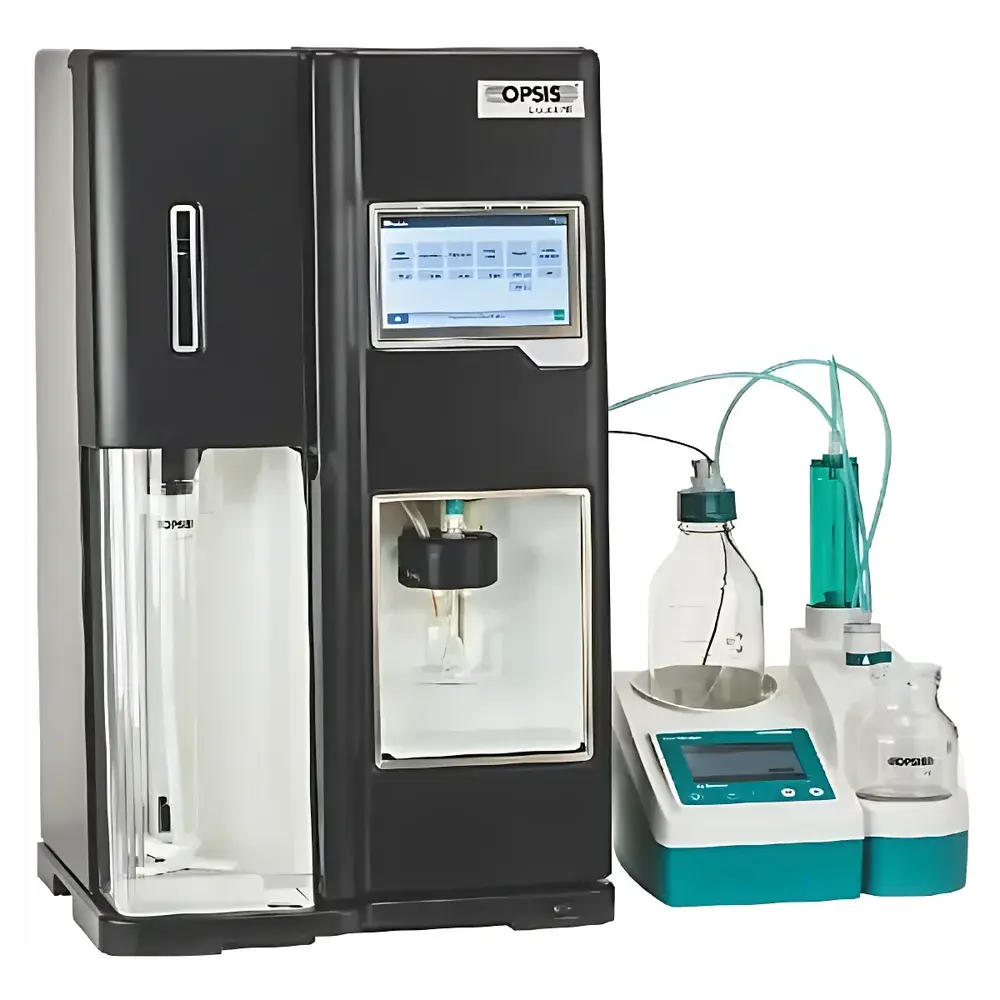
OPSIS KD-210 Automated Kjeldahl Nitrogen Determinator with Potentiometric Titration
| Brand | OPSEUS / OPISIS |
|---|---|
| Origin | Sweden |
| Manufacturer Status | Authorized Distributor |
| Origin Category | Imported |
| Model | KD-210 |
| Instrument Type | Potentiometric Titration-Based Kjeldahl System |
| Automation Level | Semi-Automated Kjeldahl Distillation Unit |
| Nitrogen Range | 0.05–240 mg N per sample |
| Distillation Time | 2–4 min/sample |
| Repeatability | RSD ≤ ±0.5% |
| Sample Weight Capacity | ≤5 g (solid) or ≤20 mL (liquid) |
| Recovery Rate | ≥99.5% |
| Power Consumption | 2200 W |
| Dimensions (L×W×H) | 430 mm × 330 mm × 700 mm |
Overview
The OPISIS KD-210 is a microprocessor-controlled semi-automated Kjeldahl nitrogen determinator engineered for precision, safety, and method flexibility in regulated laboratory environments. It implements the classical Kjeldahl digestion–distillation–titration workflow, where nitrogen-bound organic compounds are first mineralized via sulfuric acid digestion (performed off-instrument), followed by alkaline distillation to liberate ammonia, which is then quantified via potentiometric titration. Unlike fully integrated systems, the KD-210 focuses on high-fidelity, programmable distillation control and seamless interoperability with third-party potentiometric titrators—enabling laboratories to retain existing titration platforms while upgrading distillation performance. Its core architecture centers on an integrated steam generator capable of delivering 100 mL of saturated steam within 3 minutes, supporting rapid, reproducible distillation of up to 30 mg N in ≤3.5 minutes. All critical fluid handling—including alkali addition, boric acid dosing, dilution water delivery, waste ejection, and receiver cup rinsing—is pneumatically actuated and software-scheduled, minimizing manual intervention and operator variability.
Key Features
- Programmable distillation parameters: steam flow (10–100% adjustable), delay time (0–99 min or continuous), and distillation duration—optimized per sample matrix and nitrogen load.
- Integrated high-efficiency steam generator with overtemperature and overpressure protection; no routine descaling or maintenance required.
- Multi-stage safety system: real-time monitoring of digestion tube presence, safety door closure, cooling water flow, and steam generator thermal status—with automatic shutdown and visual/audible alerts on the 7-inch color touchscreen.
- Universal conical joint design accommodates digestion tubes from standard 100 mL to large-capacity 750 mL vessels, ensuring compatibility across diverse digestion workflows.
- Multi-level user access control (operator, supervisor, service technician) with password-protected configuration changes and audit-trail-enabled parameter modifications.
- Built-in data traceability framework compliant with GLP principles: timestamps, user IDs, method names, and instrument events are embedded in each result file.
Sample Compatibility & Compliance
The KD-210 accepts solid samples up to 5 g and liquid samples up to 20 mL, covering common matrices including foodstuffs, feedstuffs, fertilizers, soil extracts, and pharmaceutical intermediates. Its ≥99.5% nitrogen recovery rate and ≤±0.5% RSD meet the repeatability requirements specified in ISO 8968-1 (milk), AOAC 981.10 (cereals), and ASTM D5133 (petroleum products). The system supports full compliance with GLP documentation standards through timestamped electronic records and configurable export protocols (FTP/Wi-Fi). While not a standalone titrator, its RS-232/USB interface ensures deterministic handshake and result forwarding to certified potentiometric titrators (e.g., Metrohm, Hanna, Thermo Scientific), enabling end-to-end 21 CFR Part 11–ready workflows when paired with validated titration software.
Software & Data Management
The KD-210 runs on an embedded Linux-based OS with a responsive 7-inch capacitive touchscreen interface. Operation language options include English, Swedish, Danish, and Chinese—facilitating multinational lab deployment. Method files store complete distillation profiles (steam ramp, hold time, reagent volumes) and are version-controlled with checksum validation. All measurement metadata—including sample ID, operator ID, date/time stamp, distillation duration, steam volume, and final titrant consumption—is exported as CSV or XML via FTP or local USB storage. Wireless connectivity enables remote diagnostics and firmware updates without physical access. For labs requiring full automation, the KD-210 can be upgraded to the KD-310 configuration, integrating a built-in photometric color endpoint detector and eliminating external titrator dependency.
Applications
- Quality control of protein content in dairy, meat, and plant-based foods (calculated as N × conversion factor).
- Regulatory testing of nitrogen fertilizer efficacy and urea content in agricultural inputs.
- Environmental analysis of total Kjeldahl nitrogen (TKN) in wastewater and sludge digestates.
- Pharmaceutical raw material verification per USP Chapter 467 and EP 2.5.22.
- Research applications requiring method development flexibility—e.g., low-N botanicals or high-fat samples where steam modulation prevents bumping or carryover.
FAQ
Does the KD-210 include a built-in titrator?
No—the KD-210 is a dedicated distillation module designed for integration with external potentiometric titrators. It outputs titrant volume data directly to compatible instruments via standardized serial protocols.
Can it be used with colorimetric titration methods?
Not natively—but the system is field-upgradable to the KD-310 configuration, which adds an integrated photometric detector and color endpoint recognition.
Is cooling water flow monitored continuously?
Yes—integrated flow sensor feedback triggers immediate alarm and distillation halt if cooling water pressure falls below threshold, preventing condenser dry-out and ammonia loss.
What safety certifications does the KD-210 hold?
It complies with IEC 61010-1 (Safety Requirements for Electrical Equipment for Measurement, Control, and Laboratory Use) and carries CE marking for the European Economic Area.
How is method validation supported?
Each run logs all critical process variables (steam temperature, pressure, timing, reagent volumes) alongside results—enabling full retrospective validation per ISO/IEC 17025 and FDA guidance on analytical instrument qualification.
Related Products





