
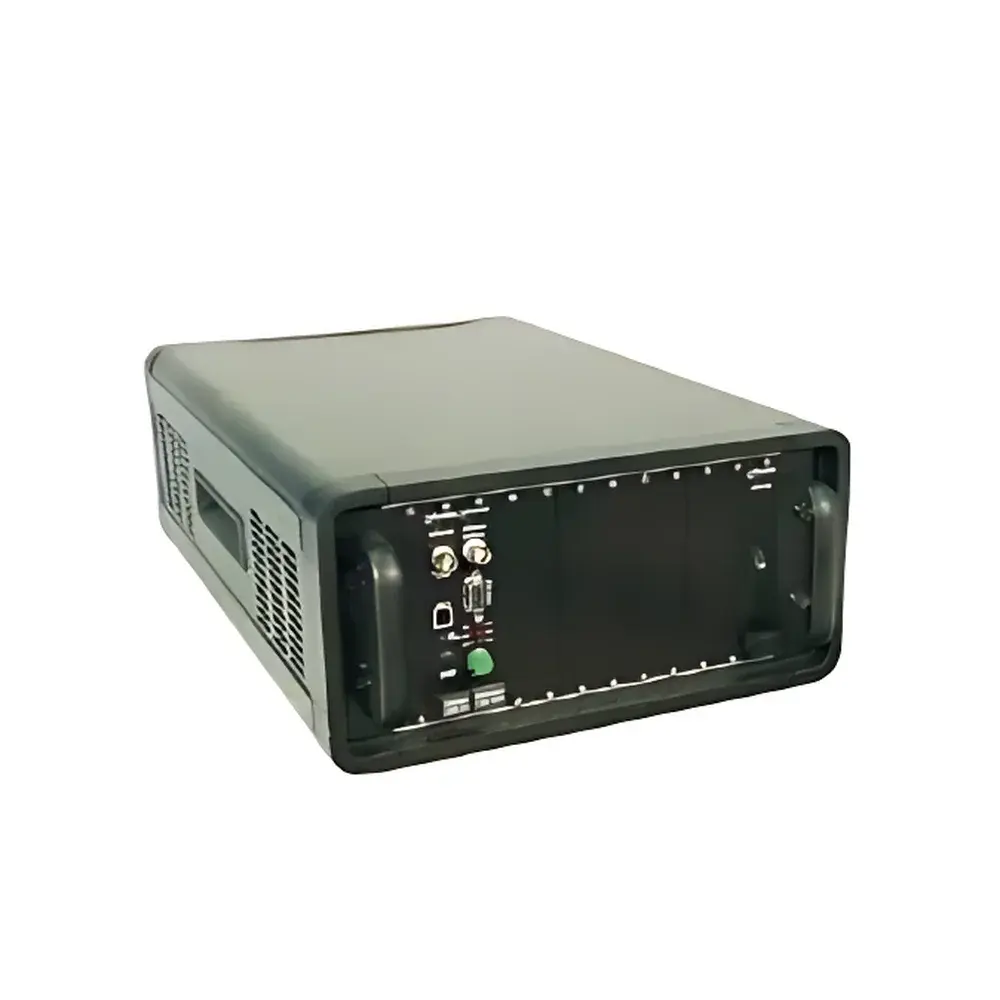
Optiphase OPD-4000 Optical Phase Demodulator
| Brand | Optiphase |
|---|---|
| Origin | USA |
| Model | OPD-4000 |
| Resolution | 6 µrad |
| Output Format | 32-bit digital, ±2000 fringes range |
| Modulation Frequency | Adjustable |
| Output Options | Digital and analog with selectable high-pass filtering |
| Data Processing | Optional averaging |
| Control Mode | Servo control (selectable on/off) |
| Receiver Configuration | Polarization-diverse receiver (optional) |
| Integrated Photoreceiver | Yes |
| Interface | USB 2.0 |
| Software | PhaseView™ |
Overview
The Optiphase OPD-4000 Optical Phase Demodulator is a precision interferometric signal processing instrument engineered for high-fidelity extraction of phase information from optical interferograms. It operates on the principle of homodyne or heterodyne phase demodulation—digitally reconstructing the instantaneous optical phase shift induced by dynamic perturbations in fiber-optic or free-space interferometric sensing systems. Designed for demanding applications in metrology, structural health monitoring, acoustic emission detection, and distributed fiber sensing (e.g., φ-OTDR, interferometric fiber hydrophones), the OPD-4000 delivers deterministic phase recovery with sub-microradian resolution and real-time latency under 100 µs. Its architecture integrates a low-noise, wide-dynamic-range photoreceiver with a field-programmable gate array (FPGA)-based digital signal processor, enabling adaptive demodulation algorithms without reliance on analog feedback loops.
Key Features
- True all-digital phase demodulation architecture eliminating analog drift and thermal hysteresis
- Phase resolution of 6 µrad RMS over full ±2000-fringe range (equivalent to ~1.2 nm optical path difference at 1550 nm)
- 32-bit signed integer output with linear scaling, supporting both absolute phase tracking and differential phase change measurement
- User-configurable modulation frequency—supports carrier frequencies from DC to >1 MHz for compatibility with external phase modulators or intrinsic sensor dynamics
- Selectively enabled high-pass filtering (digital and analog paths) to suppress low-frequency noise and DC offset while preserving signal bandwidth
- On-device data averaging (moving window or block-based) to enhance SNR in low-light or vibration-prone environments
- Optional servo-control mode for closed-loop phase stabilization; configurable as open-loop demodulator when static or quasi-static phase tracking is required
- Polarization-diverse reception option mitigates polarization-induced signal fading in single-mode fiber systems
- Integrated balanced photoreceiver with transimpedance gain optimization for 1310 nm and 1550 nm operation
- USB 2.0 interface compliant with USB CDC ACM class—enables plug-and-play integration with Windows, Linux, and real-time OS platforms
Sample Compatibility & Compliance
The OPD-4000 interfaces directly with Michelson, Mach–Zehnder, Sagnac, and Fabry–Pérot interferometric configurations. It accepts input signals from single-mode or polarization-maintaining fiber pigtails (FC/APC or FC/PC), with typical input power range of −20 dBm to +3 dBm. The device complies with IEC 61326-1:2013 for electromagnetic compatibility in laboratory and industrial environments. While not certified for medical or aerospace safety standards, its firmware and hardware design support traceable calibration procedures aligned with ISO/IEC 17025 requirements for testing laboratories. All internal clocking and ADC references are temperature-compensated, ensuring stability across ambient operating conditions of 15–35 °C.
Software & Data Management
PhaseView™ software provides native support for real-time visualization, parameter configuration, and data logging. It implements time-synchronized multi-channel acquisition (up to four OPD-4000 units via USB hub), supports HDF5 and CSV export with metadata embedding (timestamp, gain setting, filter status), and enables script-driven automation via Python API (pyOPD). Audit-trail functionality logs all configuration changes with user ID and timestamp—facilitating GLP-compliant documentation. The software is validated for use in regulated environments where FDA 21 CFR Part 11 electronic record requirements apply, including electronic signatures, role-based access control, and immutable log archiving.
Applications
- Fiber-optic acoustic sensors (FOAS) for seismic and underwater acoustics
- High-resolution displacement and vibration metrology in MEMS characterization
- Dynamic strain monitoring in composite materials using interferometric fiber Bragg grating arrays
- Phase-resolved optical coherence tomography (OCT) system front-ends
- Stabilization of narrow-linewidth lasers via Pound–Drever–Hall error signal generation
- Calibration reference for phase-modulated LIDAR and coherent detection systems
FAQ
What interferometer topologies are supported by the OPD-4000?
The OPD-4000 is topology-agnostic and compatible with any two-beam interferometer producing sinusoidal intensity modulation—including Michelson, Mach–Zehnder, and unbalanced Sagnac configurations.
Is the 6 µrad resolution achievable across the entire ±2000-fringe range?
Yes—the resolution is maintained uniformly due to FPGA-based arctangent calculation with oversampled quadrature inputs and correction for nonlinearity in the photoreceiver transfer function.
Can multiple OPD-4000 units be synchronized?
Yes—via external TTL trigger input and programmable delay compensation in PhaseView™, enabling sub-microsecond inter-unit timing alignment.
Does the device support real-time streaming to third-party DAQ systems?
Yes—through USB CDC serial interface with fixed-packet framing; drivers and LabVIEW/ViLib examples are provided in the SDK.
Is PhaseView™ software validated for GMP environments?
Validation documentation (IQ/OQ protocols, test reports) is available upon request for customers operating under pharmaceutical or biotech quality systems.





