
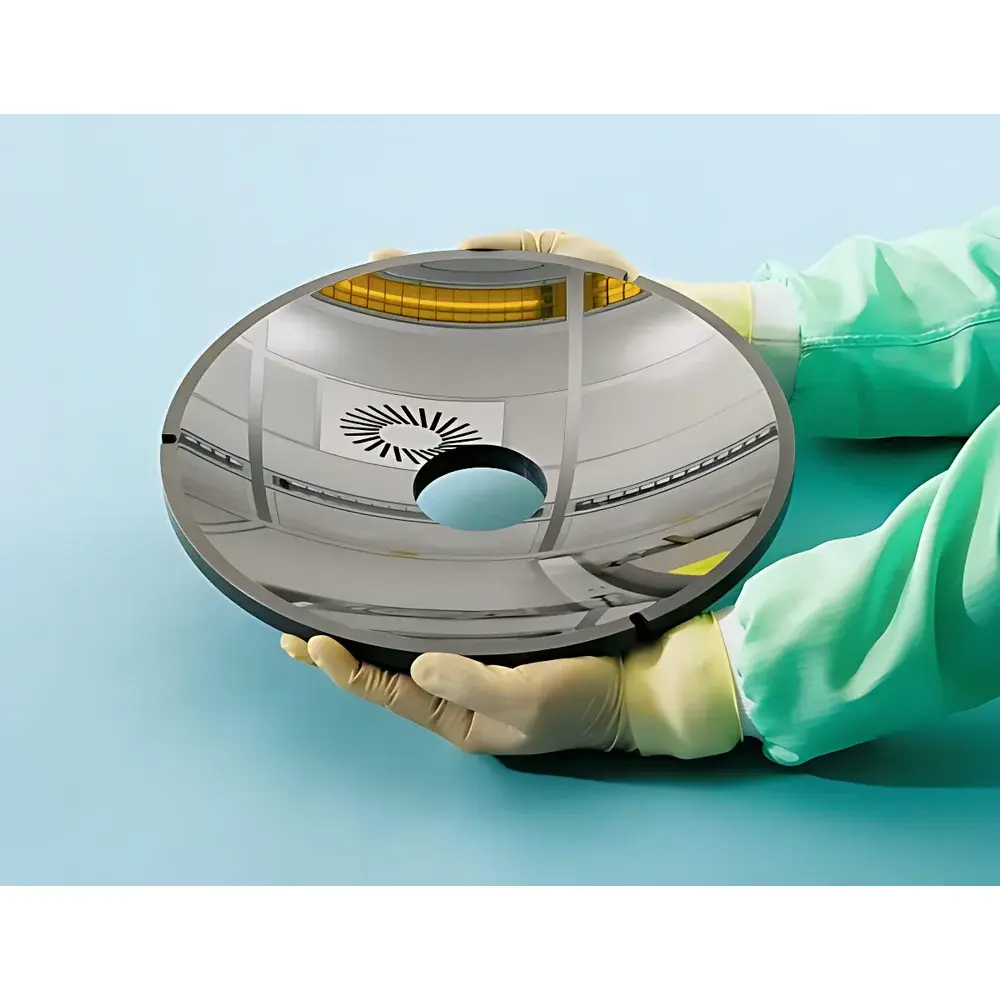
optiXfab 13.5 nm EUV Multilayer Collection Mirror
| Brand | optiXfab |
|---|---|
| Origin | Germany |
| Manufacturer Type | Authorized Distributor |
| Product Category | Optical Component |
| Component Diameter Options | Up to 700 mm |
| Coating Material | Mo/Si Multilayer |
| Central Wavelength | 13.5 nm |
| Application | EUV Light Collection for Laser-Driven Plasma & HHG Sources |
| Reflectivity (Peak, at 13.5 nm, near-normal incidence) | >65% (as-measured, post-coating) |
| Thermal Stability | Engineered for high-heat-load operation in plasma-based EUV environments |
| Serviceability | Refurbishment available for carbon-contaminated optics |
Overview
The optiXfab 13.5 nm EUV Multilayer Collection Mirror is a precision optical component engineered for high-efficiency photon capture from laser-driven plasma and high-harmonic generation (HHG) extreme ultraviolet (EUV) sources. Operating at the industry-standard 13.5 nm wavelength—aligned with the Si/Mo multilayer Bragg reflection peak—it leverages patented thin-film deposition technology originally developed at Fraunhofer IOF and commercialized by optiXfab since 2012. Unlike broadband reflective optics, this mirror employs a precisely engineered Mo/Si periodic multilayer stack (typically 40–60 bilayers), optimized via dynamical diffraction modeling to maximize reflectance under near-normal incidence conditions (5°–15°). Its design addresses the fundamental challenge of low intrinsic EUV photon flux: by enabling large solid-angle collection (up to ~1.5 sr for 700 mm aperture configurations), it significantly improves signal-to-noise ratio in metrology, actinic mask inspection, and coherent diffractive imaging setups. The substrate material—typically low-expansion ULE® or Zerodur®—is selected for dimensional stability under thermal transients induced by pulsed plasma emission.
Key Features
- High peak reflectance (>65% at 13.5 nm, measured at 9° incidence) enabled by ion-beam-sputtered Mo/Si multilayer architecture with sub-nanometer interfacial roughness control
- Scalable aperture up to 700 mm diameter, supporting wide-collection-angle Schwarzschild-type and ellipsoidal collector geometries
- Thermally robust design validated for operation under repetitive nanosecond-scale EUV plasma pulses (fluence tolerance >10 J/cm² per pulse at 13.5 nm)
- Customizable substrate curvature (spherical, aspheric, or off-axis parabolic) and surface figure error (λ/10 PV typical, λ/20 optional)
- Refurbishment service available: in-house carbon contamination removal and re-coating with traceable process documentation and post-refurbish reflectance verification
- Compliant with ISO 10110-7 surface quality standards; scratch-dig specification ≤ 10-5 per MIL-PRF-13830B
Sample Compatibility & Compliance
This collection mirror is compatible with laboratory-scale EUV sources including laser-produced plasma (LPP) systems (e.g., Nd:YAG-driven Sn or Xe targets), gas-puff Z-pinch devices, and tabletop HHG sources driven by Ti:sapphire or Yb-based femtosecond amplifiers. It integrates seamlessly into vacuum environments down to 1×10⁻⁷ mbar and accommodates standard CF-100 or ISO-K 250 flange mounting. All coatings are deposited under ultra-high-vacuum (UHV) conditions (<5×10⁻⁸ mbar) to minimize oxygen incorporation and interdiffusion at Mo/Si interfaces—critical for long-term reflectance stability. The manufacturing process adheres to ISO 9001:2015 quality management protocols, and coating uniformity is verified via synchrotron-based reflectometry at BESSY II (Helmholtz-Zentrum Berlin). Documentation includes full spectral reflectance curves (12–15 nm range), surface topography maps (measured via phase-shifting interferometry), and batch-specific certification reports.
Software & Data Management
While the mirror itself is a passive optical element, optiXfab provides comprehensive metrological support through its EUV Optics Characterization Portal—a secure web interface granting authorized users access to calibrated reflectance datasets, surface error maps, and thermal deformation simulations (ANSYS-based, assuming 10 W average power loading). All measurement data conforms to ASTM E2750–19 (Standard Practice for Spectral Reflectance Measurements of EUV Optics) and includes uncertainty budgets per GUM (JCGM 100:2008). For integration into automated beamline control systems, optiXfab supplies machine-readable metadata (JSON-LD format) compliant with the FAIR principles (Findable, Accessible, Interoperable, Reusable), facilitating traceability in GLP-compliant research environments.
Applications
- Actinic photomask inspection systems requiring high-throughput in-band EUV collection
- Compact EUV interferometers and ptychographic microscopes utilizing tabletop HHG sources
- Plasma diagnostics: time-resolved spectral filtering and radiometric calibration of LPP sources
- Development of next-generation EUV lithography source collectors (R&D stage)
- Attosecond science beamlines where high collection efficiency directly impacts harmonic yield quantification
FAQ
What is the typical turnaround time for custom mirror fabrication?
Standard lead time for mirrors up to 300 mm diameter is 12–14 weeks from order confirmation; larger apertures (500–700 mm) require 20–24 weeks due to extended coating and metrology cycles.
Do you provide mounting hardware or kinematic mounts?
Yes—custom-designed UHV-compatible kinematic mounts (three-point flexure or piezo-actuated tip/tilt) are available upon request, with thermal expansion matching verified for <±50 µrad drift over 20–30 °C ambient variation.
Can this mirror be used at grazing incidence?
No—this optic is optimized for near-normal incidence (5°–15°). For grazing-incidence applications (>45°), optiXfab offers separate Ru/B4C or Ni/C multilayer designs with distinct layer count and interface engineering.
Is refurbishment included in the warranty?
Refurbishment is a billable service; however, all new mirrors include a 24-month limited warranty covering coating delamination and substrate fracture under specified operational conditions.
How is contamination resistance validated?
Accelerated carbon deposition testing is performed using EUV-induced hydrocarbon cracking in controlled CH4/H2 atmospheres, followed by reflectance monitoring over 100-hour equivalent exposure—results are reported in the Certificate of Conformance.





