
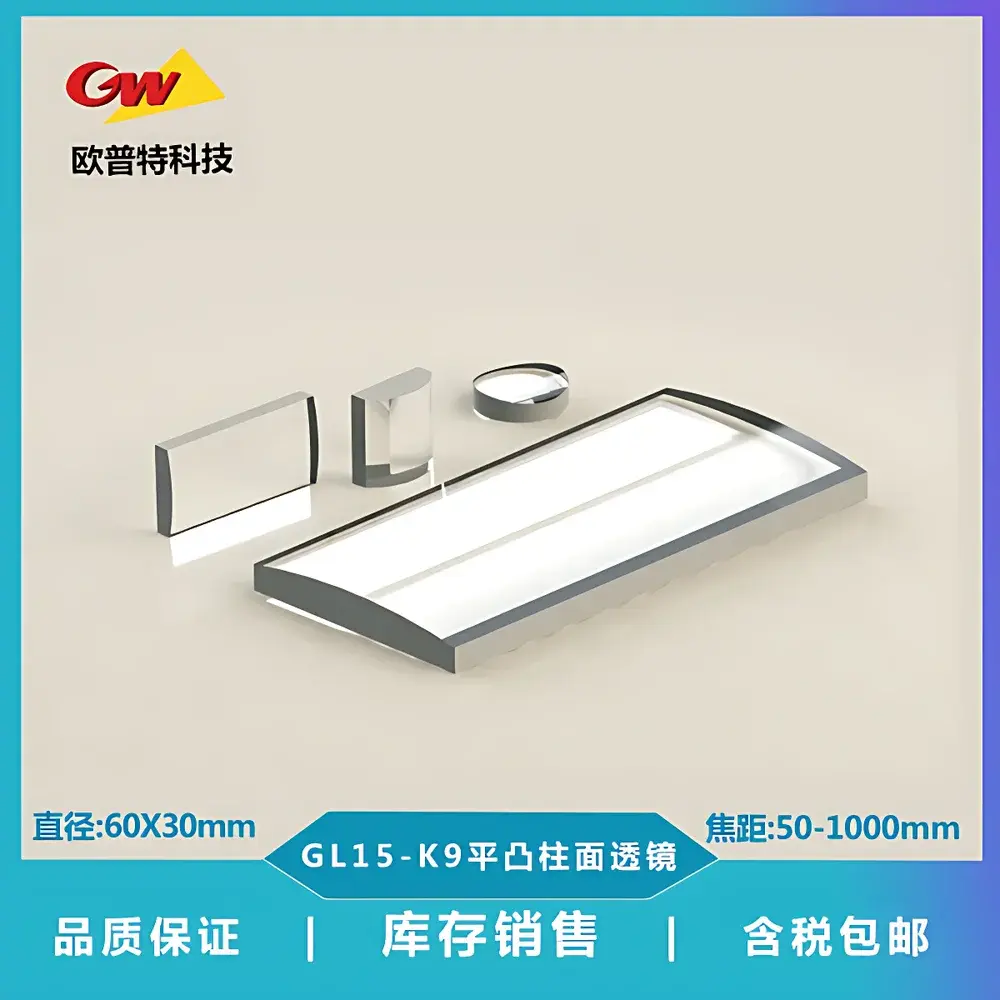
Optoprecision GL15 K9 Plano-Convex Cylindrical Lens – Broadband AR-Coated for VIS, NIR & SWIR
| Origin | Beijing, China |
|---|---|
| Manufacturer Type | Authorized Distributor |
| Regional Origin | Domestic (PRC) |
| Model | GL15 |
| Component Category | Optical Element |
| Price Range | USD 0.15–75.00 (unit price varies by size, focal length, and coating) |
Overview
The Optoprecision GL15 K9 Plano-Convex Cylindrical Lens is a precision-engineered optical component designed for beam shaping, line generation, anamorphic imaging, and aspect ratio correction in demanding photonic systems. Unlike spherical lenses, cylindrical lenses possess curvature along only one axis—here, the convex surface—while the orthogonal axis remains planar. This geometry enables focusing of incident light into a line rather than a point, making the GL15 series indispensable in laser scanning, spectroscopic slit illumination, optical metrology, and structured light projection. Fabricated from homogenously annealed K9 borosilicate crown glass (Schott BK7 equivalent), the lens exhibits excellent transmission across the visible spectrum (350–700 nm), extended near-infrared (650–1050 nm), and short-wave infrared (1000–1650 nm) bands when specified with appropriate anti-reflection coatings. Each lens is optimized for minimal wavefront distortion and high surface fidelity, conforming to ISO 10110-7 standards for surface quality and centration.
Key Features
- Optical substrate: Precision-annealed K9 optical glass (refractive index nd = 1.5163 @ 587.6 nm; Abbe number νd = 64.2)
- Geometry: Plano-convex cylindrical profile with positive effective focal length (EFL), defined along the curved axis
- Focal tolerance: ±2% EFL, verified via interferometric collimation testing at design wavelength (587.6 nm)
- Dimensional accuracy: Clear aperture tolerance +0.0 / −0.1 mm; center thickness tolerance ±0.2 mm
- Surface quality: 3–4 scratch-dig per MIL-PRF-13830B; surface flatness λ/4 @ 633 nm (planar side); surface figure λ/2 PV (convex side)
- Centration error: ≤ 3–5 arcminutes, measured via autocollimation
- Edge treatment: 0.2 mm × 45° protective chamfer on all perimeters
- Coating options: Uncoated, or broadband dielectric AR coatings optimized for VIS (400–700 nm), NIR (650–1050 nm), or SWIR (1000–1650 nm) spectral ranges; average R < 0.5% per surface
Sample Compatibility & Compliance
The GL15 series supports integration into both free-space and fiber-coupled optical architectures. Its standardized dimensions—including rectangular apertures (e.g., 5.0 × 5.0 mm, 20.0 × 20.0 mm) and circular variants (Ø12.5 mm, Ø25.0 mm)—facilitate mounting in standard lens holders, kinematic mounts, and OEM optomechanical assemblies. All lenses comply with RoHS Directive 2011/65/EU and are manufactured under controlled cleanroom conditions (ISO Class 7). While not certified to ISO 9001 or IATF 16949 at the component level, production adheres to traceable process controls aligned with ISO 10110-1 (drawing specification) and ISO 10110-3 (surface imperfections). No hazardous substances are introduced during coating deposition (ion-assisted e-beam evaporation).
Software & Data Management
As a passive optical element, the GL15 lens does not incorporate embedded firmware or digital interfaces. However, full optical prescription data—including radius of curvature (R₁), effective focal length (EFL), back focal length (BFL), center thickness (Tc), edge thickness (Te), and coating spectral reflectance curves—is provided in tabular and CSV format upon request. Zemax-compatible .ZMX files (including sequential and non-sequential models) are available for licensed users. All product identifiers (e.g., GL15-20×20-100-VIS) follow a deterministic nomenclature encoding aperture (X×Y or Ø), EFL, and coating type—enabling unambiguous specification in bill-of-materials (BOM) documentation and automated procurement systems.
Applications
- Laser line generation for machine vision inspection, triangulation sensors, and confocal microscopy illumination
- Anamorphic beam expansion or compression in ultrafast laser systems (e.g., Ti:sapphire oscillator output conditioning)
- Slit illumination in monochromators, spectrometers, and Fourier-transform infrared (FTIR) instruments
- Optical character recognition (OCR) and barcode scanning optics requiring asymmetric magnification
- Thermal imaging optics in uncooled microbolometer arrays operating in SWIR band (1.0–1.65 µm)
- Educational laboratory setups for demonstrating cylindrical aberration, astigmatism, and orthographic projection principles
FAQ
What is the damage threshold for GL15 lenses under CW laser irradiation?
For uncoated K9 substrates, the typical bulk laser-induced damage threshold (LIDT) is ≥ 5 J/cm² at 1064 nm, 10 ns pulse width, 10 Hz repetition rate. With VIS/NIR/SWIR AR coatings, LIDT is reduced to 2–3 J/cm² due to thin-film absorption; exact values depend on coating design and beam profile. Continuous-wave (CW) thresholds scale linearly with spot size and inversely with absorption coefficient.
Can GL15 lenses be used in vacuum or high-humidity environments?
Yes—K9 glass is chemically stable and non-hygroscopic. AR coatings are dense, ion-assisted films with low water absorption (< 0.1% mass gain after 24 h at 85% RH). For ultra-high vacuum (UHV) applications (<10⁻⁷ mbar), outgassing data (TML < 0.5%, CVCM < 0.05%) is available upon request.
Is custom focal length or coating design available?
Yes. Optoprecision offers OEM customization including non-standard EFLs, hybrid coatings (e.g., VIS+NIR dual-band), and substrate alternatives (e.g., fused silica for UV or high-power applications). Minimum order quantities apply; lead time is typically 4–6 weeks.
How is centration error measured and guaranteed?
Centration is verified using a high-resolution autocollimator (resolution 0.5 arcsec) referenced to the mechanical cylinder axis. The angular deviation between optical and mechanical axes is reported as “centration error” and conforms to ≤ 5 arcmin for standard grades. Tighter tolerances (≤ 1 arcmin) are available under GL15-CT designation.
Do you provide test reports or certification for individual lenses?
Standard shipments include a Certificate of Conformance (CoC) listing batch-level metrology results. Full individual lens test reports—including interferometric surface figure maps and spectral reflectance scans—are available as a value-added service (additional fee applies).




