
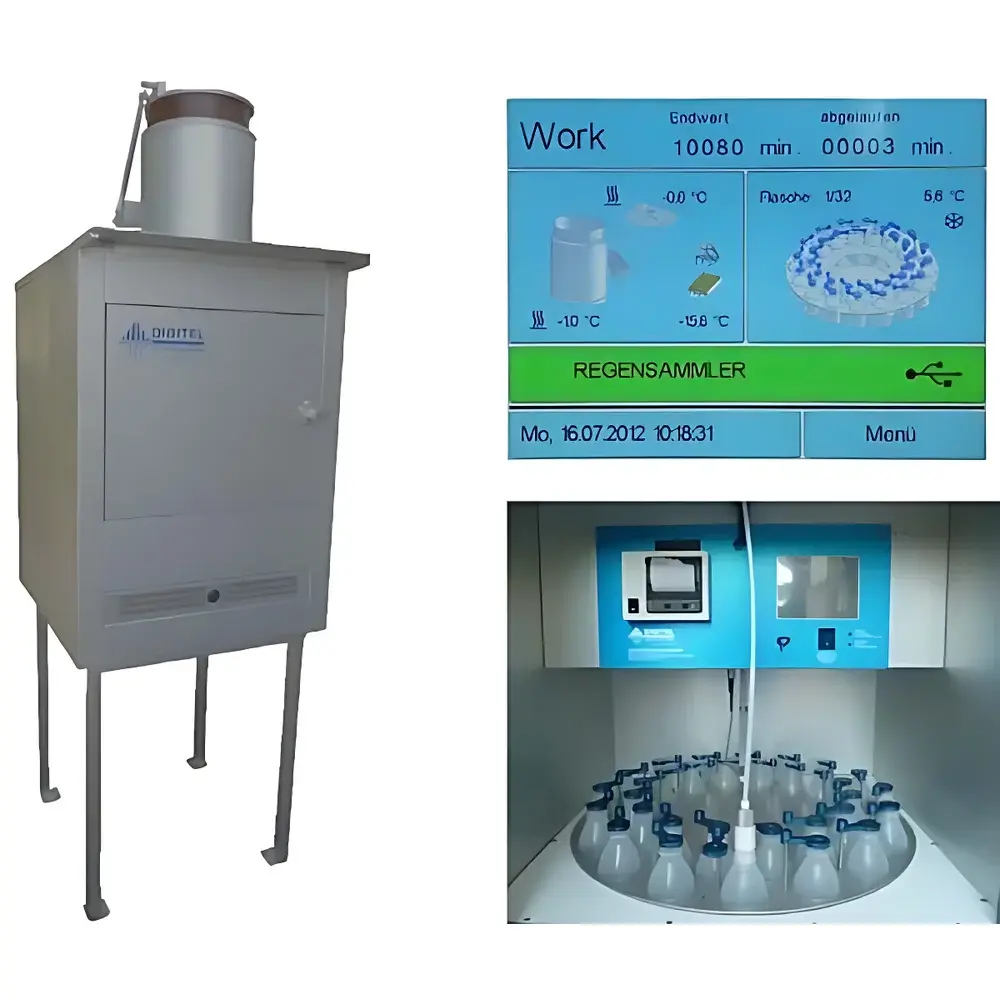
Digitel DRA-12 Wet-Only Atmospheric Deposition Sampler
| Brand | Digitel |
|---|---|
| Origin | Switzerland |
| Model | DRA-12 |
| Sampling Principle | Precipitation-Triggered Sequential Wet-Deposition Collection |
| Bottle Capacity | 32 × 250 mL PTFE-Coated Polyethylene Vials |
| Bottle Exchange | Automatic, Level-Sensing Actuated |
| Contact Materials | Fully PTFE-encapsulated Wet Path |
| Temperature Control | Integrated Heating/Cooling of Lid, Funnel, and Roof Assembly |
| Environmental Sensors | Radiation-Shielded Ambient Temperature Sensor |
| Control System | Onboard Microprocessor with Real-Time Clock & Programmable Logic |
| Interface | RS-232C, Modem, Wireless Modem Support |
| Compliance Ready | Designed for ISO 9060:2018 (Solar Radiation), ASTM D5475-21 (Atmospheric Deposition Sampling), and EU Directive 2004/107/EC (Heavy Metals in Air) |
Overview
The Digitel DRA-12 Wet-Only Atmospheric Deposition Sampler is a field-deployable, microprocessor-controlled instrument engineered for the automated, selective collection of wet deposition events—rain, snowmelt, and fog drip—while excluding dry particulate fallout. It operates on a precipitation-triggered sampling logic: integrated rain sensors initiate collection only upon confirmed liquid or melting-phase precipitation onset, ensuring strict adherence to “wet-only” protocols mandated by international atmospheric chemistry monitoring networks (e.g., EMEP, GAW, NADP). The system’s core architecture follows the dual-chamber funnel design with programmable closure timing, enabling precise control over sedimentation duration within the sealed collection funnel—a critical parameter for minimizing post-capture chemical alteration (e.g., volatilization of NH₃, oxidation of SO₂-derived sulfite). Its fully PTFE-encapsulated wet path eliminates metal leaching and adsorptive losses, preserving sample integrity for subsequent ion chromatography (IC), ICP-MS, and trace element analysis.
Key Features
- Automated sequential vial exchange driven by capacitive liquid-level detection across all 32 × 250 mL PTFE-lined polyethylene bottles—no mechanical contact with sample fluid ensures zero cross-contamination.
- Climate-resilient thermal management: radiation-shielded ambient temperature sensor feeds real-time data to a closed-loop PID controller that activates heating elements on the lid, cutting head, and roof assembly below 2 °C, preventing ice accumulation and funnel clogging during freezing rain or snowmelt events.
- Programmable sedimentation time (1–120 minutes) within the sealed funnel chamber—enables standardized settling of coarse aerosols prior to transfer, improving reproducibility in suspended solids quantification per ISO 11926.
- Integrated LCD display and membrane keypad allow full on-site configuration of sampling schedules, trigger thresholds, heating profiles, and diagnostic logs without external software.
- RS-232C serial interface supports direct connection to data loggers or SCADA systems; optional modem and wireless modem modules enable remote status reporting, firmware updates, and event-triggered alerting via SMS or email.
- Self-diagnostics include motor current monitoring, vial position verification, heater continuity checks, and clock synchronization validation—all logged with timestamps for GLP-compliant audit trails.
Sample Compatibility & Compliance
The DRA-12 is validated for collection of acidic and alkaline precipitation matrices (pH 2.5–8.5), including high-ionic-strength marine-influenced rain and low-conductivity continental snowmelt. All fluid-contact surfaces—including funnel interior, transfer tubing, and bottle caps—are coated with medical-grade PTFE (≥99.9% purity, per ASTM D4894), eliminating catalytic surface reactions and minimizing adsorption of transition metals (e.g., Cu²⁺, Zn²⁺), anions (NO₃⁻, Cl⁻), and organic acids (formic, acetic). The system meets structural and operational requirements of ISO/IEC 17025:2017 for environmental testing laboratories and supports full traceability under EU Regulation (EU) 2016/425 for personal protective equipment used in field deployment. Its thermal and electrical design complies with IEC 60529 IP55 ingress protection rating for outdoor operation in heavy rain and dust environments.
Software & Data Management
Onboard firmware (v3.2+) implements non-volatile memory logging of 10,000+ timestamped events—including precipitation start/stop, vial change, heater activation cycles, temperature excursions, and error codes—with automatic rollover and CRC-32 checksum validation. Data export is supported via ASCII-formatted CSV files through RS-232 or USB-to-serial adapter. Digitel’s optional DepoSoft™ desktop application (Windows 10/11, 64-bit) enables batch calibration of rain sensors, graphical visualization of multi-event temporal patterns, and automated report generation compliant with EMEP Form 1A and US EPA Form 102 templates. Audit trail functionality satisfies FDA 21 CFR Part 11 requirements for electronic records, including user authentication, electronic signatures, and immutable log archiving.
Applications
- Long-term trend analysis of acid deposition (SO₄²⁻, NO₃⁻, NH₄⁺) in national monitoring networks (e.g., Canadian Air and Precipitation Monitoring Network, CAPMoN).
- Source apportionment studies using isotopic tracers (δ³⁴S, ⁸⁷Sr/⁸⁶Sr) requiring ultra-low blank contamination from collector surfaces.
- Validation of regional chemical transport models (e.g., CMAQ, LOTOS-EUROS) through high-temporal-resolution wet-only flux measurements.
- Monitoring of atmospheric heavy metal deposition (Pb, Cd, As) near industrial zones, adhering to EU Directive 2004/107/EC limit values and sampling frequency mandates.
- Arctic and alpine research stations where autonomous winter operation and freeze-thaw resilience are essential for uninterrupted data continuity.
FAQ
How does the DRA-12 distinguish between wet and dry deposition events?
It uses a dual-sensor precipitation detector (capacitive + optical) that responds only to sustained liquid water presence on the sensing surface for ≥30 seconds—rejecting dew, frost, and wind-blown dust that fail this temporal threshold.
Can the DRA-12 be operated unattended for extended periods?
Yes—field deployments exceeding 12 months are routinely achieved with annual maintenance (PTFE seal inspection, battery replacement, sensor recalibration); internal lithium-thionyl chloride clock battery retains time/date for >10 years.
Is the system compatible with existing networked environmental monitoring infrastructure?
Fully interoperable via Modbus RTU over RS-232 or TCP/IP gateway; preconfigured drivers available for Campbell Scientific CR1000X, Siemens Desigo CC, and ABB Ability™ platforms.
What is the maximum allowable ambient operating temperature range?
−30 °C to +50 °C, verified per IEC 60068-2-1 (cold) and IEC 60068-2-2 (dry heat) test standards.
Does Digitel provide calibration services traceable to national metrology institutes?
Yes—NIST-traceable rain sensor calibration and temperature probe certification are offered annually through Digitel’s accredited service lab (ISO/IEC 17025:2017 certified, DAkkS No. D-K-17025-0025).







