
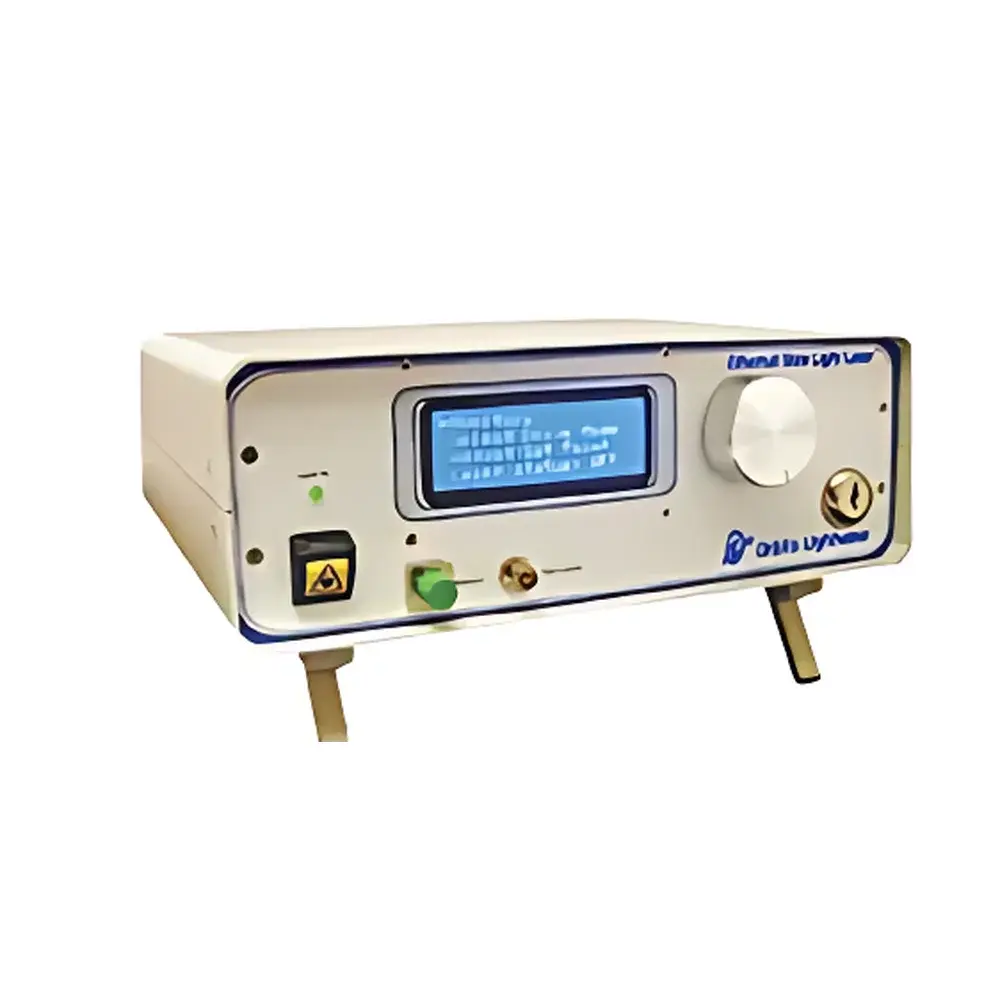
Orbits Lightwave Eternal™ & SlowLight™ Fiber Laser System
| Origin | USA |
|---|---|
| Manufacturer Type | Authorized Distributor |
| Origin Category | Imported |
| Model | INST Laser Instrument |
| Price | Upon Request |
| Core Components | Semiconductor-based Fiber Laser Module |
Overview
The Orbits Lightwave Eternal™ and SlowLight™ Fiber Laser System represents a paradigm shift in ultra-low-noise, narrow-linewidth laser source design for precision photonic applications. Engineered around Orbits’ proprietary “virtual ring” cavity architecture—a linear physical configuration that supports traveling-wave oscillation without physical loop closure—the system eliminates traditional resonator instability mechanisms associated with mechanical stress and thermal drift. This breakthrough enables exceptional coherence properties: sub-1 Hz Lorentzian linewidth, frequency stability of ±0.25 MHz/°C, and integrated RMS power fluctuation below ±0.1% over 24 hours. The SlowLight™ technology actively reduces group velocity within the gain fiber, suppressing both amplitude (AM) and frequency (FM) noise to levels approaching the quantum limit. As a result, the laser achieves record-breaking optical signal-to-noise ratio (>90 dBc @ 50 pm RBW) and side-mode suppression ratio (>75 dBc @ 3 MHz RBW), making it suitable for demanding interferometric, metrological, and coherent detection environments where phase integrity is non-negotiable.
Key Features
- Fully fiber-integrated virtual-ring SlowLight™ oscillator architecture with no free-space alignment or active cavity locking
- StableLase™ passive packaging technology providing shock and vibration immunity (tested per MIL-STD-810G, Method 514.6)
- Output power up to 350 mW from single oscillator; scalable to 500 mW via optional booster amplifier stage
- Lorentzian linewidth 10 km delay line)
- Integrated linewidth < 200 Hz over 1 ms measurement window (fast Fourier transform–based analysis)
- Relative intensity noise (RIN) of –175 dBc/Hz at 100 MHz (at 100 mW output), exceeding shot-noise floor
- Frequency noise spectral density: < 30 Hz/√Hz @ 100 Hz, < 20 Hz/√Hz @ 1 kHz, < 1 Hz/√Hz @ 100 kHz
- Passive temperature compensation combined with low-thermal-expansion packaging ensures long-term wavelength anchoring
- Polarization-maintaining (PANDA-type) PM fiber output with PER > 23 dB; standard FC/APC connectorization
Sample Compatibility & Compliance
This laser system is compatible with standard single-mode and polarization-maintaining fiber infrastructures used in telecom, sensing, and metrology labs. It operates within ITU-T C-band (1530–1565 nm) and Yb-band (1047–1080 nm) windows, supporting absolute wavelength accuracy of ±0.02 nm (traceable to NIST SRM 1920a). All units undergo full environmental burn-in and performance validation per IEC 61326-1:2013 for EMC compliance and IEC 61000-4 series for ESD/surge immunity. Firmware and hardware configurations support audit-ready operation under GLP and GMP frameworks, including optional 21 CFR Part 11–compliant electronic logbook integration via Ethernet interface.
Software & Data Management
The system includes Orbits’ LaserControl™ GUI (Windows/Linux/macOS), enabling real-time monitoring of output power, temperature, current, and diagnostic telemetry. All operational parameters—including PZT tuning voltage, TEC setpoint, and modulation bias—are programmable via SCPI commands over TCP/IP or RS-232. Data logging supports CSV export with timestamped metadata (ISO 8601 format) and optional integration with LabVIEW, MATLAB, and Python (PyVISA) environments. Firmware updates are performed securely via signed binary packages with SHA-256 verification; configuration backups include cryptographic checksums to ensure traceability across instrument lifecycles.
Applications
- Distributed acoustic sensing (DAS) for pipeline integrity monitoring and border surveillance
- Coherent LIDAR systems requiring high phase fidelity and long coherence length (>100 km)
- Seed lasers for high-energy pulsed amplifiers (e.g., MOPA configurations in industrial micromachining)
- Carrier-grade coherent optical communication transceivers (QPSK, 16-QAM)
- Microwave photonics links for analog RF signal distribution with SFDR > 120 dB·Hz2/3
- High-resolution molecular spectroscopy, including cavity-enhanced absorption and photoacoustic gas detection
- Optical atomic clocks and cold-atom interferometry requiring sub-Hz linewidth stability
- Gravitational wave detector prototype testing and optical metrology reference sources
FAQ
What is the difference between Lorentzian linewidth and integrated linewidth?
Lorentzian linewidth reflects the intrinsic Fourier-transform-limited width of the laser’s spectral line shape (typically measured using delayed self-heterodyne interferometry). Integrated linewidth quantifies the total frequency excursion over a defined observation time (e.g., 1 ms), incorporating both white frequency noise and low-frequency drift contributions.
Does the system support external cavity length stabilization?
No—this laser is designed as a self-contained, passively stabilized source. Its virtual-ring architecture and StableLase™ packaging eliminate the need for active cavity-length feedback loops or piezo-driven mirror mounts.
Can the laser be operated in CW mode only, or does it support direct modulation?
It operates exclusively in continuous-wave (CW) mode. High-speed frequency or intensity modulation is implemented externally using integrated PZT actuators or electro-optic modulators—no internal modulation driver is included.
Is calibration traceable to national standards?
Yes—wavelength calibration is traceable to NIST Standard Reference Material 1920a (SRM 1920a), with certificate of calibration provided per unit. Power calibration follows ISO/IEC 17025-accredited procedures.
What safety certifications does the unit carry?
Complies with IEC 60825-1:2014 Class 1M laser product requirements. Includes interlock-ready connectors and embedded laser emission control logic compliant with EN 61511 for functional safety in industrial settings.





