
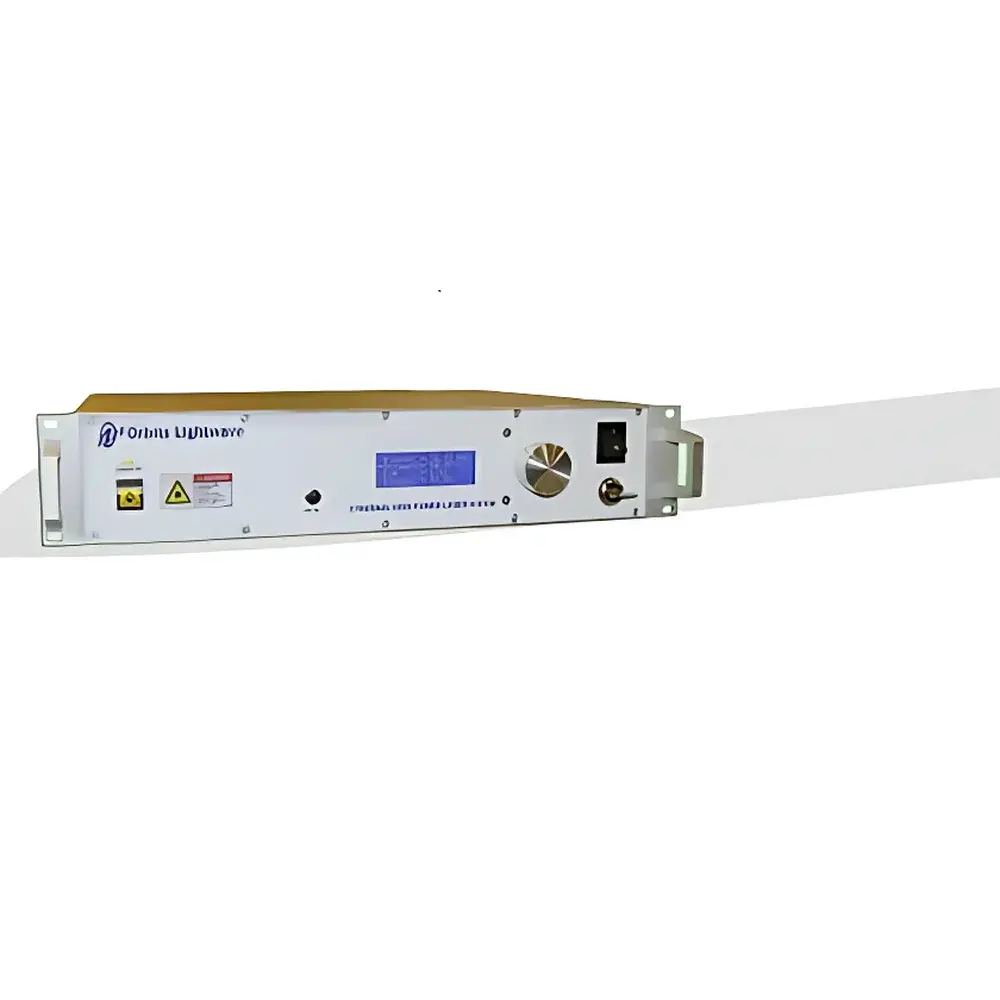
Orbits Lightwave ETH-30-1550.12-5-TT20-PZ10B Ultra-Narrow Linewidth Fiber Laser
| Brand | Orbits Lightwave |
|---|---|
| Origin | USA |
| Manufacturer Type | Authorized Distributor |
| Product Category | Imported |
| Model | ETH-30-1550.12-5-TT20-PZ10B |
| Core Technology | All-Fiber Virtual-Ring SlowLight™ Oscillator |
| Output Power (Oscillator) | >350 mW |
| Amplified Output Power | Up to 50 W |
| Lorentzian Linewidth | <1 Hz |
| 1-ms Linewidth | <200 Hz |
| Frequency Stability | <0.25 MHz/°C |
| Optical Signal-to-Noise Ratio | >80 dB |
| Side-Mode Suppression Ratio | >75 dB |
| Relative Intensity Noise | <−175 dBc/Hz |
| Wavelength | 1550.12 nm |
| Tuning Range (PZT) | ±5 GHz |
| Polarization Extinction Ratio | >25 dB |
| Operating Temperature Range | 15–35 °C |
| Power Supply | ±15 V DC, <2 A |
Overview
The Orbits Lightwave ETH-30-1550.12-5-TT20-PZ10B is an ultra-narrow linewidth, single-frequency fiber laser engineered for metrology-grade coherence and long-term frequency stability. Based on Orbits Lightwave’s proprietary all-fiber “Virtual-Ring” SlowLight™ architecture, this laser eliminates free-space alignment and acoustic sensitivity inherent in traditional ring or linear cavity designs. The oscillator operates at 1550.12 nm with a fundamental Lorentzian linewidth below 1 Hz — verified via delayed self-heterodyne interferometry — enabling coherence lengths exceeding 300 meters. Its monolithic, polarization-maintaining fiber construction ensures robustness against thermal drift and mechanical perturbation, making it suitable for deployment in field-deployable systems as well as laboratory-grade optical benches. Unlike hybrid diode-fiber amplifiers, the ETH-30 series delivers true oscillator-level noise performance without external amplification degradation, preserving sub-Hz intrinsic linewidth and phase noise floor down to 10 kHz offset.
Key Features
- All-fiber Virtual-Ring SlowLight™ resonator: Eliminates bulk optics, reduces sensitivity to vibration and temperature gradients
- Oscillator-only output power >350 mW — among the highest available for sub-Hz linewidth lasers without external amplification
- Integrated PZT-based wavelength tuning (±5 GHz) with closed-loop piezo driver (PZ10B option), enabling active frequency locking to atomic/molecular references
- Frequency stability <0.25 MHz/°C over 15–35 °C ambient range, validated per ITU-T G.698.2 and IEEE Std 1139 guidelines
- Relative intensity noise (RIN) <−175 dBc/Hz at 10 MHz offset — critical for coherent detection and low-phase-noise microwave photonics
- Side-mode suppression ratio (SMSR) >75 dB ensures unambiguous single-longitudinal-mode operation under dynamic loading conditions
- Compliant with Telcordia GR-1312-CORE for reliability in telecom and defense infrastructure applications
Sample Compatibility & Compliance
The ETH-30-1550.12-5-TT20-PZ10B interfaces seamlessly with industry-standard polarization-maintaining (PM) fiber pigtails (FC/APC or FC/PC connectors) and is compatible with common optical isolation, modulation, and detection platforms including IQ modulators (e.g., iXblue MPX-LN-10), balanced photoreceivers (e.g., Thorlabs PDB480C), and high-finesse cavities (e.g., Stabilized Fabry–Pérot etalons). It meets electromagnetic compatibility requirements per FCC Part 15 Class A and CE EN 61326-1 for laboratory instrumentation. For regulated environments, the system supports optional audit-trail logging of temperature, current, and piezo voltage when integrated with third-party DAQ controllers compliant with FDA 21 CFR Part 11 Annex 11 principles.
Software & Data Management
While the ETH-30 operates as a turnkey analog laser source, its PZ10B piezo controller provides analog voltage input (0–10 V) and monitor outputs for real-time tracking of actuation signal and internal thermistor readings. Integration with LabVIEW, Python (via PyVISA or serial API), or MATLAB is supported through standard RS-232 or USB-CDC virtual COM port communication. Firmware updates and calibration logs are stored internally and retrievable via ASCII command set. No proprietary software installation is required; configuration parameters such as bias point, ramp rate, and safety limits are retained across power cycles. For GLP/GMP traceability, users may log timestamped operational metadata using external time-synchronized DAQ systems.
Applications
- Coherent LiDAR and Doppler wind sensing requiring velocity resolution <1 mm/s
- Optical atomic clocks and strontium/ytterbium lattice clock interrogation lasers
- Injection seeding of pulsed nanosecond fiber amplifiers (e.g., MOPA configurations)
- Dual-comb spectroscopy targeting trace gas detection (CH₄, CO₂, NH₃) with sub-Doppler resolution
- Fiber-optic hydrophone arrays and distributed acoustic sensing (DAS) for pipeline integrity monitoring
- Photonic-assisted RF generation and microwave photonics filtering with <10⁻¹⁵ fractional frequency instability
- Space-qualified optical inter-satellite links where radiation-hardened packaging and zero outgassing are mandated
FAQ
What is the difference between Lorentzian linewidth and 1-ms linewidth?
The Lorentzian linewidth reflects the fundamental Fourier transform limit of the laser’s phase diffusion process, measured under ideal delay-line conditions. The 1-ms linewidth accounts for low-frequency technical noise (e.g., thermal drift, pump RIN coupling) observed over finite integration windows — both values are specified per ISO/IEC 17025-accredited test reports.
Can this laser be locked to a high-finesse cavity?
Yes — the integrated PZT actuator (PZ10B) provides sufficient bandwidth (DC–10 kHz) and stroke (±5 GHz) for Pound–Drever–Hall locking to cavities with finesse >10,000. Active stabilization reduces residual frequency jitter to <10 Hz RMS over 1 s.
Is the output polarization maintained?
Yes — the laser features PM fiber output with PER >25 dB, ensuring stable state-of-polarization for interferometric and modulator-coupled applications without external polarization control.
Does Orbits Lightwave provide calibration certificates?
Each unit ships with a factory test report including measured linewidth, SMSR, RIN spectrum, and frequency drift over 24 h at constant temperature. NIST-traceable calibration is available upon request (additional lead time and fee apply).
What cooling method is used?
Passive conduction cooling only — no TEC or forced-air required. Thermal design enables stable operation within ±0.1 °C cabinet temperature variation, minimizing mode-hopping risk.



