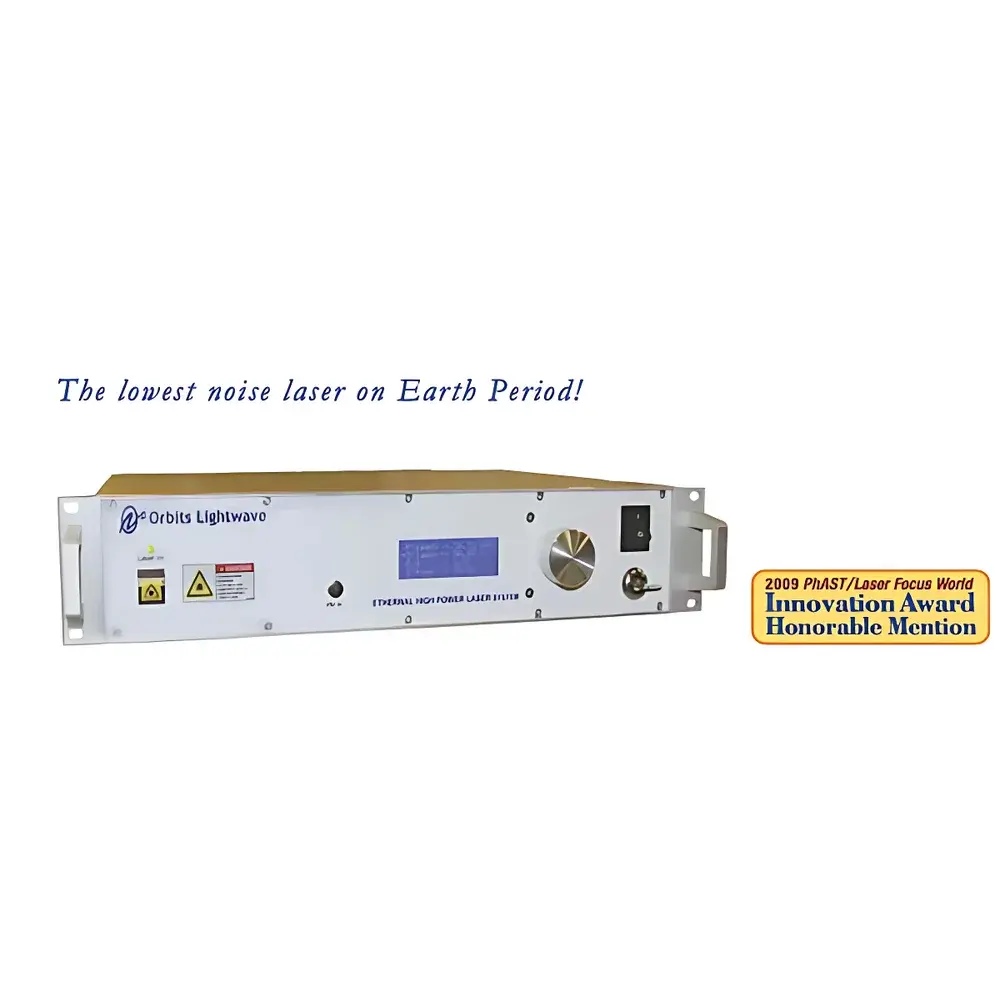
Orbits Lightwave Ethernal™/SlowLight™ High-Power Single-Frequency Fiber Laser System
| Origin | USA |
|---|---|
| Manufacturer Type | Authorized Distributor |
| Origin Category | Imported |
| Model | INST High Power |
| Core Components | Semiconductor-based seed laser + integrated/fiber-coupled optical amplification modules |
| Output Power Range | 0.3–50 W (oscillator-only to externally amplified configurations) |
| Wavelength Options | 1530–1565 nm & 1047–1080 nm |
| Linewidth | <1 Hz (Lorentzian), <1 kHz (1 ms measurement) |
| Frequency Stability | <1 MHz/°C |
| RIN | –165 to –175 dBc/Hz @ 100 MHz |
| OSNR | >90 dBc (0.05 nm RBW) |
| SMSR | >75 dBc (3 MHz RBW) |
| Polarization Extinction Ratio | >23 dB |
| Beam Quality | M² < 1.05 |
| Power Stability | ±0.1% RMS |
| Absolute Wavelength Accuracy | ±0.02–±0.05 nm |
| Operating Temperature | 10–55 °C |
| Power Consumption | 30–50 W |
| Form Factor | 2U 19″ rack-mountable chassis |
Overview
The Orbits Lightwave Ethernal™/SlowLight™ High-Power Single-Frequency Fiber Laser System is a precision-engineered optical source designed for applications demanding ultra-narrow linewidth, exceptional frequency stability, and low relative intensity noise (RIN). Based on proprietary SlowLight™ traveling-wave resonator architecture and passive temperature-compensated cavity design, this system eliminates mechanical sensitivity while maintaining sub-kilohertz spectral purity across extended operating conditions. Unlike conventional distributed feedback (DFB) or external cavity diode lasers (ECDLs), the fully fiber-integrated virtual ring oscillator achieves intrinsic robustness against vibration and thermal drift—enabling operation in mobile platforms, field-deployable sensing systems, and high-precision interferometric environments. The core oscillator delivers up to 0.5 W of diffraction-limited output (M² < 1.05), scalable to 2.5 W via integrated amplifier stages and further extended to 50 W using Nufern-compatible external amplifiers. All configurations maintain <1 kHz Lorentzian linewidth, frequency stability better than ±1 MHz/°C, and RIN performance ranging from –165 dBc/Hz to –175 dBc/Hz at 100 MHz—meeting stringent requirements for coherent detection, metrology-grade spectroscopy, and RF photonics.
Key Features
- Fully fiber-based SlowLight™ virtual ring oscillator architecture with no free-space alignment or moving parts
- Sub-10 Hz Lorentzian linewidth and <1 kHz instantaneous linewidth (1 ms integration time)
- Frequency stability <1 MHz/°C enabled by passive thermal compensation and slow-light cavity dispersion engineering
- Optical signal-to-noise ratio (OSNR) >90 dBc (0.05 nm resolution bandwidth) and side-mode suppression ratio (SMSR) >75 dBc (3 MHz RBW)
- Relative intensity noise (RIN) as low as –175 dBc/Hz @ 100 MHz, compliant with low-phase-noise microwave photonic link specifications
- Two standard wavelength bands: C-band (1530–1565 nm) and Yb-band (1047–1080 nm), with optional absolute wavelength accuracy of ±0.02 nm
- High-power scalability: 0.3–0.5 W oscillator-only; 0.5–2.5 W with internal amplifier; 0.5–50 W with external Nufern amplifier integration
- Rack-mountable 2U 19″ chassis with PM FC/APC fiber pigtails, power consumption 30–50 W, operational range 10–55 °C
Sample Compatibility & Compliance
This laser system is compatible with polarization-maintaining (PM) single-mode fiber infrastructure and integrates seamlessly into OEM instrumentation platforms requiring high-coherence light sources. It meets critical optical interface standards including IEC 61300-3-35 (fiber connector reliability) and Telcordia GR-1312-CORE (hermetic packaging for field deployment). While not certified as a medical device, its stable output and traceable wavelength calibration support GLP-compliant gas absorption spectroscopy workflows per ISO 14687 and ASTM E2797. For defense and aerospace applications, the system complies with MIL-STD-810G shock/vibration profiles when mounted in rigid enclosures, and its low RIN performance satisfies IEEE Std 1139–2008 requirements for phase-noise-limited photonic oscillators.
Software & Data Management
The INST High Power laser operates via RS-232, USB, or Ethernet (TCP/IP) interfaces supporting SCPI command sets for remote configuration of PZT tuning (1, 10, or 20 GHz range), thermal wavelength adjustment (0–160 GHz range), and real-time monitoring of output power, temperature, and pump current. Optional firmware enables audit-trail logging aligned with FDA 21 CFR Part 11 principles—including user authentication, timestamped parameter changes, and immutable event records—for regulated QC/QA laboratories. Data export supports CSV and HDF5 formats, facilitating integration with LabVIEW, MATLAB, and Python-based analysis pipelines used in LIDAR waveform processing, Brillouin scattering analysis, and optical frequency comb stabilization.
Applications
- Acoustic and distributed acoustic sensing (DAS) for pipeline integrity monitoring, border security, and seismic imaging
- Coherent LIDAR, airborne laser swath mapping (ALSM), and long-range time-of-flight distance metrology
- Injection seeding for high-energy pulsed lasers (e.g., Nd:YAG, Yb:fiber) in industrial material processing and scientific pumping
- Coherent optical communications (DP-QPSK, QAM-16) and microwave photonics signal generation
- High-resolution molecular spectroscopy, cavity-enhanced absorption spectroscopy (CEAS), and trace gas detection
- Optical atomic clocks, cold atom interferometry, and gravitational wave detector pre-stabilization
- Space-qualified optical links requiring radiation-tolerant, low-SWaP, and thermally insensitive laser sources
FAQ
What is the difference between Ethernal™ and SlowLight™ technologies?
Ethernal™ refers to Orbits Lightwave’s ultra-low-noise oscillator platform; SlowLight™ denotes the patented slow-light dispersion engineering applied within the fiber cavity to enhance coherence length and suppress mode-hopping—both are implemented synergistically in this system.
Can the laser be operated in continuous-wave (CW) and modulated modes simultaneously?
Yes—fast PZT modulation (up to 20 GHz) and slower thermal tuning (up to 160 GHz) operate independently, enabling hybrid frequency agility for swept-source OCT or multi-tone RF photonics experiments.
Is external cooling required for 50 W output operation?
No—thermal management is fully passive within the 2U chassis up to 2.5 W; external amplifiers (e.g., Nufern) require separate air- or water-cooling per their datasheet specifications.
Does the system support third-party wavelength lockers or interferometric stabilization?
Yes—the PM fiber output and low phase noise enable direct integration with Pound-Drever-Hall (PDH) locking electronics or commercial wavemeters with <10 MHz readout uncertainty.
What documentation is provided for regulatory validation?
Factory calibration reports, test certificates per ISO/IEC 17025, and detailed optical safety classification (Class 3B/4 per IEC 60825-1:2014) are included with each unit.