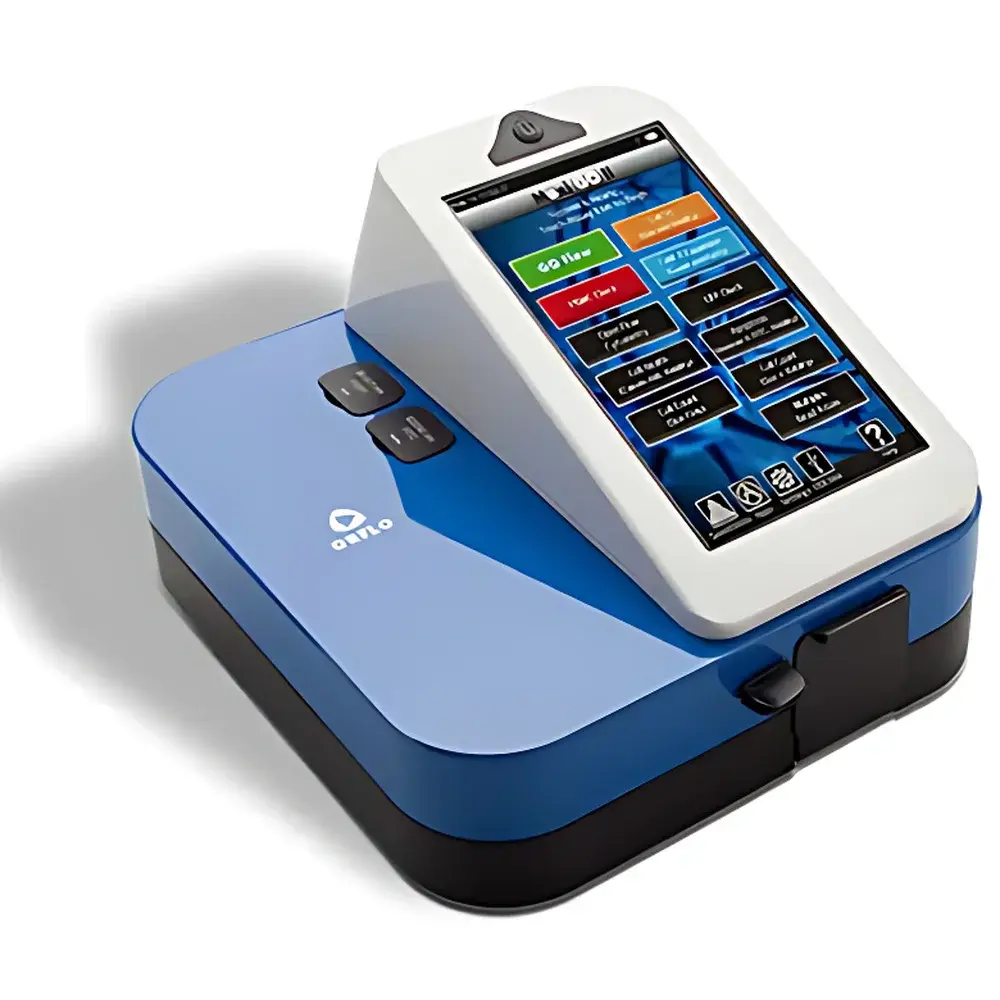
Orflo Moxi GO II Dual-Fluorescence Channel Coulter-Principle Flow Cytometer
| Brand | Orflo (USA) |
|---|---|
| Origin | USA |
| Model | Moxi GO II |
| Detection Time | 10 s |
| Minimum Detectable Concentration | 5 × 10³ cells/mL |
| Sample Volume | <1 µL |
| Detection Channels | 2 PMT-based fluorescence channels |
| Cell Size Range | 3–35 µm |
| Principle | Electrical impedance (Coulter principle) + dual-channel fluorescence detection |
| Compliance | Designed for GLP-compliant workflows |
Overview
The Orflo Moxi GO II is a compact, benchtop dual-fluorescence flow cytometer engineered for high-precision cell analysis using the gold-standard Coulter principle—electrical impedance sensing—integrated with two independent photomultiplier tube (PMT)-based fluorescence detection channels. Unlike optical scatter–based counters, the Moxi GO II measures cell volume directly via microfluidic aperture-based resistive pulse sensing, enabling absolute, calibration-free counting and highly reproducible size distribution profiling across a broad 3–35 µm dynamic range. This hybrid architecture eliminates reliance on refractive index assumptions or morphological approximations, delivering intrinsic volumetric accuracy critical for applications such as CAR-T manufacturing, yeast bioprocessing, platelet characterization, and algal biomass quantification. The system operates without external sheath fluid, lasers, or complex alignment procedures—leveraging proprietary microfluidic cartridge technology to ensure consistent hydrodynamic focusing and minimal carryover.
Key Features
- Coulter-Principle Core: Real-time, label-free cell counting and volumetric sizing based on electrical impedance—providing CV <3% for size measurements and linear response down to 5 × 10³ cells/mL.
- Dual-Channel Fluorescence Detection: Two spectrally distinct PMT channels (e.g., FITC/PE and PI/7-AAD compatible) enable simultaneous viability assessment, apoptosis staging (Annexin V/PI), transfection efficiency quantification (GFP/RFP), and functional marker expression profiling.
- Ultra-Low Sample Consumption: Requires ≤1 µL per analysis—ideal for precious primary cells, rare hematopoietic progenitors, or low-yield bioreactor samples.
- Sub-10-Second Turnaround: Full impedance + dual-fluorescence acquisition and onboard analysis complete in ≤10 seconds—enabling real-time process monitoring during cell culture passaging or biomanufacturing QC release testing.
- Touchscreen-Driven Workflow: Integrated Android-based interface with preloaded application modules—including Mammalian Cell Counting, Yeast Viability, Platelet Sizing, Apoptosis Profiling, and CAR-T QC—requiring zero software installation or instrument calibration.
- Maintenance-Free Architecture: Solid-state electronics, disposable microfluidic cartridges, and no moving parts eliminate routine maintenance, laser recalibration, or fluidic line cleaning.
Sample Compatibility & Compliance
The Moxi GO II accommodates heterogeneous suspensions including adherent and suspension mammalian cells (HEK293, CHO, Jurkat), primary T cells, platelets, Saccharomyces cerevisiae, Chlamydomonas reinhardtii, and other eukaryotic microorganisms. Its impedance-based sizing is insensitive to cellular granularity or internal complexity—unlike forward/side scatter—making it robust for samples with variable morphology or debris-rich preparations. All data files include timestamped metadata, operator ID, cartridge lot number, and analysis parameters. Export formats (CSV, FCS 3.1) support traceability in regulated environments; the system’s firmware enforces electronic signatures and audit trails aligned with FDA 21 CFR Part 11 and ISO/IEC 17025 documentation requirements.
Software & Data Management
Analysis is performed onboard using Orflo’s proprietary firmware—no PC dependency required. Each cartridge contains embedded calibration constants and application-specific algorithms validated per ASTM E2877-22 (Standard Guide for Flow Cytometer Performance Verification). Data exports include raw pulse height/width histograms, fluorescence intensity distributions, gating statistics, and coefficient-of-variation metrics. Optional cloud synchronization enables centralized lab-wide QC dashboards compliant with ISO 9001 quality management systems. Raw FCS files are compatible with third-party platforms including FlowJo, Cytobank, and FCS Express for advanced reanalysis.
Applications
- Bioprocess monitoring: Daily viability and concentration tracking of CHO cultures in upstream development.
- CAR-T manufacturing: Release testing for viable CD3+ cell concentration, size homogeneity, and transduction efficiency (GFP+ %).
- Yeast fermentation: Rapid assessment of budding index, viability (using FUN-1 or propidium iodide), and biomass density without centrifugation.
- Platelet quality control: Discrimination of microparticles (<1 µm) from intact platelets (2–4 µm) and aggregates via volumetric thresholds.
- Algal biofuel research: Enumeration and size distribution of Chlorella or Nannochloropsis under nitrogen-starvation stress conditions.
- Transfection optimization: Quantitative comparison of plasmid vs. mRNA delivery efficiency across multiple cell lines using dual-fluorescent reporters.
FAQ
Does the Moxi GO II require daily calibration or standardization beads?
No—each disposable microfluidic cartridge is factory-calibrated and contains embedded reference pulses; no user-performed calibration is necessary.
Can the system distinguish between live and dead cells without fluorescent dyes?
Yes—the Coulter principle provides intrinsic viability inference via membrane integrity assessment: compromised cells exhibit reduced impedance amplitude and altered pulse width profiles, enabling dye-free health scoring in select applications.
Is the Moxi GO II compatible with GMP-regulated environments?
Yes—its firmware supports electronic signatures, audit logs, and 21 CFR Part 11–compliant data export; full validation documentation (IQ/OQ/PQ protocols) is available upon request.
What sample preparation steps are required prior to analysis?
Minimal preparation: Cells must be suspended in conductive buffer (e.g., PBS with ≥0.9% NaCl); filtration through a 40-µm strainer is recommended for debris-rich samples.
How does the Moxi GO II compare to traditional flow cytometers in terms of resolution and throughput?
It trades multi-parameter immunophenotyping capability for speed, precision, and simplicity—delivering Coulter-grade volumetric accuracy at flow cytometer-level fluorescence multiplexing, but with 10× faster per-sample turnaround and no need for sheath fluid or alignment.