
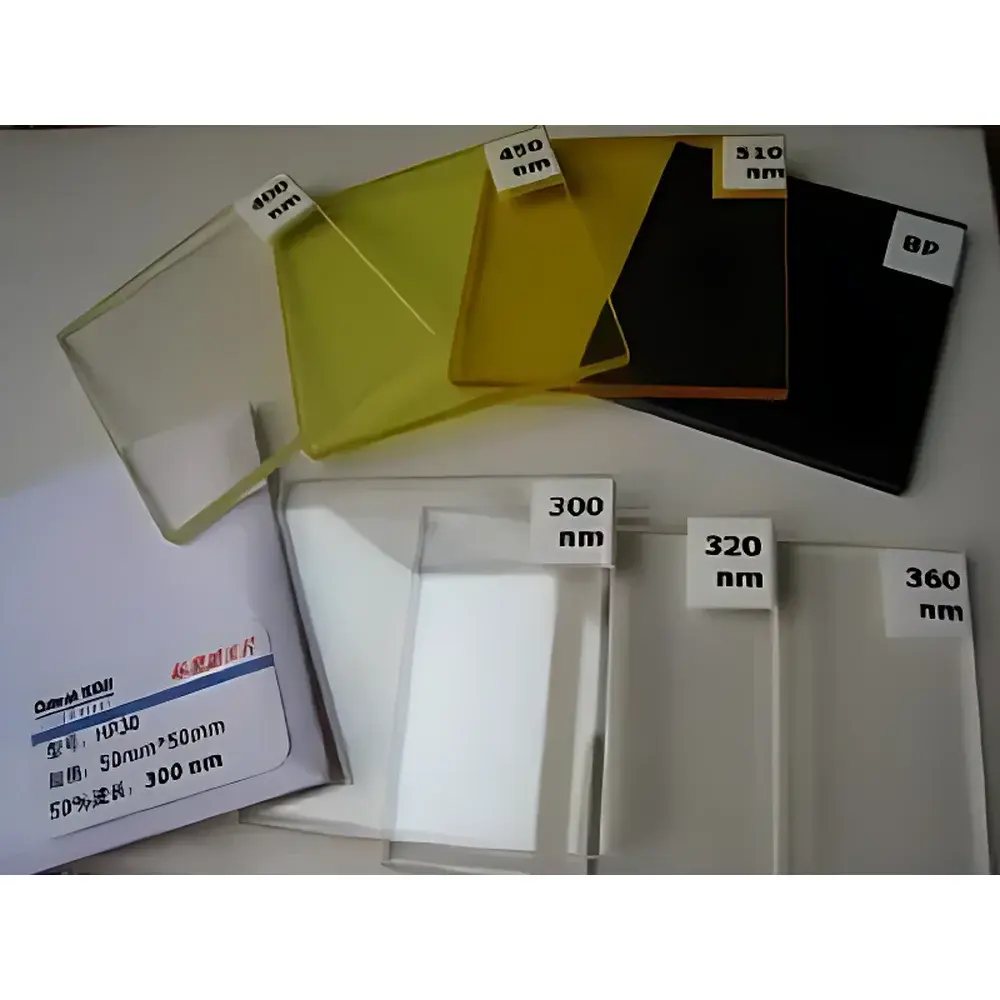
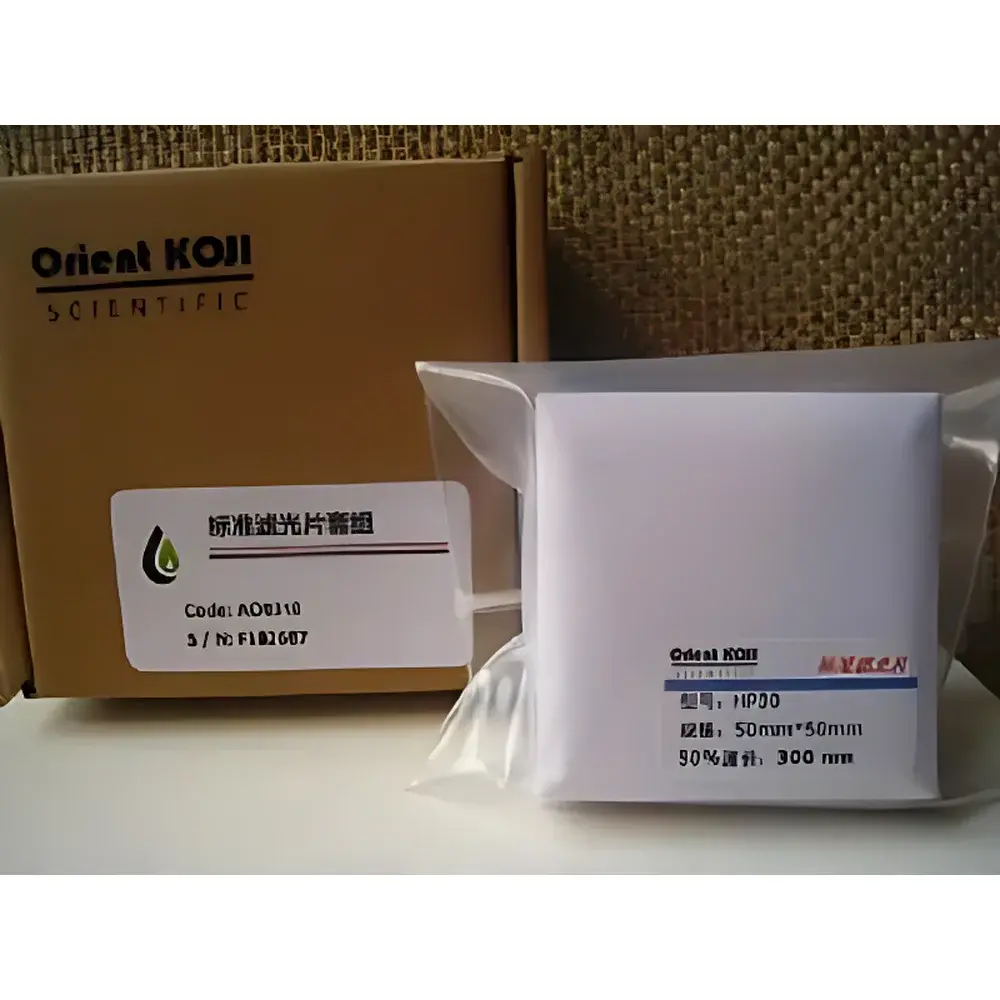
Orient KOJI AO8310 Standard Filter Set for Fluorescence Spectrometers
| Brand | Orient KOJI |
|---|---|
| Origin | Tianjin, China |
| Manufacturer Type | Authorized Distributor |
| Product Origin | Domestic (China) |
| Model | AO8310 |
| Component Category | Optical Element |
| Dimensions | 50 × 50 mm |
| Included Filters | 7 pieces with center wavelengths at 290–380 nm (broadband), 300 nm, 320 nm, 360 nm, 400 nm, 450 nm, and 510 nm |
Overview
The Orient KOJI AO8310 Standard Filter Set is a precision-engineered optical component suite designed specifically for wavelength calibration, performance verification, and routine quality assurance of high-sensitivity fluorescence spectrometers. Engineered to meet the stringent spectral alignment requirements of benchtop and research-grade fluorometers, this set enables traceable validation of excitation and emission monochromator accuracy, photometric linearity, and signal-to-noise stability. The filters are manufactured using hard-coated interference thin-film technology on UV-grade fused silica substrates, ensuring high transmission (>85% peak), steep edge slopes (<5 nm transition width), and minimal out-of-band leakage (<0.01% OD4). Each filter is individually characterized and labeled with certified center wavelength (CWL), full width at half maximum (FWHM), and blocking range specifications—critical for laboratories operating under ISO/IEC 17025 or GLP-compliant workflows.
Key Features
- Seven calibrated interference filters in standard 50 × 50 mm format, compatible with standard filter holders used in Hitachi F-4500, F-4600, F-7000, and F-2700 series fluorometers, as well as Horiba Jobin Yvon FluoroMax-4 and FluoroLog-3 systems
- Broadband 290–380 nm filter included for wide-range excitation source characterization and lamp spectral profile verification
- Center wavelengths traceably referenced to NIST-traceable spectrophotometric standards; CWL tolerance ±1.5 nm across all units
- UV-grade fused silica substrates with AR coating on both surfaces (R < 0.5% per surface from 250–700 nm)
- Robust environmental stability: resistant to humidity, thermal cycling (−10 °C to +60 °C), and moderate mechanical handling per MIL-C-48497A guidelines
- Individually serialized and supplied with calibration certificate documenting spectral transmittance curves measured on a double-beam UV-Vis-NIR spectrophotometer
Sample Compatibility & Compliance
The AO8310 filter set is mechanically and optically optimized for integration into the excitation and emission optical paths of commercially available scanning fluorescence spectrometers. It complies with mechanical interface standards defined in Hitachi Technical Bulletin FL-002-2021 and Horiba Application Note AN-FL-018 Rev. D. All filters satisfy ISO 10110-7:2019 (optical element surface quality) and ISO 9022-3:2015 (environmental testing for optical instruments). The set supports method validation protocols aligned with USP “Fluorescence Spectrophotometry” and ASTM E275-22 “Standard Practices for Describing and Measuring Performance of Fluorescence Spectrophotometers.” No re-certification is required for use in FDA-regulated environments when deployed within instrument qualification frameworks (IQ/OQ/PQ) per 21 CFR Part 11 Annex 11 requirements.
Software & Data Management
While the AO8310 is a passive optical component, its application in instrument qualification necessitates structured data capture. Laboratories routinely integrate filter-based verification results into electronic lab notebooks (ELN) or LIMS platforms via standardized CSV or XML export templates provided in Orient KOJI’s Instrument Qualification Toolkit (v2.1). The calibration certificate includes machine-readable QR codes linking to digital spectral data archives hosted on secure, audit-trail-enabled cloud storage—fully compliant with ALCOA+ principles (Attributable, Legible, Contemporaneous, Original, Accurate, Complete, Consistent, Enduring, Available). Raw transmittance datasets are provided in JIS Z 8401-compliant numeric format for third-party statistical analysis (e.g., control charting per ASTM E2587).
Applications
- Annual or semi-annual wavelength accuracy verification of fluorescence spectrometer monochromators
- Baseline correction and stray light assessment during system suitability testing
- Inter-instrument comparability studies across multi-site analytical laboratories
- Training and demonstration of spectral resolution limits and bandpass effects on quantum yield measurements
- Supporting regulatory submissions requiring documented evidence of instrument performance consistency (e.g., ICH Q2(R2), OECD 111)
- Validation of excitation source stability in time-resolved fluorescence setups using pulsed xenon lamps or LEDs
FAQ
Are these filters certified to NIST traceable standards?
Yes—each filter’s center wavelength and bandwidth are verified against NIST SRM 2031 (UV-Vis transmission standards) using a calibrated double-beam spectrophotometer accredited to ISO/IEC 17025.
Can the AO8310 set be used with non-Hitachi or non-Horiba fluorometers?
Mechanical compatibility depends on holder dimensions and optical path geometry; users should verify physical fit and beam clearance prior to deployment. Spectral utility remains valid if the instrument accepts 50 × 50 mm square filters.
Is recalibration required after purchase?
No—filters are supplied with permanent calibration certificates. Recertification is only recommended after exposure to extreme thermal shock, abrasive cleaning, or accidental substrate damage.
Does Orient KOJI provide installation support or SOP templates?
Yes—application engineers supply instrument-specific SOPs (aligned with ISO 17025 Annex A.3), including step-by-step verification procedures, acceptance criteria tables, and deviation reporting forms.
What is the expected service life under routine laboratory conditions?
With proper handling and storage in desiccated, anti-static filter cases, operational lifetime exceeds 10 years without measurable spectral drift (verified by accelerated aging per IEC 60068-2-30).




