
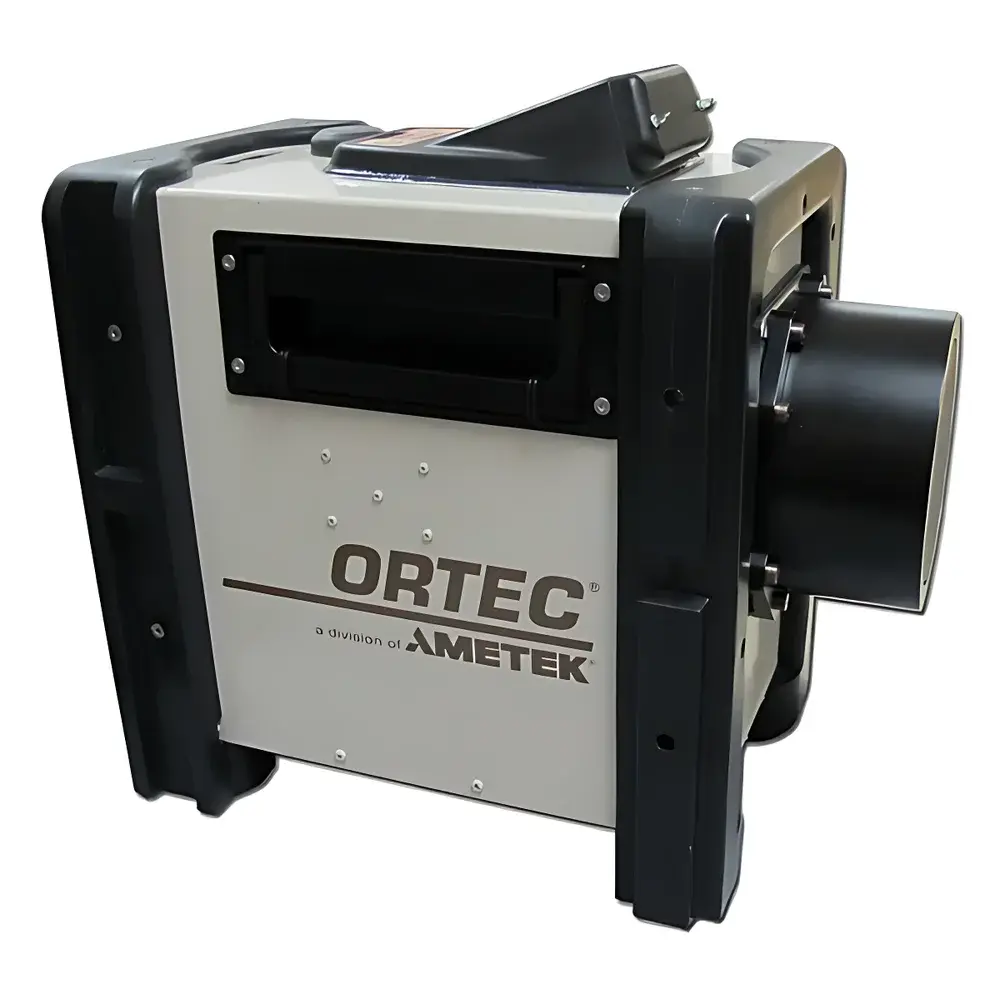
ORTEC DETECTIVE 200 Mobile High-Purity Germanium (HPGe) Spectrometer
| Brand | ORTEC |
|---|---|
| Origin | USA |
| Model | DETECTIVE 200 |
| Detector Type | Portable HPGe Gamma-Ray Spectrometer |
| Effective Crystal Area | ~5657 mm² |
| Angular Acceptance (with Collimator) | 120° |
| Ingress Protection Rating | IP67 |
| Buoyancy | Floats on Water |
| Relative HEU Identification Speed vs. NaI | Up to 10× Faster |
| Primary Application Domain | Radiological Emergency Response, Nuclear Security, SNM Detection |
Overview
The ORTEC DETECTIVE 200 is a field-deployable, high-resolution gamma-ray spectrometer engineered for rapid, reliable radionuclide identification in dynamic operational environments. At its core lies a large-volume, high-purity germanium (HPGe) detector—optimized for maximum detection efficiency and energy resolution (typically <1.8 keV FWHM at 1332 keV). Unlike scintillation-based systems (e.g., NaI(Tl)), the DETECTIVE 200 leverages intrinsic semiconductor physics to resolve closely spaced gamma-ray peaks, enabling unambiguous isotopic identification of special nuclear materials (SNM), including highly enriched uranium (HEU), plutonium isotopes, and medical/industrial radionuclides—even under low-count or mixed-source conditions. Its fully integrated architecture eliminates external cryostat plumbing, dewar connections, or separate signal processing units, supporting immediate deployment without pre-field calibration or thermal stabilization delays.
Key Features
- Integrated HPGe detector with ~5657 mm² effective crystal surface area—maximizing solid-angle coverage and absolute photopeak efficiency for low-activity or shielded sources.
- Modular, ruggedized chassis rated to IP67: fully dust-tight and submersible up to 1 m for 30 minutes; validated for shock resistance per MIL-STD-810G (vibration, drop, and transit testing).
- Detachable 120° collimator assembly—reducing background continuum via geometric rejection while preserving wide-field situational awareness during survey operations.
- Built-in liquid nitrogen (LN2) autorefill system with dual-stage vacuum insulation—enabling >24-hour continuous operation without manual refills under typical ambient conditions.
- Floating capability: sealed enclosure design allows safe operation on water surfaces during maritime or flood-related radiological assessments.
- Real-time isotope identification using ORTEC’s ISOCS®-compatible algorithm suite, compliant with ANSI N42.42–2022 data format standards.
Sample Compatibility & Compliance
The DETECTIVE 200 operates without sample preparation—designed for direct measurement of environmental media (soil, water, air filters), sealed sources, scrap metal, cargo containers, and personnel-contaminated surfaces. It meets performance criteria outlined in IEC 62327:2017 (hand-held radioisotope identifiers) and supports audit-ready reporting aligned with U.S. Department of Homeland Security (DHS) Operational Requirements Document (ORD) for Radiation Detection Systems. Firmware and spectral analysis workflows are traceable per GLP/GMP principles, with optional 21 CFR Part 11-compliant electronic signature modules available for regulated emergency response agencies.
Software & Data Management
Acquisition and analysis are managed through ORTEC’s GammaVision®–Field Edition software, running natively on the integrated Windows 10 IoT Enterprise platform. The system supports encrypted local storage (AES-256), time-stamped spectral logging, GPS-tagged measurement metadata, and automated upload to centralized command servers via LTE/Wi-Fi. All spectra are stored in standard .CNF format, enabling interoperability with third-party libraries (e.g., IAEA NuDat, LANL ENDF/B-VIII.0) and integration into national radiation monitoring networks such as RadNet or EURDEP. Audit trails record user actions, calibration history, and spectral processing parameters—ensuring full data integrity for post-event forensic reconstruction.
Applications
- Radiological dispersal device (RDD) and improvised nuclear device (IND) interdiction at border checkpoints and seaports.
- Post-accident mapping of contamination plumes following nuclear facility incidents (e.g., Fukushima-type scenarios).
- Environmental baseline surveys near legacy uranium mining sites or decommissioned research reactors.
- Verification of radioactive waste drum contents prior to transport or disposal under IAEA RS-G-1.9 guidelines.
- First-responder triage during lost-source recovery operations—differentiating naturally occurring radioactive material (NORM) from threat isotopes in real time.
FAQ
Does the DETECTIVE 200 require liquid nitrogen refills during extended field use?
Yes—though its optimized vacuum-jacketed dewar extends hold time, routine LN2 replenishment is required every 24–36 hours depending on ambient temperature and duty cycle.
Can it operate while floating on water?
Yes—the sealed, buoyant enclosure enables stable spectral acquisition on calm water surfaces; however, wave motion may affect count statistics and requires averaging over longer acquisition windows.
Is spectral library customization supported?
Yes—GammaVision® allows users to import, validate, and deploy custom nuclide libraries—including classified or site-specific isotopes—subject to export control compliance (EAR/ITAR).
What communication protocols are supported for remote data relay?
Standard support includes TCP/IP, HTTP(S), and MQTT; optional cellular modems (LTE Cat-M1/NB-IoT) enable secure telemetry to incident command centers with TLS 1.2 encryption.
How is energy calibration maintained under varying thermal conditions?
The system employs embedded reference sources (e.g., 152Eu or 241Am) and real-time temperature-compensated gain stabilization—ensuring peak centroid drift remains within ±0.05% across –20 °C to +50 °C operating range.
Related Products







