
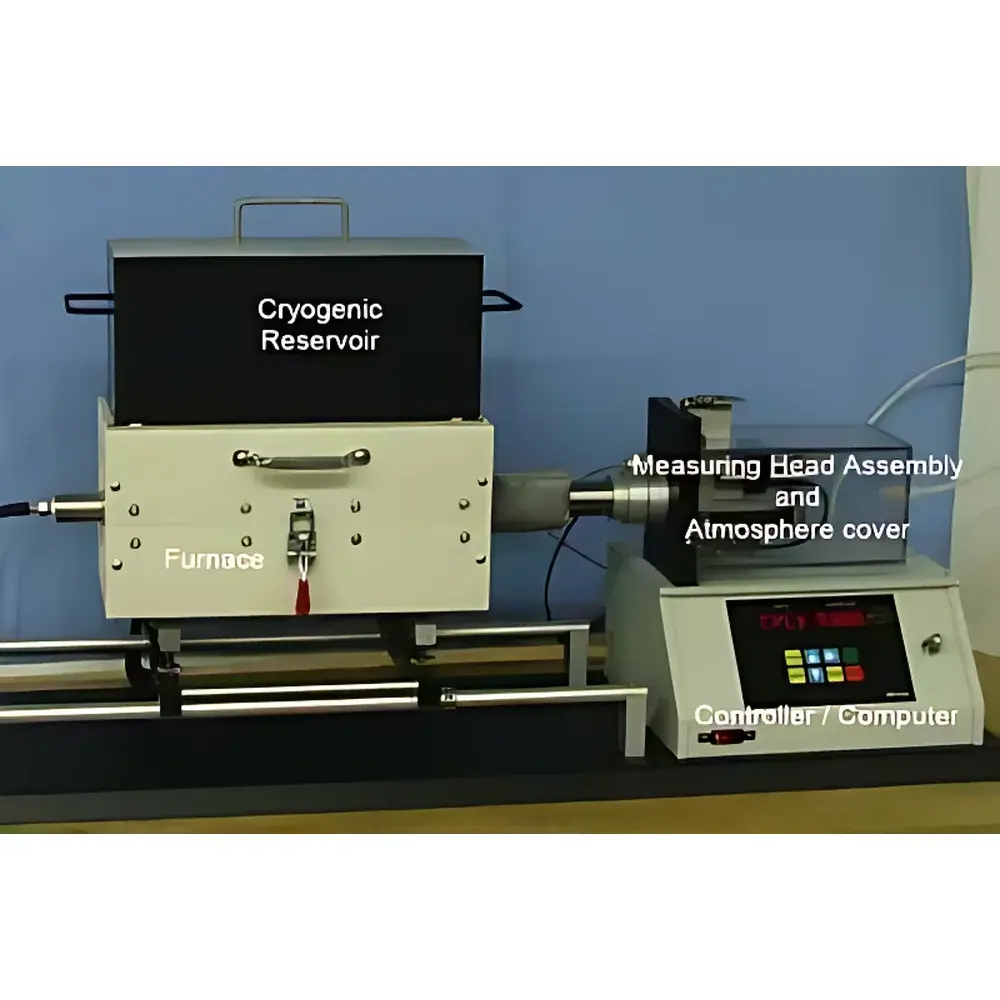
Orton DIL2010C Low-Temperature Dilatometer
| Brand | Orton |
|---|---|
| Origin | USA |
| Model | DIL2010C |
| Temperature Range | –170 °C to 500 °C (or RT to 1000 °C with standard configuration) |
| Max Sample Size | 50 mm length × 10 mm diameter |
| Furnace Type | Split-tube (clamshell) quartz tube furnace |
| Sample Holder & Pushrod | Fused silica |
| Thermocouple | Type N (sample & control) |
| Heating Rate | 1–30 °C/min |
| LVDT Linear Range | ±2.54 mm |
| LVDT Resolution | 0.02 µm |
| Contact Force | Adjustable |
| Cryogenic Assembly | Stainless-steel cold stage with vertical transfer tube, Dewar reservoir mounted above furnace |
| Ambient Protection | Acrylic enclosure with dry inert gas purge |
| Compliance | ASTM E228, ISO 11359-1/-2, USP <631>, GLP-ready data logging |
Overview
The Orton DIL2010C Low-Temperature Dilatometer is a dual-range, benchtop thermal dilatometer engineered for high-precision measurement of linear dimensional changes in solid materials as a function of temperature. It operates on the principle of contact-based pushrod dilatometry: a fused silica pushrod transmits minute axial displacements from the expanding or contracting sample to a high-resolution linear variable differential transformer (LVDT), whose output is calibrated against traceable temperature references. The instrument uniquely integrates cryogenic capability—down to –170 °C via liquid nitrogen cooling through a vertically oriented stainless-steel transfer line—while retaining full functionality as a high-temperature dilatometer up to 1000 °C upon removal of the low-temperature module. This modular architecture eliminates the need for separate instruments for cryogenic and elevated-temperature characterization, reducing footprint, calibration overhead, and inter-system variability. The system conforms to fundamental thermomechanical testing standards including ASTM E228 (linear thermal expansion of solids), ISO 11359-1 (general principles) and ISO 11359-2 (determination of coefficient of linear thermal expansion), supporting regulatory submissions and interlaboratory comparability.
Key Features
- Modular dual-range operation: seamless transition between cryogenic (–170 °C to 500 °C) and high-temperature (RT to 1000 °C) modes via hardware reconfiguration
- Fused silica sample holder and pushrod assembly ensuring chemical inertness, dimensional stability, and minimal thermal drift across the full operating range
- Adjustable mechanical contact force mechanism enabling optimization for brittle ceramics, soft polymers, or sintered composites without sample damage
- High-fidelity LVDT sensor with ±2.54 mm linear range and 0.02 µm resolution—capable of resolving sub-nanometer-scale expansions during glass transition or α-β quartz inversion
- Cryogenic subsystem featuring a vertically aligned stainless-steel cold stage, insulated transfer tube, and integrated Dewar reservoir; sample remains dry and non-immersed during cooling
- Acrylic environmental enclosure with continuous dry inert gas (N₂ or Ar) purge to prevent frost formation on LVDT electronics and optical path integrity
- Clamshell-type split-tube furnace design enabling rapid sample loading/unloading and uniform radial heating profiles per ASTM E228 requirements
Sample Compatibility & Compliance
The DIL2010C accommodates cylindrical specimens up to 50 mm in length and 10 mm in diameter, suitable for dense ceramics, optical glasses, metallic alloys, cementitious binders, mineral aggregates, and semi-crystalline polymers. Its fused silica fixture set ensures compatibility with aggressive alkaline or fluoride-containing systems where alumina or metal fixtures would degrade. All thermal protocols—including ramp-hold-cool cycles—are fully programmable and auditable. Data acquisition meets GLP and GMP documentation requirements: time-stamped raw displacement/temperature records, operator ID logging, and electronic signature support are embedded in Orton’s proprietary software. The system supports 21 CFR Part 11 compliance when deployed with validated IT infrastructure, including audit trails for method changes, calibration events, and result modifications.
Software & Data Management
Orton’s DilNet™ software provides a deterministic, ISO/IEC 17025-aligned analysis environment. It delivers automated calculation of coefficient of linear expansion (CTE) over user-defined intervals, first-derivative dL/dT plots for inflection point identification (e.g., Tg, softening point, quartz inversion at ~573 °C), and comparative overlay of up to eight curves with statistical deviation mapping. Export formats include CSV, XML, and PDF reports compliant with internal QA templates. Raw data files are stored in HDF5 format—self-describing, versioned, and machine-readable—ensuring long-term archival integrity. Calibration routines include multi-point LVDT offset correction, furnace temperature uniformity mapping, and pushrod thermal expansion compensation using certified reference materials (e.g., SRM 735a fused quartz).
Applications
- Quantification of CTE mismatch in ceramic-metal seals for vacuum feedthroughs and hermetic packaging
- Characterization of low-expansion glass-ceramics used in telescope mirror substrates and semiconductor lithography stages
- Thermal stability assessment of polymer matrix composites in aerospace structural components
- Detection of phase transitions in shape-memory alloys and ferroelectric ceramics via discontinuities in dL/dT
- Quality control of refractory linings in metallurgical furnaces using repeat-run reproducibility (±0.004 PLC)
- Hydration kinetics modeling in Portland cement systems through early-age expansion monitoring under controlled humidity
FAQ
How is sample temperature measured during cryogenic operation?
Type N thermocouples are embedded in both the sample and furnace wall, with cold-junction compensation performed digitally. A second thermocouple monitors the stainless-steel cold stage surface to validate thermal equilibration prior to data acquisition.
Can the instrument measure volumetric expansion directly?
No—it measures uniaxial linear expansion. Volumetric expansion is derived assuming isotropic behavior (β ≈ 3α), which is valid for polycrystalline ceramics and glasses but requires validation for anisotropic single crystals or fiber-reinforced composites.
What maintenance is required for the LVDT under repeated thermal cycling?
The LVDT is sealed and isolated from thermal gradients by the acrylic enclosure and inert gas purge. Annual verification using a NIST-traceable micrometer standard is recommended; no field recalibration is necessary under normal use.
Is ASTM E228 compliance verified out-of-the-box?
Yes—the system ships with a certificate of conformance referencing calibration against NIST SRM 735a and interlaboratory round-robin data demonstrating repeatability within ±0.2% of certified CTE values across –50 °C to 300 °C.



