
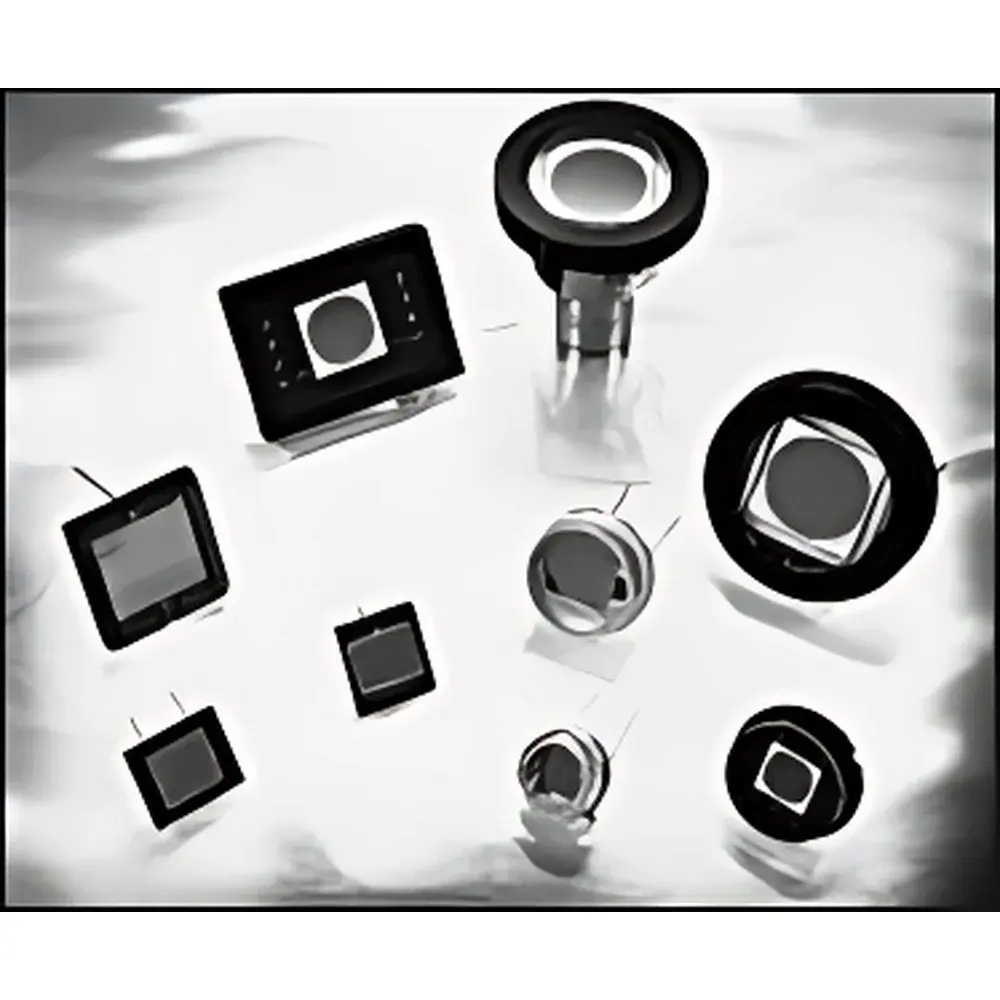
OSI Optoelectronics SI-Series Silicon Photodiode Detectors
| Brand | OSI Optoelectronics |
|---|---|
| Origin | USA |
| Product Type | Imported Spectroscopy Detector |
| Model Designation | SI-Series (including PIN, UV-Enhanced, Soft X-ray, Position-Sensitive, and APD variants) |
| Packaging | Ceramic or Plastic TO-18/TO-5 |
| Spectral Range | 350–1100 nm (standard Si), 6 eV–17.6 keV (soft X-ray), 254 nm (UV-enhanced), 820 nm peak (APD) |
| Response Time | 10 ns (photoconductive mode, biased), 0.4 ns (APD @850 nm, G=100) |
| Dark Current | ≤0.01 nA (standard PIN), <1 pA (low-noise variants) |
| Responsivity | 0.65 A/W (typ. @633 nm), 0.14 A/W @254 nm (UV-enhanced), 42 A/W @850 nm (APD, G=100) |
| Quantum Efficiency | >90% (UV-enhanced, back-illuminated), ~100% internal QE (inverted channel), high QE across soft X-ray band |
| Compliance | RoHS-compliant packaging |
Overview
The OSI Optoelectronics SI-Series Silicon Photodiode Detectors are a family of precision optoelectronic sensing components engineered for integration into analytical instrumentation, particularly spectroscopic systems requiring stable, linear, and spectrally tailored photodetection. These detectors operate on the principle of the internal photoelectric effect in crystalline silicon, where incident photons generate electron-hole pairs proportional to irradiance—enabling quantitative radiant flux measurement across ultraviolet, visible, and near-infrared spectral regions. The SI-Series encompasses five functionally distinct subfamilies: standard PIN photodiodes (photoconductive and photovoltaic modes), UV-enhanced devices with optimized shallow-junction architecture, single-pixel soft X-ray detectors capable of direct photon counting without scintillation conversion, quadrant and linear position-sensitive detectors (PSDs) for beam centroid tracking, and silicon avalanche photodiodes (APDs) for low-light, high-speed applications. All variants are manufactured in the United States under strict process controls, with ceramic and plastic TO-style hermetic packages ensuring long-term stability in laboratory, industrial, and regulated environments.
Key Features
- Multi-spectral coverage: Standard Si PIN diodes cover 350–1100 nm; UV-enhanced variants deliver peak responsivity at 254 nm with deep-UV quantum efficiency exceeding 90%; soft X-ray detectors respond directly from 6 eV to 17.6 keV.
- High temporal fidelity: Photoconductive-mode PIN diodes achieve 10 ns rise time under reverse bias; APD models (e.g., APD-300) deliver 0.4 ns pulse response at 850 nm with gain = 100.
- Ultra-low noise performance: Typical dark current ≤0.01 nA (25°C, 0 V bias); low-noise variants specified down to <1 pA for photon-starved applications such as fluorescence lifetime measurement or synchrotron beamline monitoring.
- Configurable geometry and packaging: Available in circular (4.0 mm and 8.0 mm active area), quadrant, and linear PSD formats; TO-18 and TO-5 metal cans with flat window or fiber-coupled ball-lens options for APDs.
- Matched emitter-detector pairs: Pre-characterized dual-wavelength LED/detector assemblies (e.g., DLED-660/905-CSL-2 + PIN-8.0-CSL) minimize optical crosstalk and simplify ratiometric design for SpO₂ sensors, turbidimetric analyzers, and dual-beam spectrophotometers.
Sample Compatibility & Compliance
The SI-Series is designed for use with diverse sample interfaces—including cuvettes, flow cells, fiber-optic probes, vacuum chambers (for soft X-ray variants), and collimated free-space beams—without requiring external amplification or cooling in most routine applications. All detectors comply with RoHS Directive 2011/65/EU and are compatible with ISO/IEC 17025-accredited calibration procedures. UV-enhanced and soft X-ray models support NIST-traceable spectral responsivity certification. When integrated into medical or pharmaceutical instrumentation, these detectors meet the photometric linearity and stability requirements referenced in IEC 60601-2-57 (optical radiation safety), ASTM E308 (colorimetry), and USP (spectrophotometric system suitability). Their passive operation (no bias required for soft X-ray and photovoltaic modes) simplifies compliance with intrinsic safety standards in hazardous-area installations.
Software & Data Management
While the SI-Series detectors themselves are analog transducers, they are routinely interfaced with OEM data acquisition systems supporting IEEE 1451.4 TEDS (Transducer Electronic Data Sheets) for automatic configuration. Detector-specific calibration coefficients—including spectral responsivity curves, linearity deviation maps (<±0.2% over 4-decade dynamic range), and temperature-dependent dark current profiles—are provided in machine-readable CSV and XML formats. These files integrate seamlessly with LabVIEW™, MATLAB® Instrument Control Toolbox, and Python-based frameworks (e.g., PyVISA, NIDAQmx) for automated spectral scanning, kinetic assay logging, and real-time beam position feedback control. For regulated environments, detector firmware and calibration metadata can be archived within 21 CFR Part 11–compliant LIMS or ELN platforms when paired with validated DAQ hardware.
Applications
- Spectroscopy Systems: Reference and sample channel detection in UV-Vis-NIR spectrophotometers, FTIR accessories, and Raman probe heads.
- Medical Diagnostics: Dual-wavelength emitter/detector pairs for pulse oximetry (SpO₂), co-oximetry, and hemoglobin assay platforms compliant with CLIA and IEC 62304.
- Environmental Monitoring: UV absorbance sensors for nitrate, TOC, and ozone quantification; soft X-ray detectors for synchrotron-based aerosol composition analysis.
- Industrial Process Control: High-speed position sensing in laser alignment systems, wafer metrology tools, and robotic vision guidance; APD-based time-of-flight sensors for distance and thickness gauging.
- Research Instrumentation: Direct-detection soft X-ray spectrometers, ultrafast pump-probe setups, and particle-induced X-ray emission (PIXE) systems operating under UHV conditions.
FAQ
Are these detectors calibrated prior to shipment?
Yes—each unit undergoes spectral responsivity characterization at three reference wavelengths (e.g., 254 nm, 633 nm, 900 nm) using NIST-traceable sources. Calibration certificates include uncertainty budgets per ISO/IEC 17025 Annex A.
Can the soft X-ray detector operate in air?
No—these detectors require vacuum or helium-purged environments (≤10⁻³ mbar) to prevent absorption by atmospheric oxygen and water vapor below 100 eV.
What is the maximum reverse bias voltage for the PIN photodiodes?
Standard SI-series PIN diodes are rated for up to 100 V reverse bias; high-voltage variants (e.g., SI-HV-8.0) support 200 V for enhanced speed and linearity.
Do UV-enhanced detectors require special handling?
Yes—shallow-junction UV devices are sensitive to surface contamination and mechanical stress; cleanroom handling and quartz-window mounting are recommended to preserve QE stability.
Is there a software development kit (SDK) available for APD integration?
OSI provides application notes, SPICE models, and reference schematics for transimpedance amplifier design—but no proprietary SDK. All electrical interface specifications conform to JEDEC JESD22-A114 for electrostatic discharge robustness.
Related Products






