
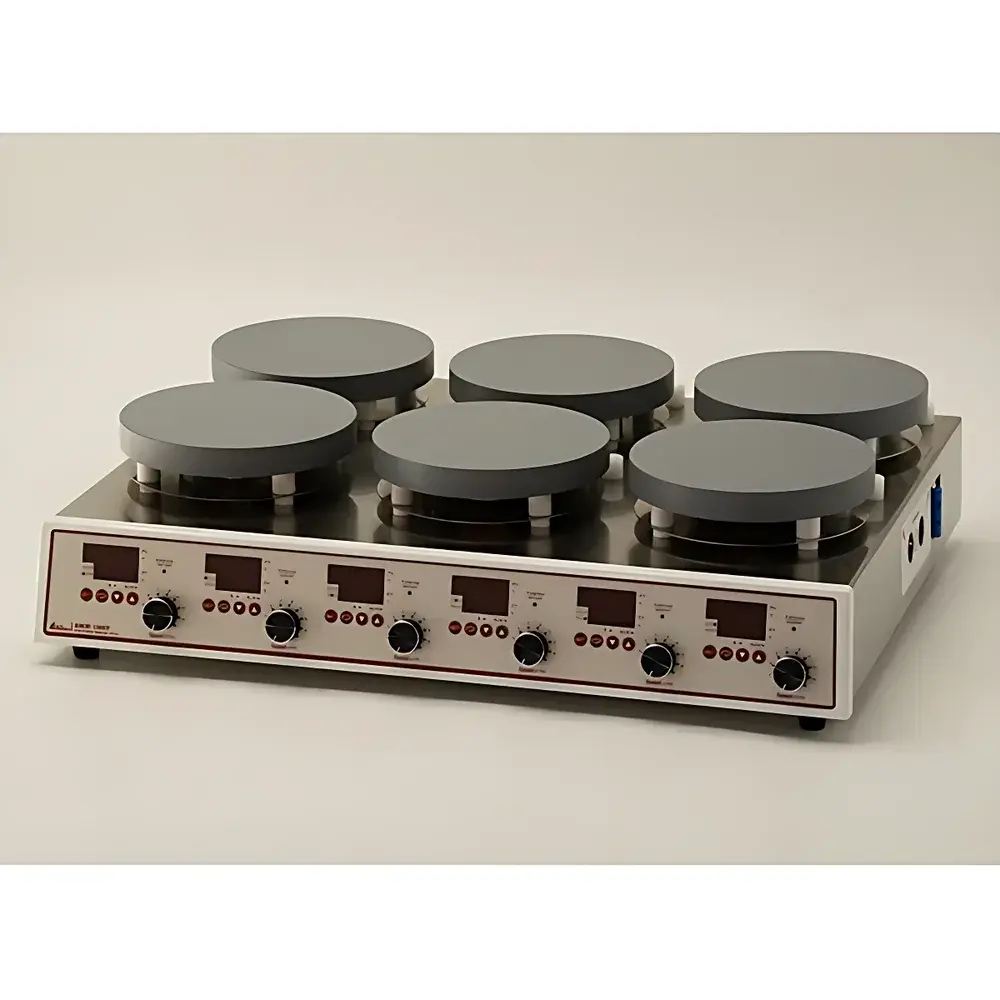
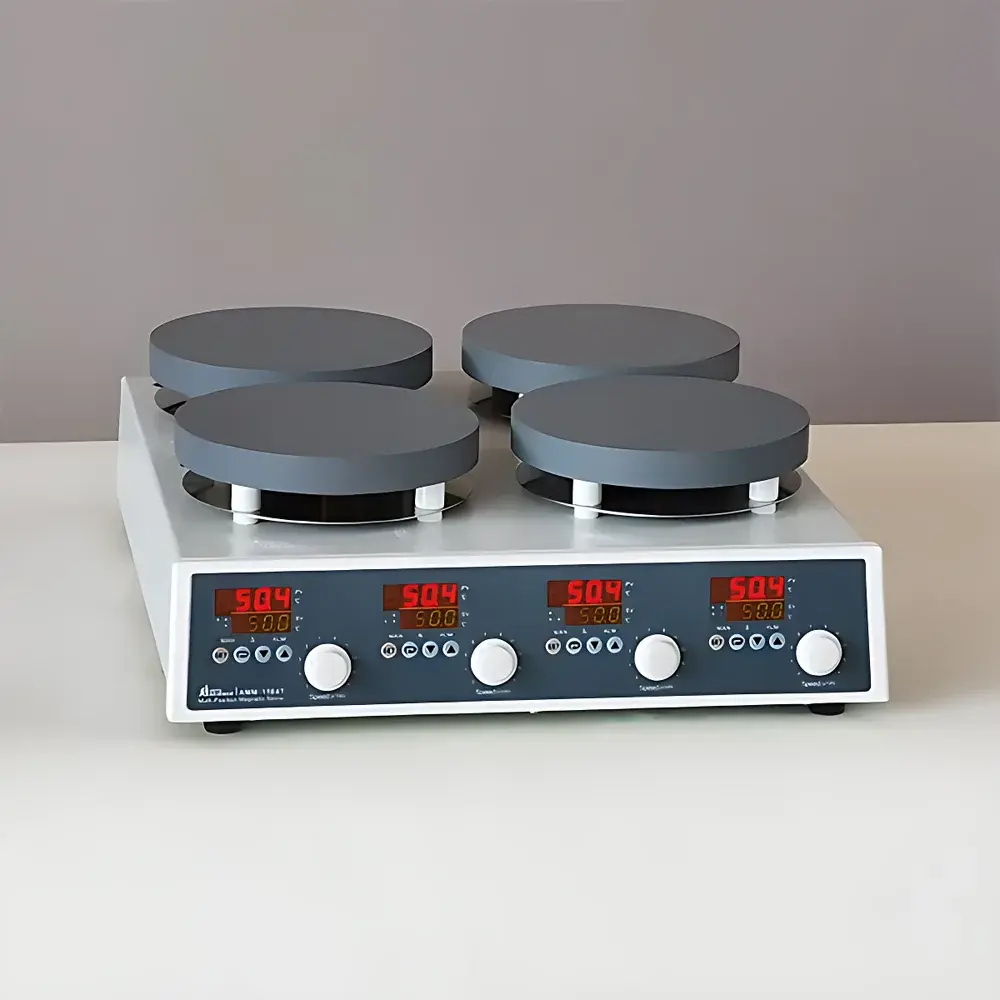
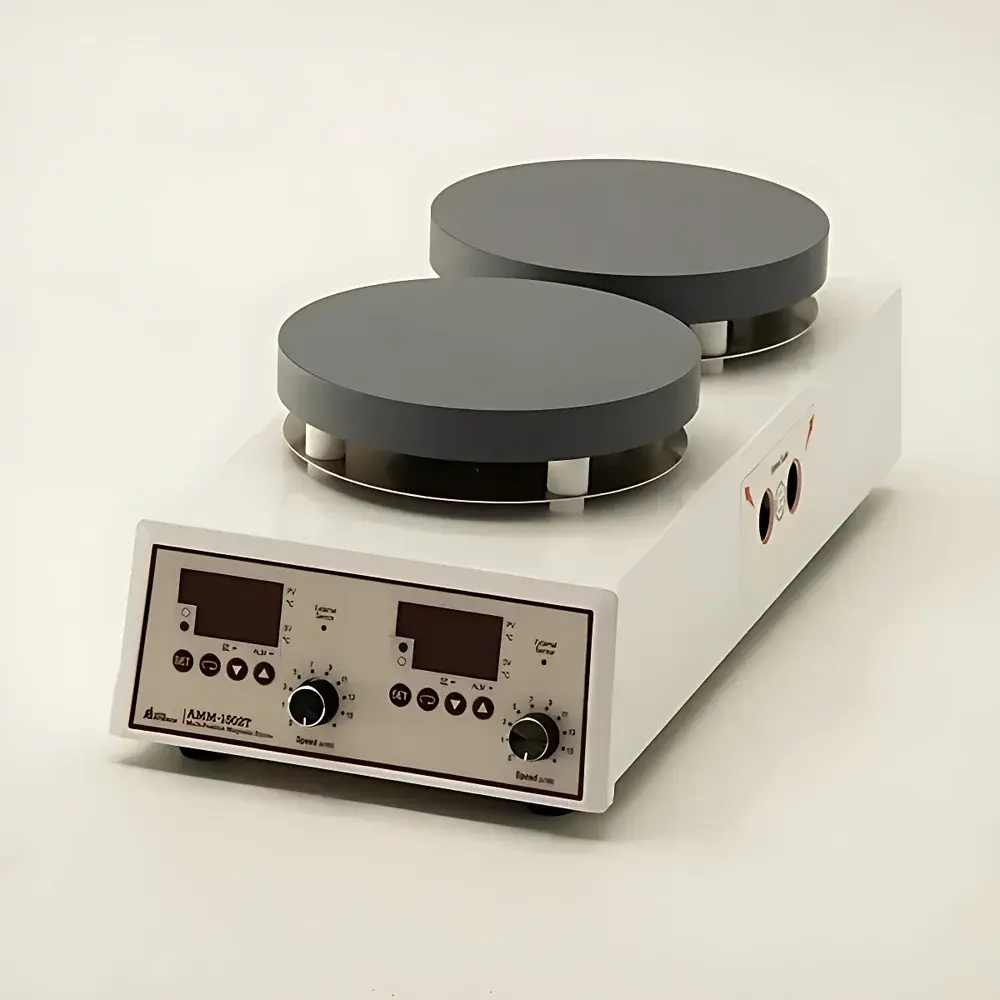
Otisience AMM-1500 Series Multi-Position Magnetic Stirrer
| Brand | Otisience |
|---|---|
| Model | AMM-1500 Series |
| Stirrer Type | Magnetic Stirrer |
| Max Stirring Capacity | 50–3000 mL per position × 2 / × 4 / × 6 positions |
| Speed Range | 0–1500 rpm |
| Temperature Control Range | Ambient to 350 °C |
| Heating Plate Material | Anodized Aluminum with PTFE Coating |
| Control System | Dual 4-digit PID Display (per position) |
| External Temperature Sensor Support | Yes (2 / 4 / 6 channels) |
| Max Heating Power | 380 W per position |
| Dimensions (W×H×D) | 183×120×392 mm (AMM-1502T) / 352×120×392 mm (AMM-1504T) / 512×120×392 mm (AMM-1506T) |
Overview
The Otisience AMM-1500 Series Multi-Position Magnetic Stirrer is an engineered solution for high-throughput laboratory environments requiring simultaneous, independent control of stirring and heating across multiple samples. Designed around the principles of electromagnetic induction and precision thermal regulation, this instrument employs rare-earth magnet arrays beneath a chemically inert PTFE-coated aluminum heating plate to generate uniform rotational torque on standard magnetic stir bars. Unlike single-position units, the AMM-1500 architecture integrates discrete drive circuits and dedicated PID temperature controllers for each stirring station—enabling true parallel operation without cross-talk or thermal drift between positions. Its operational envelope spans ambient conditions up to 350 °C and speeds from standstill to 1500 rpm, supporting viscosity ranges typical of aqueous buffers, organic solvents, polymer solutions, and low-to-medium consistency suspensions. The system meets fundamental design expectations for ISO/IEC 17025-compliant laboratories where procedural reproducibility and equipment traceability are prerequisites.
Key Features
- Modular multi-position configurations: Selectable 2-, 4-, or 6-station variants (AMM-1502T, AMM-1504T, AMM-1506T) to match workflow scale without over-provisioning.
- Independent dual-parameter control per position: Each station features a dedicated 4-digit LED display showing real-time speed (rpm) and plate temperature (°C), driven by isolated PID algorithms.
- PTFE-bonded anodized aluminum heating plate: Provides rapid thermal response, uniform heat distribution (±3 °C at 300 °C), and resistance to acid/base exposure and mechanical abrasion.
- External Pt100 sensor compatibility: Supports optional external temperature probes for sample-in-vessel monitoring, enabling closed-loop control aligned with USP & ASTM E2251 thermal validation protocols.
- Robust mechanical construction: Reinforced chassis with integrated sensor mounting brackets (2/4/6 per model) and standardized M4 threaded inserts for accessory integration.
- Energy-efficient heating architecture: 380 W per station with adaptive power modulation—reducing standby consumption and minimizing thermal load on adjacent instrumentation.
Sample Compatibility & Compliance
The AMM-1500 Series accommodates standard laboratory glassware including beakers (50–3000 mL), Erlenmeyer flasks, and jacketed reactors. Stir bar selection (e.g., PTFE-coated, elliptical, or cross-shaped) is determined by fluid viscosity and vessel geometry—not instrument limitations. All models comply with IEC 61010-1:2010 for electrical safety in laboratory equipment and incorporate over-temperature cutoff (360 °C threshold) and motor stall protection. While not certified for Class I Div 1 hazardous locations, the unit operates safely in general-purpose chemical fume hoods and QC labs adhering to GLP documentation standards. Calibration records for temperature and speed output can be maintained per ISO/IEC 17025 Clause 6.4.10, and firmware supports audit-trail logging when paired with optional RS-232/USB data capture modules.
Software & Data Management
The AMM-1500 operates as a standalone analog-digital hybrid platform. Though it lacks embedded Wi-Fi or cloud connectivity, its RS-232 interface (optional cable kit) enables bidirectional communication with LIMS or custom Python/Matlab scripts for automated parameter logging. Each PID controller stores last-set values through power cycles, and external sensor inputs allow correlation of plate temperature vs. actual solution temperature—a critical distinction during method transfer per FDA 21 CFR Part 11 Annex A guidelines. For regulated environments, users may implement manual logbooks or integrate the device into electronic batch records via third-party SCADA middleware compliant with GAMP 5 Category 3 classification.
Applications
- Parallel synthesis screening in medicinal chemistry: Simultaneous optimization of reaction kinetics across six solvent systems under identical thermal profiles.
- QC testing of pharmaceutical suspensions: Uniform dispersion of insoluble actives (e.g., corticosteroids) while maintaining USP dissolution temperature tolerances.
- Materials science prep: Controlled co-precipitation of metal oxide nanoparticles in ethylene glycol/water mixtures requiring precise 80–120 °C setpoints.
- Environmental lab workflows: Digestion of soil extracts using HNO₃/HF blends under reflux conditions, leveraging PTFE surface resistance and 350 °C capability.
- Biotechnology buffer preparation: pH-sensitive formulations requiring gentle agitation (<300 rpm) and tight ±0.5 °C thermal control across multiple volumetric flasks.
FAQ
Can the AMM-1500 Series be used with non-magnetic vessels such as stainless steel or ceramic?
No. Magnetic coupling requires diamagnetic or paramagnetic vessel walls; stainless steel (ferritic/martensitic grades) and thick-walled ceramics attenuate the field excessively. Borosilicate glass, polypropylene, and PTFE-lined containers are recommended.
Is calibration certificate included with shipment?
A factory-as-tested report is supplied. NIST-traceable calibration certificates (temperature and speed) are available as optional add-ons, issued by an ILAC-MRA accredited provider.
What stir bar sizes are compatible with the 3000 mL capacity setting?
Elliptical stir bars measuring 40–50 mm in length and 8–10 mm in diameter deliver optimal vortex formation and torque transfer in tall-form vessels at full capacity.
Does the unit support ramp-and-hold temperature programming?
No. It provides static setpoint control only. For programmable thermal profiles, external programmable temperature controllers with relay outputs may be interfaced via the unit’s auxiliary trigger terminals.
How often should the PTFE coating be inspected for integrity?
Visual inspection is advised before each use. Any visible chipping, discoloration beyond light amber, or loss of hydrophobicity indicates degradation and warrants replacement of the heating plate assembly to prevent aluminum oxidation and contamination.



