
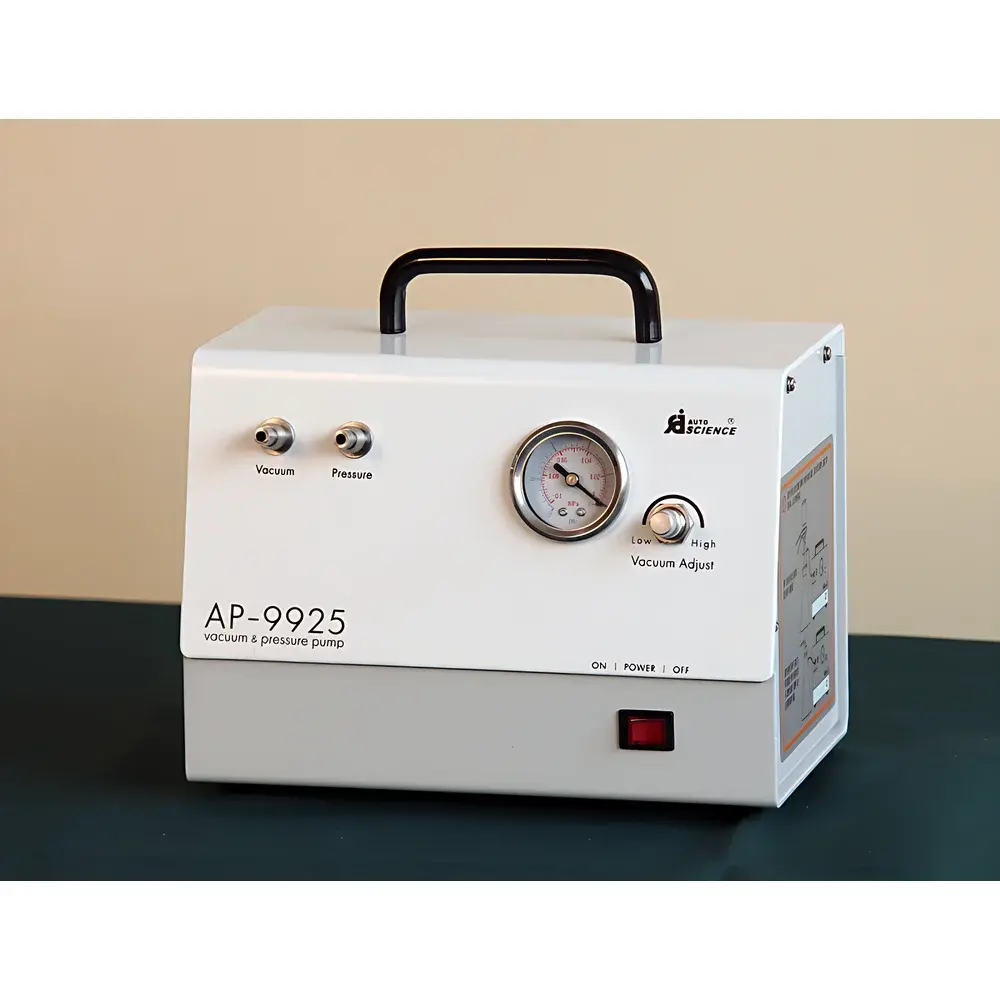
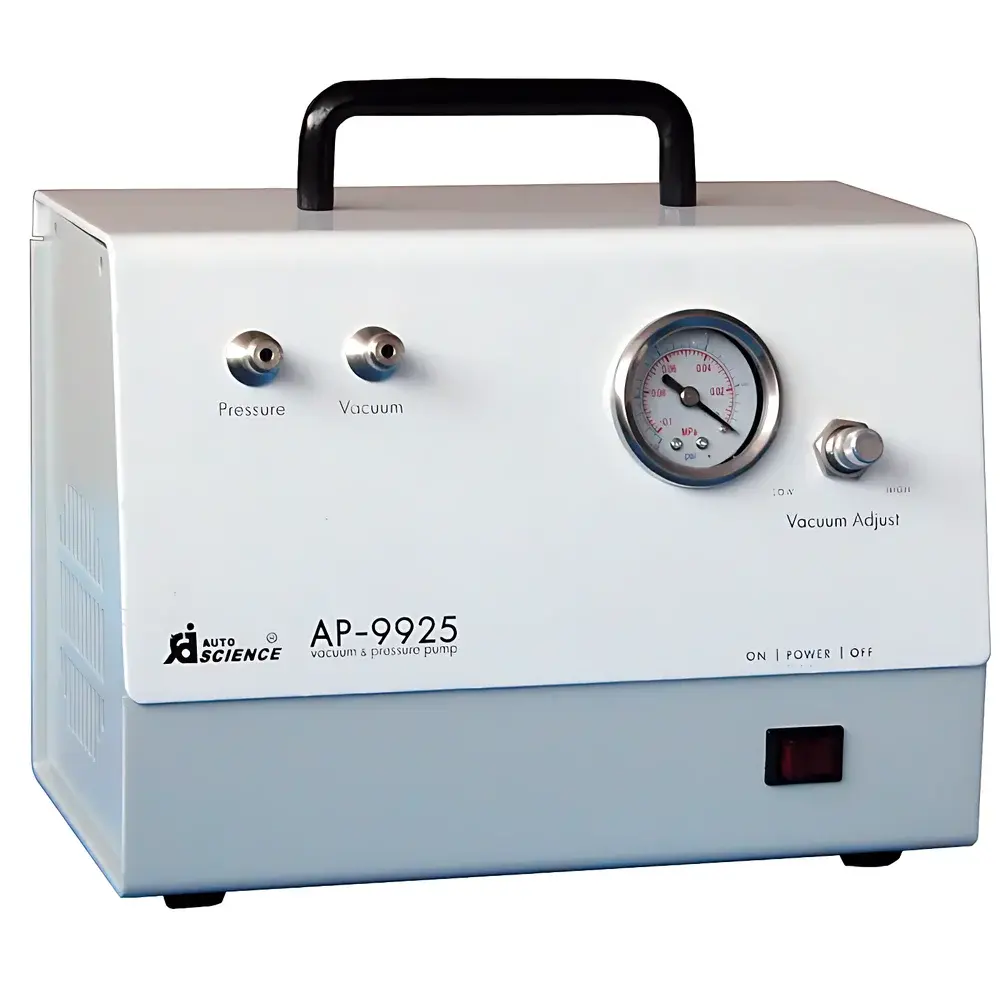
Otisience AP-9925(N) Oil-Free Vacuum Pump
| Brand | Otisience |
|---|---|
| Origin | Tianjin, China |
| Model | AP-9925(N) |
| Type | Diaphragm-Type Oil-Free Vacuum Pump |
| Ultimate Vacuum | <15 kPa (abs) |
| Pumping Speed | 25 L/min |
| Motor Power | 50 W |
| Dimensions (W×D×H) | 230 × 130 × 160 mm |
| Weight | 3.1 kg |
| Voltage/Frequency | 220 V / 50 Hz |
| Pressure Regulation | Manual Knob-Controlled Dual-Port (Vacuum & Positive Pressure) |
| Diaphragm & Cylinder Surface | PTFE-Coated |
| Compliance | CE-marked per EN 61000-6-3 & EN 61000-6-2 (EMC), RoHS 2015/863/EU |
Overview
The Otisience AP-9925(N) is a compact, diaphragm-type oil-free vacuum pump engineered for precision laboratory applications requiring clean, hydrocarbon-free vacuum generation. Unlike rotary vane or piston pumps that rely on lubricating oils—posing contamination risks in solvent-sensitive workflows—the AP-9925(N) employs a PTFE-coated reciprocating diaphragm mechanism to achieve reliable vacuum and positive pressure output without internal oil vaporization or carryover. Its operating principle follows the positive displacement principle: an eccentrically driven motor actuates a reinforced elastomeric diaphragm, creating cyclic expansion and compression within a sealed chamber. Integrated check valves direct gas flow unidirectionally, enabling continuous evacuation of connected systems to an ultimate absolute pressure of <15 kPa (equivalent to ~85 kPa gauge vacuum). Designed for integration into analytical sample preparation workflows—including filtration, degassing, solid-phase extraction (SPE), and solvent removal—the pump delivers stable 25 L/min free-air displacement at ambient conditions, with manual pressure regulation via dual-purpose control knob.
Key Features
- PTFE-coated diaphragm and cylinder surfaces ensure exceptional chemical resistance to common organic solvents (e.g., acetonitrile, methanol, chloroform, ethyl acetate) and mild acids/bases, extending service life under aggressive chemical exposure.
- Dual-port configuration: independent vacuum (–) and positive pressure (+) outlets enable bidirectional gas handling—supporting both vacuum-driven filtration and pressure-assisted elution in SPE manifolds or membrane filtration systems.
- Compact footprint (230 × 130 × 160 mm) and lightweight design (3.1 kg) facilitate benchtop deployment in space-constrained environments such as QC labs, academic teaching laboratories, and mobile analytical units.
- Low-power 50 W induction motor ensures energy-efficient operation with minimal thermal load and acoustic noise (<52 dB(A) at 1 m), suitable for continuous duty cycles up to 8 hours per day.
- Manual pressure regulation via calibrated rotary knob allows fine-tuned control over system vacuum level or backpressure—critical for optimizing filtration rates, preventing membrane rupture, or maintaining inert atmosphere integrity during sample transfer.
Sample Compatibility & Compliance
The AP-9925(N) is routinely deployed in applications governed by standardized methodologies including ASTM D854 (specific gravity of soils), USP <788> (particulate matter in injections), ISO 7207-1 (microbiological air sampling), and EPA Method 3550C (solid-phase extraction of semivolatile organics). Its oil-free architecture eliminates risk of hydrocarbon contamination in GC-MS carrier gas lines, HPLC mobile phase degassing, or lyophilizer condenser systems. The pump meets RoHS 2015/863/EU restrictions on hazardous substances and carries CE marking per electromagnetic compatibility standards EN 61000-6-2 (immunity) and EN 61000-6-3 (emissions). While not certified to ISO 8573-1 Class 0 for compressed air purity, its output is appropriate for non-critical vacuum tasks where Class 3–4 cleanliness suffices (e.g., filtration, drying, basic vacuum ovens).
Software & Data Management
The AP-9925(N) operates as a standalone analog device with no embedded firmware, digital interface, or data logging capability. This design prioritizes operational simplicity, mechanical reliability, and regulatory transparency—eliminating validation complexities associated with programmable logic controllers or software-based audit trails. For laboratories operating under GLP or GMP frameworks, the absence of electronic controls simplifies IQ/OQ documentation and reduces requirements for 21 CFR Part 11 compliance. Users maintain full traceability through manual logbook entries recording date, operator ID, application type (e.g., “SPE cartridge conditioning”), duration of operation, and observed pressure stability—consistent with Annex 11 principles for low-complexity equipment.
Applications
- Routine vacuum filtration using FB-series filter flasks or PVM/SSM multi-position filtration manifolds.
- Mobile phase degassing prior to HPLC or UHPLC analysis to minimize baseline noise and bubble-induced detector artifacts.
- Sample concentration and solvent exchange in preparative chromatography workflows.
- Assisting ASE (Accelerated Solvent Extraction) systems during solvent collection and fraction transfer stages.
- Creating controlled negative pressure in environmental monitoring chambers or microbiological isolation hoods.
- Supporting gravimetric analysis procedures requiring consistent vacuum drying of precipitates or filters per ASTM E180 or ISO 5667-3.
FAQ
What is the maximum achievable vacuum level (absolute pressure) of the AP-9925(N)?
The pump achieves an ultimate absolute pressure of <15 kPa under standard laboratory conditions (23 °C, 101.3 kPa ambient). This corresponds to approximately 85 kPa gauge vacuum.
Can this pump be used continuously for extended periods?
Yes—rated for continuous operation up to 8 hours per day. Allow ≥30 minutes cooldown after prolonged use to maintain diaphragm elasticity and thermal stability.
Is the AP-9925(N) compatible with corrosive gases such as HCl or Cl₂?
No. While PTFE coating resists liquid-phase organic solvents and diluted aqueous reagents, it is not rated for sustained exposure to reactive gaseous acids, oxidizers, or halogens.
Does the pump include vacuum gauging or automatic pressure feedback?
No. Pressure monitoring requires external analog or digital vacuum gauge (e.g., Pirani or capacitance manometer) connected downstream.
What maintenance intervals are recommended?
Inspect diaphragm integrity and valve seating every 500 operating hours; replace diaphragm kit (Otisience P/N AP-DK-9925) annually or after 1,000 hr cumulative runtime.



