
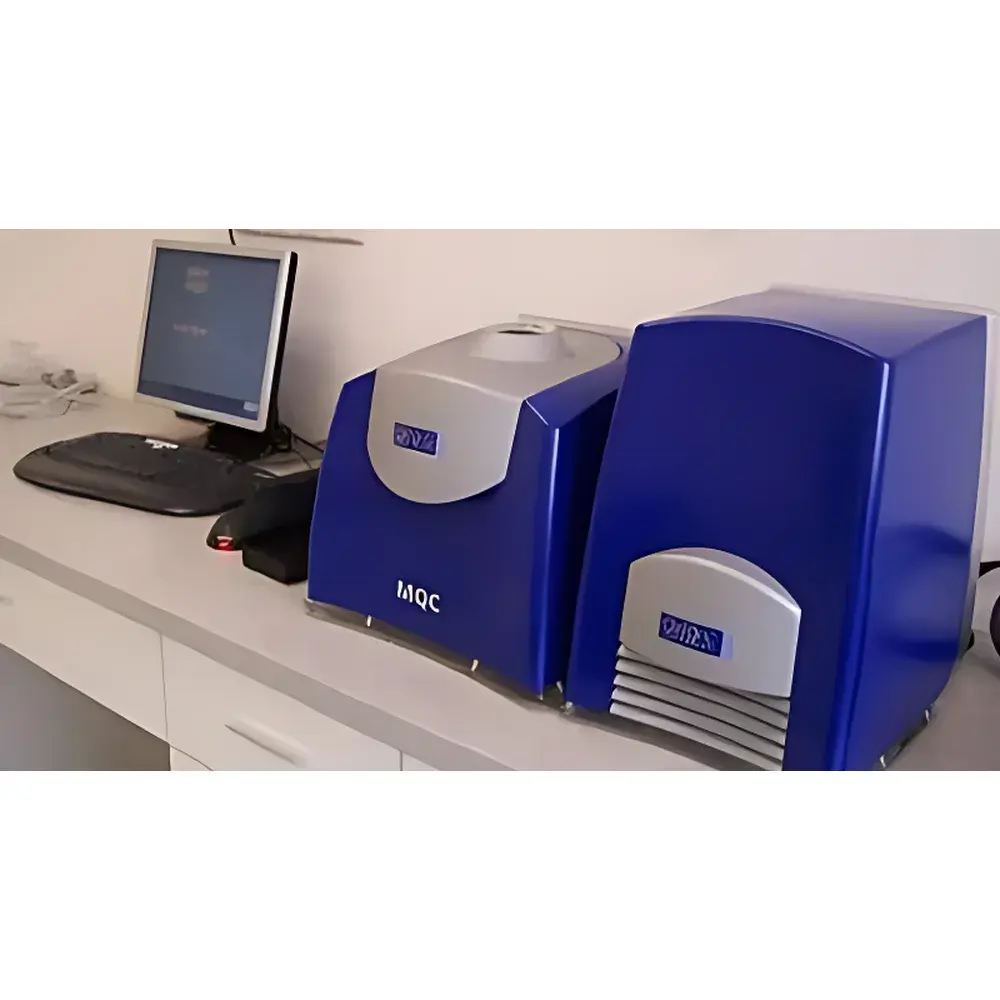
Oxford Instruments MQC Series Benchtop Low-Field Nuclear Magnetic Resonance Analyser
| Brand | Oxford Instruments |
|---|---|
| Origin | United Kingdom |
| Instrument Type | Low-Field NMR Analyser |
| Model | MQC-2, MQC-5, MQC-23, MQC-F |
| Operating Frequency (¹H) | 2 MHz, 5 MHz, 23 MHz |
| Operating Frequency (¹⁹F) | 19 MHz |
| Sample Tube Diameters | 5–51 mm (model-dependent) |
| Compliance | ASTM, ISO 10565, ISO 10632, AOCS Cd 16b-93, ISO 82, IUPAC 2.150(a), IUPAC 2.323(a) |
Overview
The Oxford Instruments MQC Series is a family of benchtop low-field nuclear magnetic resonance (NMR) analysers engineered for quantitative, non-destructive analysis of hydrogen (¹H) and fluorine (¹⁹F) nuclei in solid, semi-solid, and heterogeneous samples. Unlike high-field NMR spectrometers designed for molecular structure elucidation, the MQC operates on the principle of pulsed NMR relaxometry—measuring transverse (T₂) and longitudinal (T₁) relaxation decay curves to extract physical and compositional parameters. The signal amplitude is directly proportional to the number of resonant nuclei (e.g., protons), while differences in relaxation times enable discrimination between phases—such as solid fat vs. liquid oil, crystalline polymer vs. amorphous phase, or bound vs. free water. This makes the MQC uniquely suited for industrial QA/QC and applied research where speed, reproducibility, and sample integrity are critical. Its permanent magnet architecture delivers stable, drift-free operation without cryogens or RF shielding rooms, enabling deployment in production labs, field stations, and regulated environments.
Key Features
- True benchtop design: Compact footprint (< 60 cm × 60 cm), air-cooled permanent magnet, no liquid helium or nitrogen required.
- Multi-frequency platform: Dedicated models operating at 2 MHz (MQC-2), 5 MHz (MQC-5), 23 MHz (MQC-23), and 19 MHz for ¹⁹F (MQC-F), each optimized for specific sample classes—porous media, seeds, polymers, or fluorinated compounds.
- Modular probe interchangeability: All MQC models share a common console; probes (e.g., SFC probe for solid fat content, 26 mm absolute probe for seed oil analysis) are swapped manually in <60 seconds without tools or realignment.
- Zero-sample-prep workflow: Most applications require only mass calibration and insertion—no grinding, solvent extraction, or homogenization.
- Self-diagnostic software suite: Built-in hardware diagnostics continuously monitor magnet stability, RF pulse fidelity, and receiver gain, logging anomalies with timestamped event reports.
- Regulatory-ready operation: Full audit trail support, user access control, electronic signatures, and data integrity features compliant with FDA 21 CFR Part 11 and GLP/GMP documentation requirements.
Sample Compatibility & Compliance
The MQC accepts intact, unprocessed samples—including single oilseeds, meat cuts, polymer pellets, rock cores, and toothpaste tubes—leveraging full-volume RF penetration to eliminate surface bias and color interference. It complies with internationally recognized standard methods across sectors: ISO 10565 and ISO 10632 for oilseed and press-cake oil content; AOCS Cd 16b-93 and IUPAC 2.150(a) for solid fat content (SFC); ASTM D7465 for polymer phase composition; and ISO 82 for fat quantification in dairy powders. In pharmaceutical and nutraceutical contexts, it supports USP guidance on analytical instrument qualification (AIQ) for routine testing. All firmware and method libraries are validated per IQ/OQ protocols and include traceable reference standards for T₂ calibration.
Software & Data Management
The proprietary MQC Software Suite provides intuitive method setup, real-time spectral visualization, and automated curve fitting using mono- and multi-exponential decay models. Pre-loaded application modules include SFC, polymer crystallinity, moisture distribution, and fluorine quantification—with embedded calibration curves traceable to NIST SRMs where applicable. Raw FID data, processed relaxation spectra, and report outputs (PDF/CSV/XML) are stored in a secure, version-controlled database with configurable retention policies. Integration with LIMS via ASTM E1384-compliant export and OPC UA connectivity enables seamless data flow into enterprise QA systems. All software updates undergo rigorous regression testing and are documented under Oxford Instruments’ ISO 9001-certified development lifecycle.
Applications
In food science, the MQC delivers rapid (<60 s), solvent-free quantification of solid fat content in cocoa butter, edible oils, and margarines—fully aligned with AOCS and ISO regulatory frameworks. It determines fat/water ratios in infant formula, pet food, and cured meats without thermal degradation or matrix interference. In agriculture, it enables single-seed oil screening for breeding programs and residual oil analysis in expeller cakes—replacing Soxhlet extraction in routine QC. For polymers, it measures polypropylene isotacticity, polyethylene density, rubber phase content in HIPS/ABS/SBS, and plasticizer loading in PVC—all traceable to ASTM D7465 and ISO 1628-1. In petroleum, it characterizes wax content in lubricants and hydrogen distribution in jet fuels. In life sciences, it supports longitudinal in vivo body composition studies in rodent models—quantifying lean mass, adipose tissue, and free/bound fluid compartments without ionizing radiation or anesthesia.
FAQ
Is the MQC suitable for regulated GMP environments?
Yes—the system includes full 21 CFR Part 11 compliance features: role-based access control, electronic signatures, immutable audit trails, and validated software release packages.
Can the same instrument be used for both food and polymer analysis?
Yes—probe interchangeability allows one MQC console to serve multiple applications; switching between SFC and polymer probes requires no recalibration or service intervention.
Does the MQC require external cooling or power conditioning?
No—it operates from standard 100–240 V AC, 50/60 Hz input and uses passive air cooling; no chiller, UPS, or RF cage is necessary.
How is method transfer handled between different MQC models?
Method portability is ensured through standardized pulse sequence definitions and relaxation time referencing; cross-model validation protocols are provided in the Application Notes Library.
What maintenance is required over a 10-year operational lifetime?
Annual magnet homogeneity verification and RF coil inspection are recommended; no consumables or scheduled replacements are specified under normal use conditions.





