
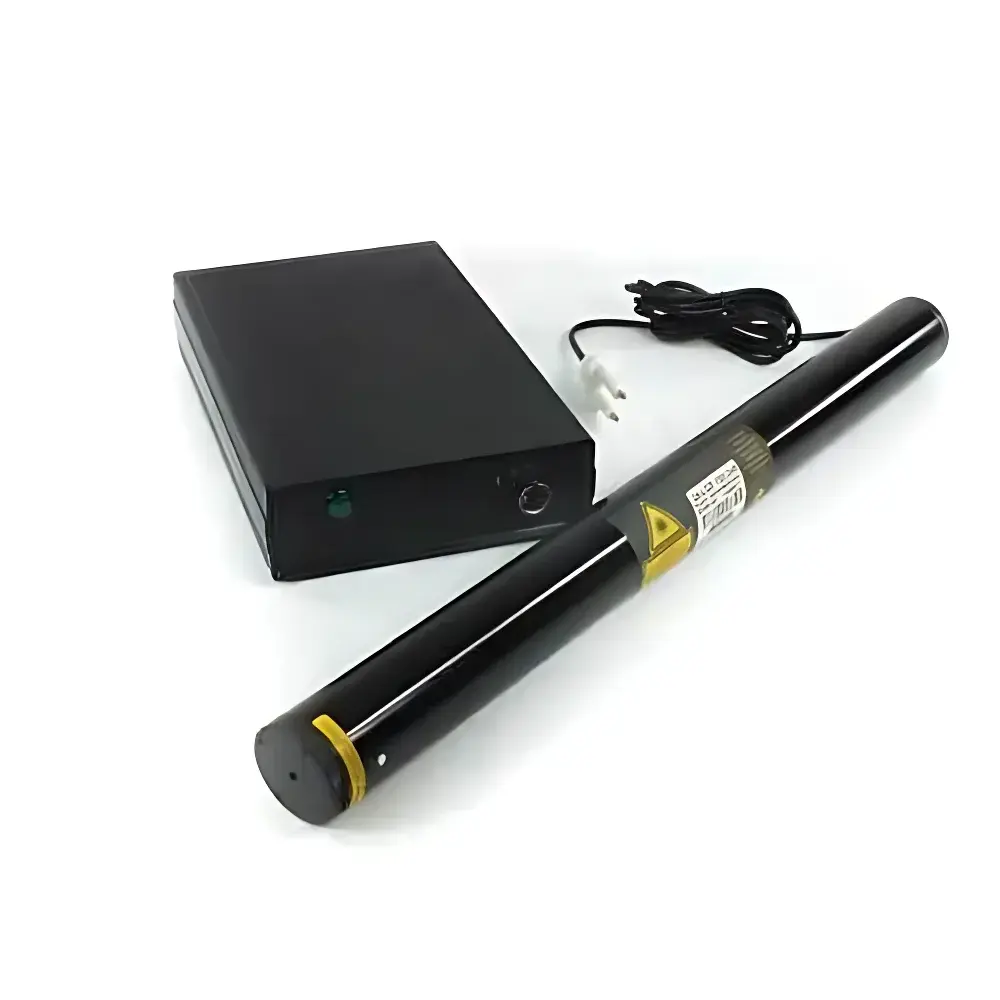
Pacific Lasertec 05-STP-910 Stabilized Helium-Neon Laser
| Origin | USA |
|---|---|
| Manufacturer Type | Authorized Distributor |
| Origin Category | Imported |
| Model | 05-STP-910 |
| Core Type | Gas Laser System |
| Wavelength | 632.8 nm |
| Output Power | 0.5 mW |
| Beam Diameter | 0.48 mm |
| Beam Divergence | 1.70 mrad |
| Polarization Ratio | >1000:1 |
| Amplitude Noise | <0.1% RMS |
| Frequency Tuning Range (Blue Side) | 400–600 MHz |
| Amplitude Tuning Range | 0.35–0.70 mW |
| Coherence Length (1 hr / 8 hr / 30 days) | >300 m / >30 m / >30 m |
| Amplitude Stability (1 hr / 8 hr / 30 days) | ±0.1% / ±0.1% / ±0.2% |
| Frequency Stability (1 hr / 8 hr / 30 days) | ±1 MHz / ±1 MHz / ±10 MHz |
Overview
The Pacific Lasertec 05-STP-910 is a thermally and mechanically stabilized helium-neon (HeNe) laser engineered for metrological-grade frequency stability and long-term amplitude consistency. Based on the legacy Melles Griot HeNe platform—renowned for over four decades of precision gas laser manufacturing—the 05-STP-910 employs active stabilization via saturated absorption spectroscopy in an iodine reference cell, enabling sub-MHz short-term frequency control and drift-compensated operation over extended periods. Its TEM00 Gaussian output at 632.8 nm serves as a primary wavelength standard in interferometry, gravitational wave detection alignment systems, optical encoder calibration, and high-resolution spectroscopy. Unlike free-running HeNe lasers, the 05-STP-910 maintains a fixed longitudinal mode with linewidth <1 MHz (FWHM), delivering coherence lengths exceeding 300 meters after one hour of warm-up—critical for applications requiring phase-stable interference over multi-meter path differences.
Key Features
- Active frequency stabilization using iodine-saturated absorption lock, achieving ±1 MHz short-term (1-hour) frequency uncertainty and ±10 MHz over 30 days
- TEM00 spatial mode with M² < 1.05, beam diameter 0.48 mm (1/e²), and divergence ≤1.70 mrad for optimal coupling into single-mode fibers and interferometric optics
- High polarization purity (>1000:1) ensured by internal Brewster-angle windows and optimized cavity alignment
- Low amplitude noise (<0.1% RMS, 10 Hz–10 MHz bandwidth) suitable for heterodyne detection and photometric referencing
- Integrated thermal management system with PID-controlled oven and low-drift current supply to minimize mode-hopping and power drift
- Factory-calibrated tuning range of 400–600 MHz on the blue side of the iodine hyperfine line, supporting precise offset locking and beat-note generation
Sample Compatibility & Compliance
The 05-STP-910 is designed for integration into Class 1 or Class 3R laser safety-compliant systems per IEC 60825-1:2014 and FDA 21 CFR Part 1040.10. Its compact, rigid aluminum housing (122 × 89 × 38 mm) supports OEM mounting in vacuum-compatible environments (outgassing tested per ASTM E595) and operates reliably from 15 °C to 35 °C ambient with <80% non-condensing humidity. The laser meets RoHS Directive 2011/65/EU and is CE-marked for EMC compliance (EN 61326-1) and low-voltage directive (2014/35/EU). While not inherently GLP/GMP-certified, its documented amplitude and frequency stability profiles support qualification under ISO/IEC 17025 for calibration laboratories performing length or refractive index measurements.
Software & Data Management
The 05-STP-910 operates as a standalone analog instrument with no embedded firmware or digital interface; all stabilization feedback is implemented in analog electronics for minimal latency and maximum immunity to electromagnetic interference. For system-level monitoring, users integrate external data acquisition (DAQ) modules (e.g., National Instruments USB-6211) to log analog monitor outputs: photodiode voltage (proportional to output power), error signal (for lock diagnostics), and piezo drive voltage (indicating frequency correction actuation). Pacific Lasertec provides traceable calibration reports—including measured coherence length vs. aging time and frequency drift vs. ambient temperature gradients—for inclusion in laboratory quality records. These reports are structured to align with audit requirements for ISO 17025 Clause 6.4.10 (equipment verification) and FDA 21 CFR Part 11 when paired with validated electronic record systems.
Applications
- Primary length standard in laser interferometers used for nanometer-scale displacement metrology (e.g., in semiconductor lithography tool calibration)
- Reference source in dual-comb spectroscopy setups requiring absolute frequency anchors
- Stabilized local oscillator in coherent optical receivers for free-space optical communication
- Alignment and wavefront sensing in adaptive optics systems for astronomical telescopes
- Calibration of wavemeters and optical spectrum analyzers traceable to NIST SRM 2519a
- Teaching and research in quantum optics labs for Doppler-free saturation spectroscopy experiments
FAQ
What is the warm-up time required to achieve specified frequency stability?
Full frequency stability (±1 MHz) is achieved within 45 minutes of cold start, with optimal performance reached after 90 minutes. Coherence length exceeds 300 m after 60 minutes.
Is the laser compatible with vacuum environments?
Yes—the housing is vacuum-rated to 10⁻⁶ Torr; however, the internal HeNe gas fill requires atmospheric pressure operation. It must be mounted externally to vacuum chambers with beam entry via sealed optical windows.
Can the 05-STP-910 be locked to an external cavity diode laser (ECDL)?
No—it is a self-contained iodine-stabilized system with fixed lock point. However, its output can serve as a master reference for locking other lasers via beat-note detection and PLL circuits.
Does Pacific Lasertec provide NIST-traceable calibration certificates?
Yes—each unit ships with a factory-issued certificate listing measured frequency offset from the iodine R(127) 11-5 transition at 632.991394 nm, referenced to NIST’s published values (J. Opt. Soc. Am. B 23, 2006).
What maintenance is required over the laser’s operational lifetime?
No user-serviceable parts exist. Mean time between failures exceeds 20,000 hours. Annual verification of amplitude stability and frequency lock integrity is recommended for metrology-critical use.




