
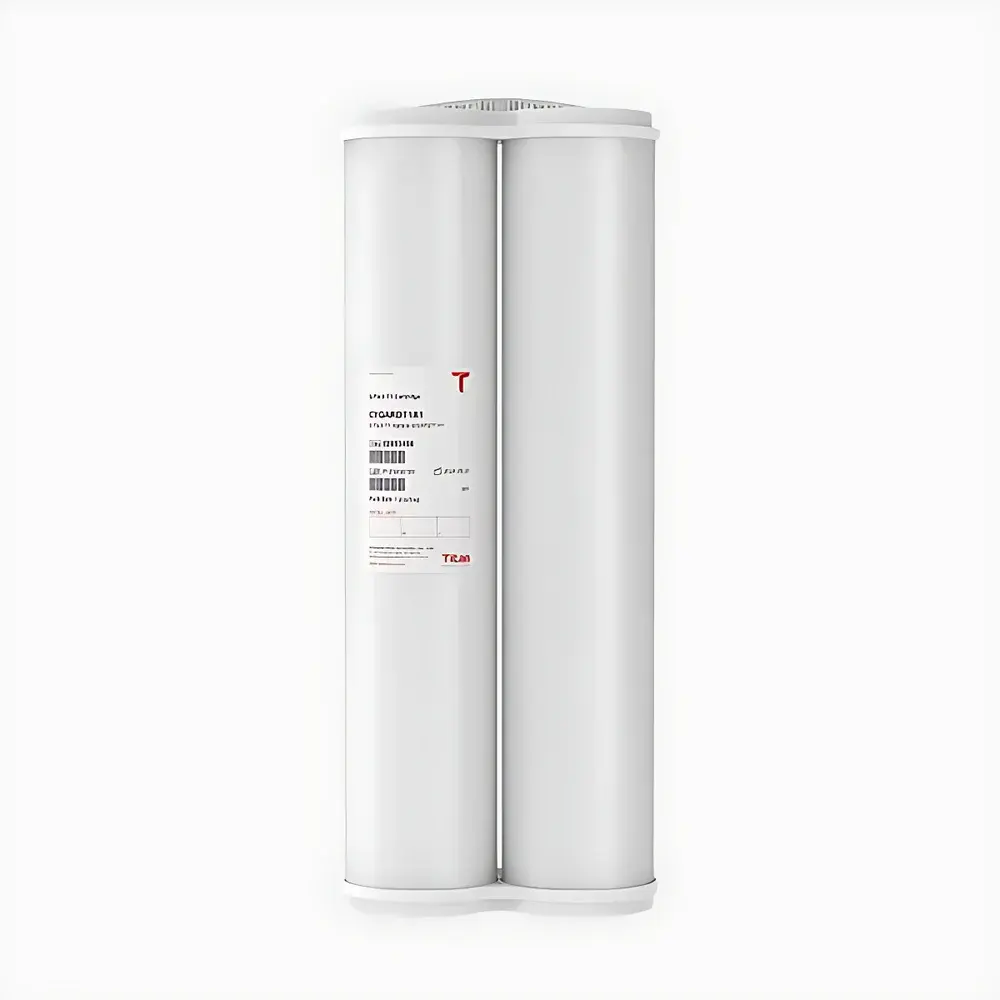
P Pack 2 Pre-Purification Cartridge (Pre-RO)
| Brand | Deepflow |
|---|---|
| Origin | Shanghai, China |
| Manufacturer Type | Authorized Distributor |
| Origin Category | Domestic |
| Model | CYR0G00002 |
| Pricing | Available Upon Request |
Overview
The P Pack 2 Pre-Purification Cartridge (Pre-RO) is a purpose-engineered consumable component designed for integration into ultra-pure water (UPW) systems operating upstream of reverse osmosis (RO) membranes. It functions as the first critical stage in multi-stage purification trains, targeting the selective removal of suspended solids, colloidal particles, chlorine, chloramines, organic contaminants, and heavy metal ions—thereby protecting downstream RO membranes from fouling, scaling, and premature degradation. Constructed with a layered media architecture—including graded-density polypropylene depth filtration, catalytic activated carbon, and ion-exchange resins—the cartridge delivers consistent contaminant reduction across variable feed water qualities typical of municipal or laboratory-grade tap supplies. Its design adheres to ISO 3696:1987 (Grade 3 water specifications) and supports compliance with ASTM D1193-20 and CLSI EP21-A guidelines for pretreatment integrity in clinical and analytical water systems.
Key Features
- Multi-layered composite media: Combines 5 µm polypropylene depth filter (mechanical retention), high-activity coconut-shell-based activated carbon (chlorine/chloramine adsorption & TOC reduction), and mixed-bed cation/anion exchange resin (divalent metal ion scavenging).
- Optimized hydraulic profile: Low-pressure drop (< 0.15 bar at 2.0 L/min flow rate) ensures compatibility with low-energy UPW system pumps while maintaining ≥99.5% chlorine removal efficiency per ASTM D6580.
- Pre-RO protection focus: Extends RO membrane service life by >40% under typical lab feed conditions (TDS 150–300 ppm, free chlorine ≤2.0 mg/L), validated via accelerated fouling tests per ASTM D4195.
- Trace-metal–free housing: Polypropylene cartridge body complies with USP for extractables and leachables; no zinc, copper, or nickel components introduced into the water stream.
- Standardized 10-inch x 2.5-inch (254 mm × 63.5 mm) configuration: Compatible with industry-standard housings (e.g., Pentair, Sartorius, ELGA) and enables tool-free replacement without system depressurization.
Sample Compatibility & Compliance
The P Pack 2 cartridge is validated for use with potable feed water meeting WHO Guidelines for Drinking-water Quality (4th ed.) and local municipal standards. It is not intended for direct use with seawater, brackish water, or wastewater effluents. Performance testing confirms compatibility with feed temperatures of 5–35 °C and pH 4.5–8.5. All materials comply with FDA 21 CFR §177.1520 (polypropylene) and NSF/ANSI Standard 61 (drinking water system components). Batch-certified test reports (including TOC breakthrough, heavy metal elution, and microbial growth inhibition data) are supplied with each shipment to support GLP/GMP documentation requirements.
Software & Data Management
As a passive consumable, the P Pack 2 does not incorporate embedded electronics or firmware. However, its usage lifecycle integrates seamlessly into digital water management platforms via manual or barcode-assisted log entry in LIMS (e.g., LabWare, STARLIMS) or dedicated UPW monitoring systems (e.g., Siemens Desigo CC, Veolia PureOne). Recommended replacement intervals—calculated based on cumulative volume (typically 1,200 L at 25 °C, ≤200 ppm TDS) or time-based triggers (max. 6 months)—can be synchronized with preventive maintenance modules. Traceability is maintained through serialized lot numbers printed on the cartridge label, enabling full audit trail linkage to calibration records and QC release certificates.
Applications
- Pretreatment for Type I ultrapure water generation in analytical laboratories (HPLC, IC, AAS, ICP-MS sample preparation).
- Feed conditioning for pharmaceutical process water systems compliant with EU GMP Annex 1 and USP .
- Protection of EDI and UV oxidation stages in hybrid UPW architectures.
- Supporting ISO/IEC 17025-accredited testing labs requiring documented pretreatment validation for method equivalence (e.g., EPA Method 502.2, ISO 14852).
- Enabling reproducible blank water quality in environmental and food safety testing where low-level anion/cation interference must be minimized.
FAQ
What is the recommended maximum service life of the P Pack 2 cartridge?
Under standard lab feed conditions (TDS ≤200 ppm, free chlorine ≤1.0 mg/L), the cartridge should be replaced after 1,200 liters of throughput or every 6 months—whichever occurs first.
Can the P Pack 2 be used downstream of an RO membrane?
No. This cartridge is engineered exclusively for pre-RO positioning; post-RO installation would cause rapid resin exhaustion and carbon channeling due to elevated ionic strength and low TOC load.
Does the cartridge require pre-flushing before initial use?
Yes. A minimum 15-minute flush at nominal system flow rate is required to remove fine carbon fines and stabilize ion-exchange kinetics prior to connecting to sensitive instrumentation.
Is the P Pack 2 compatible with ozone-sanitized distribution loops?
Not recommended. Ozone accelerates oxidative degradation of activated carbon media; alternative ozone-compatible pretreatment (e.g., UV + dual-carbon staging) should be implemented.
How is performance verification conducted during routine QC?
Users should monitor feed and effluent free chlorine (DPD method), TOC (combustion-NDIR), and conductivity (per ASTM D5127); a >10% rise in effluent conductivity or >5 ppb TOC breakthrough indicates end-of-service.



