
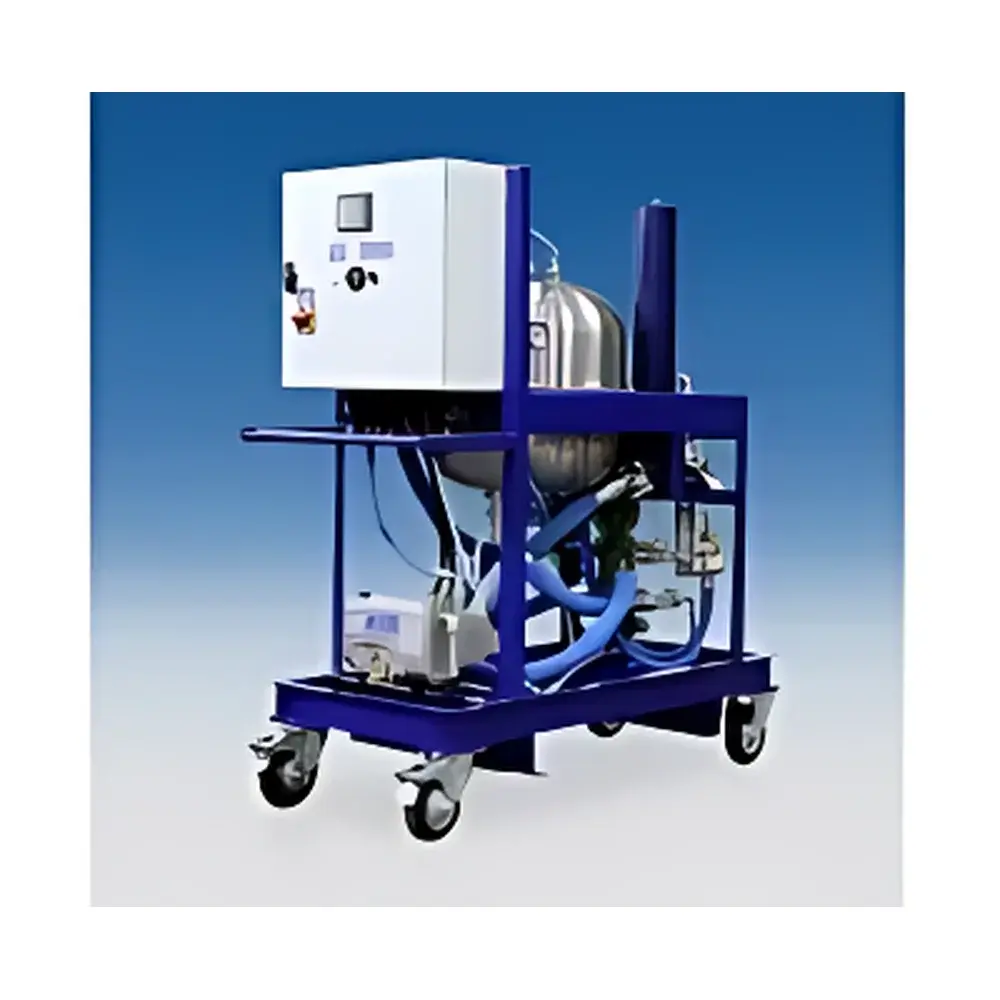
Pall HNP023 Series Oil Purifier
| Origin | Guangdong, China |
|---|---|
| Manufacturer Type | Authorized Distributor |
| Origin Category | Domestic (China) |
| Model | Pall HNP023 |
| Pricing | Available Upon Request |
Overview
The Pall HNP023 Series Oil Purifier is an engineered vacuum-based fluid conditioning system designed for continuous or batch treatment of lubricating oils and hydraulic fluids in small- to medium-scale industrial systems. It operates on the principle of vacuum dehydration—leveraging reduced pressure to lower the boiling point of water, enabling efficient phase separation of free water, dissolved water, and entrained/dissolved gases without thermal degradation of the base oil. Unlike coalescers, centrifuges, or absorbent media systems—which only remove free water up to the fluid’s saturation limit—the HNP023 achieves sub-saturation moisture levels (typically < 15 ppm H₂O), even after downstream cooling. This prevents reformation of free water during operational temperature cycling, thereby mitigating corrosion, oxidation acceleration, and valve stiction in critical hydraulic and turbine lube systems.
Key Features
- Vacuum dehydration technology capable of removing >99% of free water and up to 90% of dissolved water from mineral and synthetic oils
- Simultaneous degassing function: removes >99% of free/entrained gas and up to 80% of dissolved gases (e.g., air, nitrogen, oxygen)
- Integrated particle filtration stage compliant with ISO 4406:2017 codes down to 14/12/9 (βₓ≥75 at 3 µm)
- Compact footprint optimized for skid-mounted or portable deployment in maintenance workshops and remote sites
- PLC-controlled automation with adjustable vacuum level (down to 1–2 mbar abs), heater setpoint (typically 40–65°C), and flow rate (up to 23 L/min)
- Optional Ethernet/IP or Modbus TCP interface for integration into plant SCADA systems and remote diagnostics
- Self-contained design requiring no external steam, compressed air, or chemical additives
Sample Compatibility & Compliance
The HNP023 is validated for use with mineral-based, PAO, and ester-based lubricants (ISO VG 32–460), hydraulic fluids (HL, HM, HVLP), and turbine oils (TSA, TSE). It complies with ASTM D6304 (Karl Fischer titration reference method for water content verification), ISO 12181-2 (geometrical product specifications for vacuum chamber integrity), and meets mechanical safety requirements per ISO 12100. All wetted materials—including stainless steel 316 vacuum vessel, fluoropolymer-lined pumps, and glass-fiber depth filters—are compatible with common industrial oils and resistant to hydrolysis under prolonged vacuum exposure. The unit supports GLP-aligned documentation protocols when equipped with optional audit-trail-enabled software.
Software & Data Management
The standard control interface includes a 7-inch touchscreen HMI with real-time display of vacuum pressure, inlet/outlet temperatures, flow rate, cumulative processing volume, and alarm history. Optional Pall Connect™ software provides time-stamped operational logs, trended moisture/gas removal efficiency metrics, and configurable email/SMS alerts for process deviation. Data export is supported via USB or network transfer in CSV format for integration into CMMS platforms (e.g., IBM Maximo, SAP PM). When deployed in regulated environments, the system can be configured to meet FDA 21 CFR Part 11 requirements—including electronic signatures, role-based access control, and immutable audit trails—upon validation.
Applications
- Pre-commissioning purification of turbine lube oil systems prior to startup
- Condition-based maintenance of hydraulic reservoirs in mobile equipment (e.g., excavators, wind turbine pitch systems)
- Extended service life management of circulating lubrication systems in gearboxes and compressors
- Reclamation of contaminated oil in offshore platforms and power generation facilities
- Supporting ISO 4406 cleanliness targets in servo-valve circuits and electro-hydraulic actuators
- Mitigating micro-dielectric breakdown risk in transformer and switchgear insulating oils (when used with compatible fluid grades)
FAQ
Why does vacuum dehydration outperform coalescer-based water removal?
Coalescers only separate free water above the oil’s saturation threshold; they cannot reduce dissolved water content. Vacuum dehydration lowers water activity below saturation, preventing post-cooling condensation and associated corrosion.
Can the HNP023 process high-viscosity oils (e.g., ISO VG 460)?
Yes—its positive displacement pump and heated vacuum chamber enable stable operation with kinematic viscosities up to 1200 cSt at 40°C, provided inlet temperature is maintained ≥50°C.
Is operator certification required for routine operation?
No formal certification is mandated, but Pall recommends completion of the vendor-provided 4-hour competency training covering safety interlocks, vacuum chamber leak testing, and filter element replacement procedures.
How often must filter elements be replaced?
Typical service intervals range from 500–1,200 operating hours depending on fluid contamination load; differential pressure monitoring and scheduled ISO 4406 sampling are advised for condition-based replacement.
Does the system comply with environmental discharge regulations?
The HNP023 produces no liquid effluent or hazardous waste streams; separated water and particulates are collected in sealed, code-compliant containment vessels for off-site disposal per local wastewater and solid waste ordinances.





