
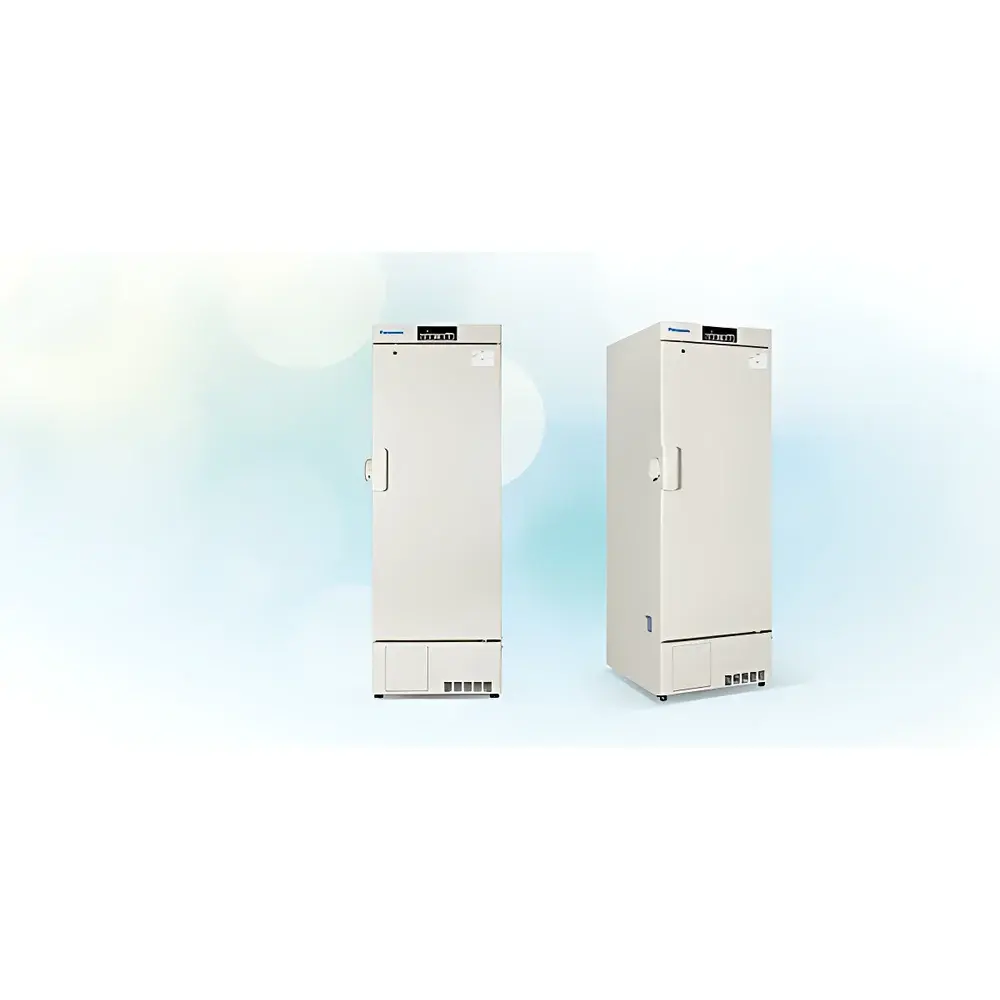
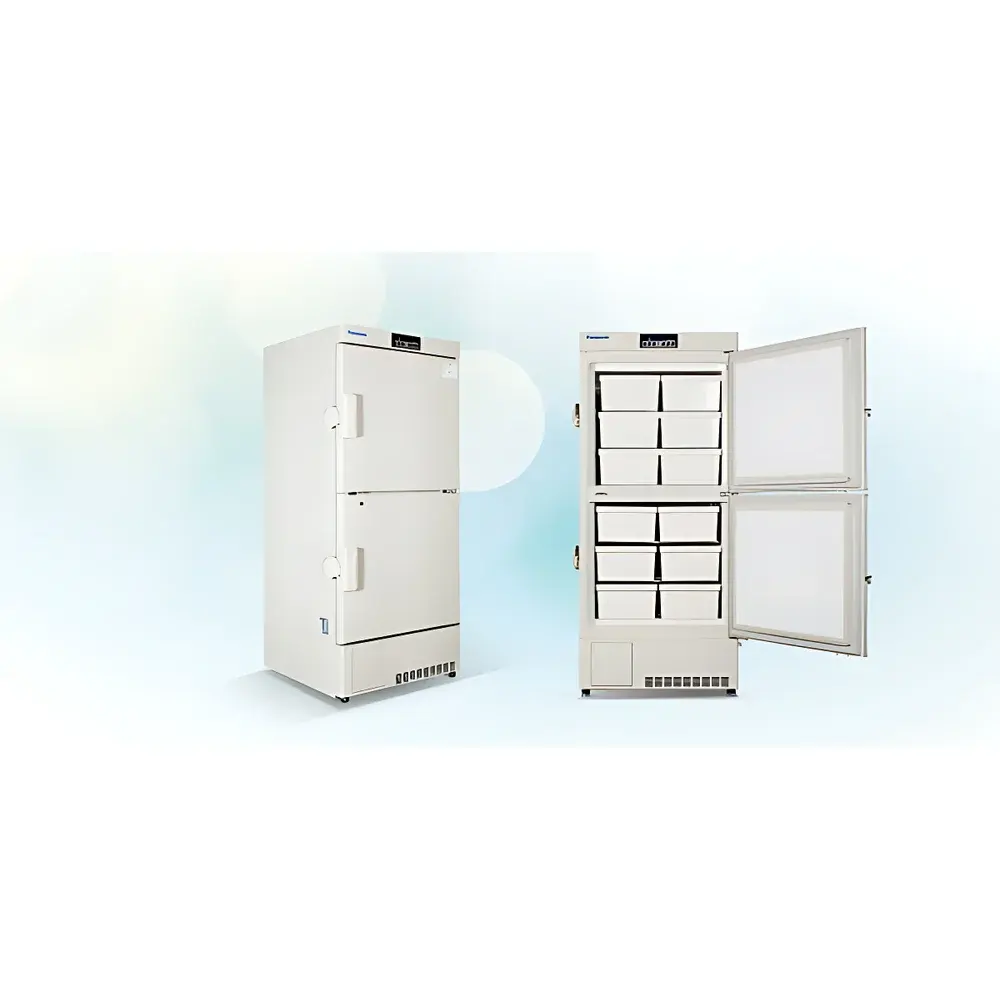
Panasonic MDF-339 & MDF-539 Ultra-Low Temperature Laboratory Freezers
| Brand | Panasonic |
|---|---|
| Origin | Liaoning, China |
| Manufacturer Type | Authorized Distributor |
| Origin Category | Domestic |
| Model | MDF-339, MDF-539 |
| Price Range | USD 4,200–7,000 |
| Instrument Type | Low-Temperature Freezer (≥ −60 °C) |
| Configuration | Upright |
| Effective Volume | 369 L (MDF-339), 504 L (MDF-539) |
| Internal Dimensions (W×D×H) | 472 × 614 × 1262 mm (MDF-339), 649 × 614 × 1262 mm (MDF-539) |
| External Dimensions (W×D×H) | 616 × 770 × 1806 mm (MDF-339), 793 × 770 × 1806 mm (MDF-539) |
| Power Supply | 220 V AC, 50/60 Hz |
| Rated Input Power | 230 W (MDF-339), 312 W (MDF-539) |
| Temperature Range | −20 °C to −30 °C (1 °C increments |
| Compressor | Hermetic, 250 W (MDF-339), 400 W (MDF-539) |
| Refrigerant | R404A |
| Safety Features | High-/low-temperature alarm, power failure alarm, sensor fault detection (temperature control, compressor, motor winding), lockable door with optional padlock provision |
| Standard Accessories | 1 set of keys, 6 adjustable wire shelves, 6 drawer boxes, 1 defrost scraper, 2 nylon clamps (S/L) |
Overview
The Panasonic MDF-339 and MDF-539 are upright laboratory low-temperature freezers engineered for stable, long-term storage of biological samples, reagents, vaccines, and pharmaceuticals at controlled temperatures between −20 °C and −30 °C. Designed for continuous operation in regulated laboratory environments, these units employ a hermetic compressor-based vapor-compression refrigeration cycle with R404A—a zero-ozone-depletion-potential (ODP) hydrofluorocarbon refrigerant compliant with current international environmental standards. The evaporator is embedded within the cabinet walls (pre-embedded structure), eliminating exposed copper tubing and significantly reducing corrosion risk over extended service life. Temperature stability is maintained via microprocessor-based PID control with high-resolution thermistor sensing and non-volatile memory retention—ensuring all user-defined parameters (setpoint, alarm thresholds, calibration offsets) persist through power interruption. Both models operate within an ambient range of 5–35 °C and meet IEC 61000-4 electromagnetic compatibility requirements for laboratory-grade equipment.
Key Features
- Non-volatile memory system preserves temperature setpoints, alarm limits, and calibration data during power outages; automatic recovery to pre-interruption configuration upon restoration.
- Digital LED temperature display with manual zero-point calibration capability via front-panel interface.
- Adjustable wire shelving system: six tiers per unit, height-adjustable to accommodate large-volume containers (e.g., 2L media bottles, cryoboxes, or stacked sample racks).
- Lockable door mechanism with integrated latch—compatible with standard padlocks—to prevent unauthorized access and support biosafety Level 2 (BSL-2) containment protocols.
- Integrated Φ30 mm temperature monitoring port on rear panel for external probe integration and independent validation (e.g., with calibrated data loggers per ISO 17025 or FDA 21 CFR Part 11 audit trails).
- Corrosion-resistant painted steel construction for both interior and exterior surfaces; seamless inner liner design minimizes crevices and supports routine decontamination.
Sample Compatibility & Compliance
The MDF-339 (369 L) and MDF-539 (504 L) are validated for storage of temperature-sensitive biological materials including serum, plasma, DNA/RNA extracts, monoclonal antibodies, cell lines, and clinical specimens. Their −20 °C to −30 °C operating range aligns with WHO guidelines for vaccine cold chain integrity and USP recommendations for sterile compounding storage. Units comply with IEC 61010-1 (Safety Requirements for Electrical Equipment for Measurement, Control, and Laboratory Use) and carry CE marking for conformity with EU directives. While not classified as ultra-low temperature (ULT) freezers (i.e., < −60 °C), their thermal performance meets ASTM F2600-22 criteria for stability (±2 °C uniformity across load) and recovery time (< 30 minutes to return to setpoint after 3-minute door opening). Optional IQ/OQ documentation packages are available for GxP-regulated environments requiring GLP or GMP compliance.
Software & Data Management
These freezers do not include embedded software or network connectivity; however, they are fully compatible with third-party environmental monitoring systems (EMS) via the rear-mounted Φ30 mm access port. When paired with validated USB or Ethernet-enabled data loggers (e.g., Vaisala, Dickson, or Sensitech), users can generate ALCOA+ compliant records—including time-stamped temperature history, alarm events, and operator actions—for audit readiness under FDA 21 CFR Part 11 or EU Annex 11. The non-volatile memory ensures traceability of configuration changes, and the buzzer-assisted post-power-failure temperature readout provides immediate situational awareness without requiring external instrumentation.
Applications
- Long-term archival storage of clinical biospecimens in biobanks and hospital core labs.
- Stabilization of diagnostic reagents, ELISA kits, and molecular assay components requiring consistent −25 °C conditions.
- Backup cold storage for active pharmaceutical ingredients (APIs) and intermediate compounds in QC laboratories.
- Supporting ISO/IEC 17025-accredited testing facilities where documented thermal stability is required for method validation.
- Field-deployable cold storage in mobile clinical units or regional public health laboratories with limited infrastructure.
FAQ
What is the minimum ambient temperature required for stable operation?
The units require a minimum ambient temperature of 5 °C to ensure reliable compressor cycling and condenser heat rejection.
Can the internal shelves be removed entirely for bulk storage?
Yes—the six wire shelves are fully removable and independently adjustable, allowing unobstructed vertical clearance up to 1262 mm.
Is R404A still permitted for new equipment installations?
R404A remains approved for use in existing and newly manufactured laboratory equipment under current EPA SNAP and EU F-Gas Regulation exemptions for critical medical applications; however, Panasonic offers R290-compatible retrofit paths for future regulatory alignment.
Does the freezer include a built-in temperature validation certificate?
No—factory calibration certificates are provided, but IQ/OQ/PQ validation must be performed on-site by qualified personnel using NIST-traceable reference standards.
How frequently should the condenser coils be cleaned?
In typical laboratory environments (non-dusty, non-humid), cleaning every 6 months is recommended; more frequent maintenance may be necessary in high-particulate settings.





