
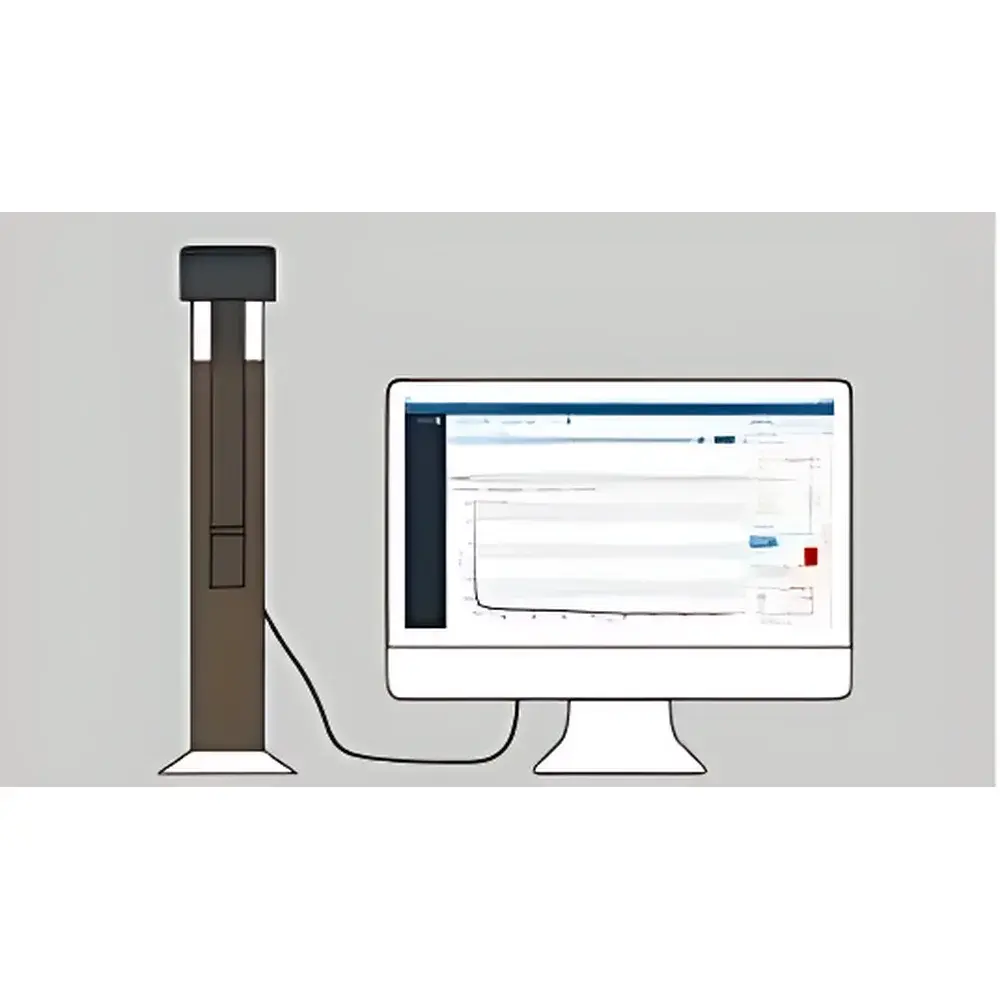
PARIO Automated Soil Particle Size Distribution Analyzer
| Origin | Germany |
|---|---|
| Manufacturer Type | Authorized Distributor |
| Origin Category | Imported |
| Model | PARIO |
| Pricing | Available Upon Request |
| Particle Size Range | 1–63 µm |
| Measurement Accuracy | ±1.5% mass error |
| Sample Mass Concentration | 25–40 g/L suspension |
| Total Measurement Duration | 6 hours |
| Data Acquisition Interval | 10 s |
| Operating Temperature Range | 15–35 °C |
| Max Allowable Temperature Drift During Measurement | 3 °C |
| Suspension Volume | 1000 cm³ |
| Sedimentation Column Height | 35 cm |
| Power Consumption | 1 mW |
| Warranty | 12 months |
Overview
The PARIO Automated Soil Particle Size Distribution (PSD) Analyzer is a precision-engineered instrument designed for high-reproducibility, fully automated determination of soil particle size distribution via gravitational sedimentation. Unlike conventional hydrometer-based methods or laser diffraction systems requiring empirical calibration, the PARIO implements the Integral Densiometer Method (IDM)—a physically grounded, model-based approach rooted in Stokes’ Law and continuous hydrostatic pressure monitoring. It measures time-resolved pressure decay at a fixed depth within a quiescent soil suspension column, enabling direct inversion of settling velocity distributions into volumetric PSD without manual intervention, optical assumptions, or matrix-specific correction functions. This method eliminates sediment disturbance, operator-dependent reading errors, and temperature-induced viscosity artifacts—critical limitations inherent in ASTM D422 and ISO 11277 standard procedures. The system is calibrated for compliance with both U.S. (USDA texture triangle) and German (VDLUFA) soil classification frameworks, supporting regulatory reporting and cross-laboratory comparability in environmental monitoring, agronomy, and geotechnical research.
Key Features
- Fully automated measurement cycle—from suspension preparation to PSD export—requiring no manual readings or post-processing calculations
- Integrated dual-sensor probe: high-stability piezoresistive pressure transducer and PT100-class temperature sensor, both embedded in the immersion shaft
- Real-time temperature compensation: dynamic viscosity correction applied during data acquisition using the empirically validated water viscosity–temperature relationship (y = 0.0007T² − 0.0531T + 1.764; r² = 0.9996)
- High temporal resolution: 10-second interval logging of pressure, temperature, and timestamp over 6-hour sedimentation runs
- Non-invasive measurement principle: zero mechanical agitation or optical interference ensures undisturbed settling dynamics
- Robust hardware architecture: corrosion-resistant glass sedimentation bottles (35 cm height), low-power electronics (1 mW standby), and USB 2.0 interface for PC connectivity
- Traceable uncertainty budget: total mass-based error quantified at ±1.5%, validated against reference standards per ISO/IEC 17025-aligned protocols
Sample Compatibility & Compliance
The PARIO accommodates mineral soils with clay-to-sand fractions (1–63 µm), including structured aggregates pre-dispersed via sodium hexametaphosphate (NaHMP) or ultrasonic treatment. It excludes organic-rich or highly flocculated matrices unless pretreated per VDLUFA Method 3.1.2. The system meets functional requirements of ASTM D422 (Standard Test Method for Particle-Size Analysis of Soils), ISO 11277 (Soil Quality — Determination of Particle Size Distribution), and supports GLP-compliant audit trails when operated with version-controlled software logs. All firmware and calibration constants are digitally signed and stored with cryptographic integrity checks to satisfy FDA 21 CFR Part 11 readiness for regulated laboratories.
Software & Data Management
The PARIO Control Software (v3.2+) provides real-time visualization of pressure decay curves, temperature stability plots, and iterative PSD convergence diagnostics. Raw .csv files contain timestamped pressure (Pa), temperature (°C), and derived density profiles. The software implements the IDM inversion algorithm described by Durner et al. (Water Resources Research, 2017, DOI: 10.1002/2016WR019830), with built-in validation against synthetic sedimentation datasets. Export options include USDA texture class assignment, cumulative PSD graphs (log-normal scale), and tabular output compliant with FAO Soil Portal metadata schemas. Audit logs record user actions, calibration events, and environmental deviations—enabling full traceability for QA/QC documentation.
Applications
- Environmental site assessment: quantifying clay/silt content for contaminant transport modeling and leaching potential evaluation
- Agronomic soil health monitoring: tracking long-term changes in fine fraction distribution under different tillage or cover crop regimes
- Geotechnical characterization: input parameter generation for hydraulic conductivity (Ks) and water retention curve (WRC) modeling
- Regulatory compliance testing: supporting EU Nitrates Directive reporting and U.S. NRCS soil survey database submissions
- Research validation: benchmarking alternative PSD methods (e.g., X-ray sedimentation, centrifugal photosedimentation) against first-principles IDM results
FAQ
How does PARIO differ from laser diffraction analyzers?
Unlike laser diffraction, which infers size from scattering patterns and requires soil-specific Mie theory corrections, PARIO relies solely on gravitational settling physics—eliminating optical assumptions and calibration drift.
Is temperature control required during measurement?
Active thermostating is not mandatory; however, ambient temperature must remain stable within ±3 °C during the 6-hour run. The system autonomously corrects for viscosity variations using real-time sensor data.
What sample preparation is needed before analysis?
Soil samples must be air-dried, sieved to <2 mm, and dispersed in deionized water with NaHMP (10 g/L) followed by 15 min ultrasonication (40 kHz, 200 W) per ISO 11277 Annex A.
Can PARIO measure particles outside the 1–63 µm range?
No—the hydrostatic pressure signal-to-noise ratio and Stokes-based inversion stability are optimized exclusively for this range. Coarser sand (>63 µm) requires sieve analysis; colloidal fractions (<1 µm) require centrifugation-coupled methods.
Does the software support multi-user environments with role-based access?
Yes—version 3.2+ includes Windows Active Directory integration, configurable user permissions (operator, reviewer, administrator), and electronic signature workflows aligned with 21 CFR Part 11 Subpart B requirements.







