
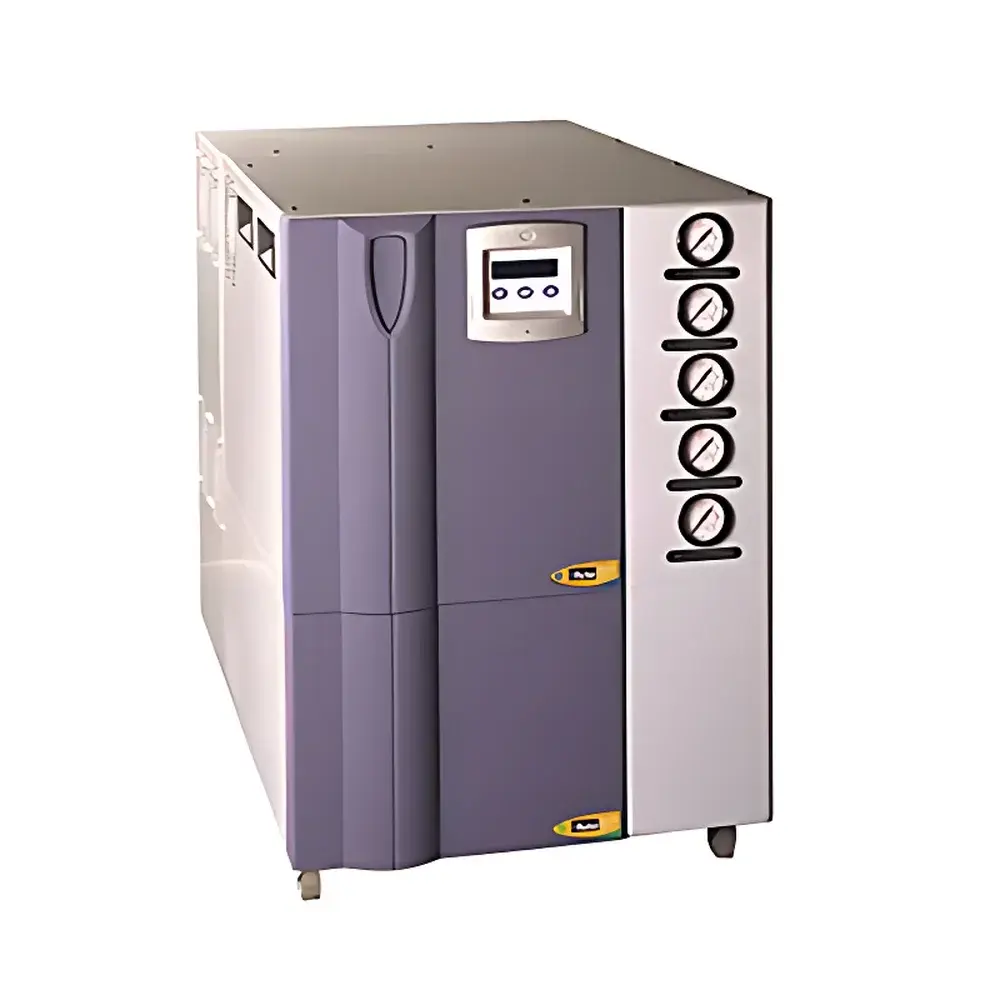
Parker Domnick Hunter LCMS64/65 Dual-Stream High-Purity Nitrogen Generator
| Brand | Parker Domnick Hunter |
|---|---|
| Origin | United Kingdom |
| Model | LCMS64/65 (Hunter Series) |
| Nitrogen Generation Principle | Pressure Swing Adsorption (PSA) with Carbon Molecular Sieve |
| Output Flow Rate | 18 L/min |
| Output Pressure | 7 bar |
| Nitrogen Purity | >99.999% (for collision gas stream) |
| Dew Point | −40 °C |
| Certifications | CE, UL |
| Compliance | ISO 9001 certified manufacturing |
| Phthalate-Free Construction | Yes |
| Integrated Oil-Free Compressor | Yes |
| Control Interface | LCD microprocessor-based controller |
| Monitoring | Five inline pressure gauges |
| Maintenance Alerts | Automated system diagnostics and service prompts |
Overview
The Parker Domnick Hunter LCMS64/65 Dual-Stream Nitrogen Generator is an engineered solution designed specifically for high-sensitivity liquid chromatography–mass spectrometry (LC–MS) platforms—particularly the Agilent 6400 Triple Quadrupole (QQQ) and 6500 Quadrupole-Time-of-Flight (Q-TOF) systems. It delivers two independent, simultaneously generated nitrogen streams with distinct purity and flow specifications, aligned precisely with the operational requirements of modern electrospray ionization (ESI) sources. The primary stream (>99.999% N₂, dew point −40 °C) serves as collision gas in the tandem MS region, where ultra-high purity and low moisture content are critical to minimize background noise, prevent adduct formation, and ensure long-term detector stability. The secondary stream (>98% N₂, particle- and phthalate-free) supplies clean, dry nitrogen for nebulization, desolvation, and source shielding—functions demanding consistent flow, low hydrocarbon contamination, and compatibility with trace-level organic analysis.
Key Features
- Dual-stream PSA architecture utilizing carbon molecular sieve beds, enabling simultaneous generation of two nitrogen grades from a single air feed without cross-contamination
- Integrated oil-free scroll compressor with acoustic enclosure, delivering stable inlet pressure while meeting laboratory noise constraints (≤55 dBA at 1 m)
- Phthalate-free wetted materials throughout gas pathways—including tubing, valves, filters, and adsorbent housings—to eliminate leachable plasticizers that compromise LC–MS reproducibility
- LCD-based microprocessor controller with real-time display of inlet pressure, dual outlet pressures, system status, and scheduled maintenance indicators
- Five calibrated analog pressure gauges for continuous visual verification of compressor output, PSA bed inlet, collision gas outlet, spray gas outlet, and buffer tank pressure
- Automated fault detection logic with audible/visual alerts for low inlet airflow, sieve saturation, filter clogging, or pressure deviation beyond ±5% setpoint
- Compact footprint (W × D × H: 580 × 530 × 820 mm) optimized for placement beneath or adjacent to LC–MS instrument benches
Sample Compatibility & Compliance
This generator is validated for use with Agilent 6400 and 6500 series LC–MS systems under routine analytical conditions, including quantitative bioanalysis, metabolomics, and environmental residue screening. Its nitrogen output meets ASTM D6673-22 (Standard Specification for High-Purity Nitrogen for Use in Analytical Instrumentation) and complies with ICH Q2(R2) guidelines for method robustness when used as a consumable gas source. All internal components conform to USP for pharmaceutical-grade polymer safety, and the system supports GLP/GMP audit readiness through timestamped event logging (power cycles, alarm triggers, filter replacement reminders). CE and UL certification confirm adherence to EN 61000-6-3 (EMC) and UL 61010-1 (safety for laboratory equipment).
Software & Data Management
While the LCMS64/65 operates as a standalone hardware unit without proprietary software dependency, its embedded controller logs operational parameters—including cumulative runtime, compressor cycles, and alarm history—for export via USB interface. These logs support preventive maintenance scheduling per ISO/IEC 17025:2017 Clause 6.4.7 (equipment management), and facilitate root-cause analysis during instrument qualification (IQ/OQ/PQ). No network connectivity or cloud integration is implemented; data retention remains local and tamper-evident, aligning with FDA 21 CFR Part 11 principles for non-electronic record systems where manual review and sign-off govern data integrity.
Applications
- Collision-induced dissociation (CID) gas supply in QQQ and Q-TOF mass analyzers requiring sub-ppb oxygen and moisture levels
- Nebulizer and desolvation gas for ESI and APCI sources, especially in high-throughput clinical toxicology workflows
- Carrier gas for GC–MS applications where cylinder-derived nitrogen introduces batch-to-batch variability in baseline stability
- Source purge and curtain gas in hybrid quadrupole-orbitrap systems requiring continuous, vibration-free gas delivery
- Long-term unattended operation in regulated environments (e.g., contract research labs performing FDA-submitted studies)
FAQ
Does this generator require external compressed air?
No—it integrates a dedicated oil-free scroll compressor; only standard 230 V AC / 50 Hz power input is required.
Can the two nitrogen streams be used interchangeably?
No—the >99.999% stream is engineered exclusively for collision cell applications; using it for nebulization wastes capacity and increases cost of ownership.
What is the expected service interval for the carbon molecular sieve beds?
Under continuous 24/7 operation at rated flow and ambient conditions (20–25 °C, <60% RH), sieve life exceeds 20,000 hours; replacement is indicated only upon sustained purity drift detected by onboard monitoring.
Is remote monitoring supported?
Not natively; however, analog pressure outputs (0–10 V DC) are available for integration into third-party building management or lab infrastructure control systems.
How does the system handle power interruptions?
It performs automatic soft-start sequencing upon power restoration, including purge cycles to evacuate residual moisture before resuming full-spec output—no manual intervention required.



