
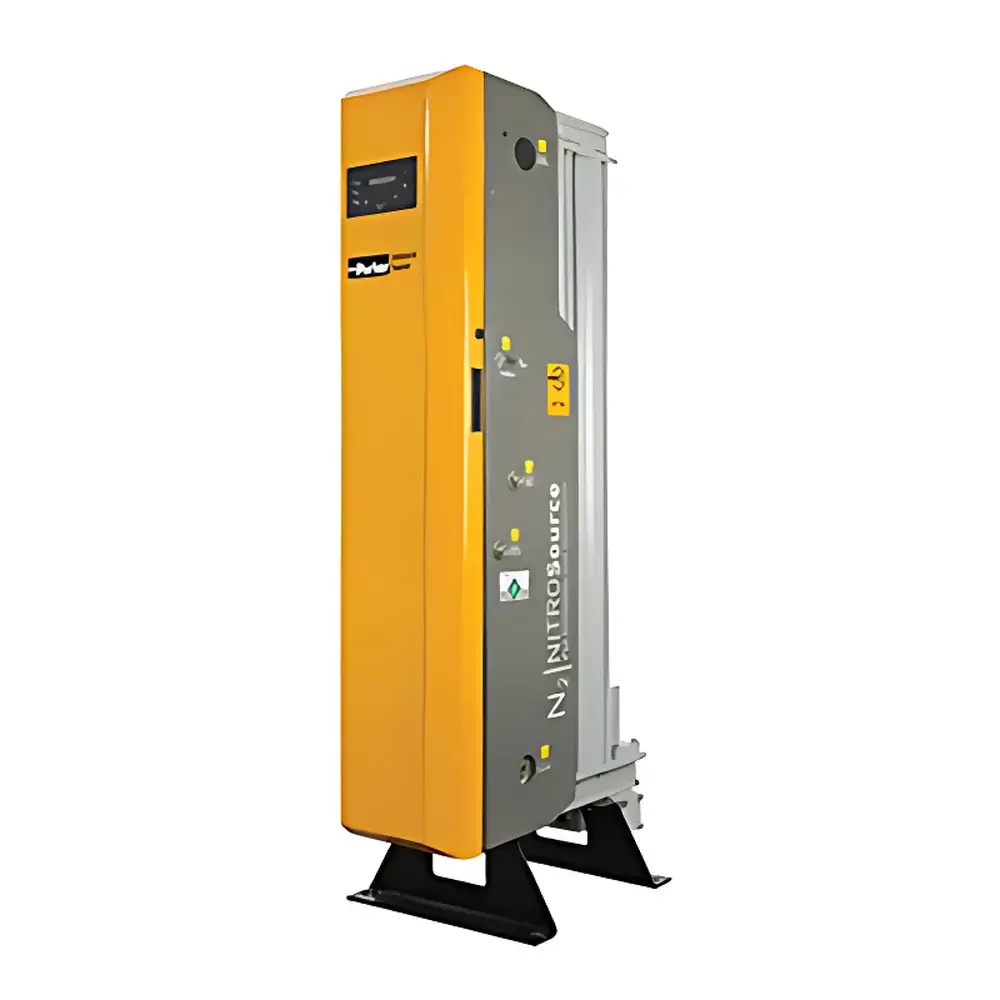
Parker Domnick Hunter NITROSOURCE PSA Nitrogen Generator
| Brand | Parker DH |
|---|---|
| Origin | United Kingdom |
| Manufacturer Type | Authorized Distributor |
| Origin Category | Imported |
| Model | NITROSOURCE PSA |
| Nitrogen Generation Principle | Pressure Swing Adsorption (PSA) |
| Output Flow Rate | 55–2600 L/min |
| Output Pressure | 4–11 bar |
| Nitrogen Purity | 95%–99.9995% |
| Dew Point | −40 °C |
Overview
The Parker Domnick Hunter NITROSOURCE PSA Nitrogen Generator is an engineered solution for laboratories and industrial facilities requiring a continuous, on-demand supply of high-purity nitrogen gas. Utilizing proven Pressure Swing Adsorption (PSA) technology, the system separates nitrogen from compressed air by selectively adsorbing oxygen, moisture, and carbon dioxide onto carbon molecular sieve (CMS) beds under elevated pressure. During the adsorption phase, nitrogen passes through with minimal resistance; during the desorption phase—achieved by depressurization—the CMS bed regenerates automatically without chemical intervention or external purge gas. This cyclic, fully automated process ensures stable output purity and flow across the entire operating range (55–2600 L/min), eliminating dependency on high-pressure nitrogen cylinders or liquid nitrogen dewars. Designed and manufactured in the United Kingdom since 1963, Parker Domnick Hunter’s legacy in gas generation includes over four decades of ISO 9001-certified engineering, with deep integration into analytical workflows demanding strict gas quality control—including LC/MS, GC, ICP-MS, and sample preparation systems.
Key Features
- Automated, self-regenerating carbon molecular sieve (CMS) beds—no consumables, no secondary purification required
- Energy-optimized airflow matching: real-time modulation of inlet compressed air to match nitrogen demand, reducing energy consumption by up to 30% versus fixed-flow systems
- Integrated dew point monitoring and drying: delivers nitrogen at −40 °C dew point, compliant with ISO 8573-1 Class 2.2.1 for particulate, water, and oil content
- Modular architecture supports scalable deployment—multiple units can be paralleled for redundancy or increased capacity without system redesign
- Factory-calibrated gas quality assurance: built-in sensors continuously monitor O₂ residual, pressure, flow, and dew point, with configurable alarm thresholds
- Five-year extended warranty option covering CMS replacement, valve actuation cycles, and electronic controller diagnostics
Sample Compatibility & Compliance
The NITROSOURCE PSA series meets stringent regulatory expectations for critical applications in regulated environments. It complies with EIGA (European Industrial Gases Association) safety guidelines for on-site gas generation and satisfies key elements of FDA 21 CFR Part 11 regarding data integrity, audit trail capability (when integrated with optional logging firmware), and operator access control. For pharmaceutical QC/QA labs operating under GLP or cGMP, the generator supports traceable gas sourcing documentation and integrates seamlessly with laboratory information management systems (LIMS) via Modbus TCP or RS-485. All wetted materials—including CMS housings, stainless-steel piping, and solenoid valves—are certified non-leaching and free of phthalates, ensuring compatibility with sensitive biological and chromatographic applications where extractables could compromise assay validity.
Software & Data Management
The NITROSOURCE PSA platform supports both local HMI operation and remote supervision via Parker’s proprietary GasLink™ Control System. This web-enabled interface provides real-time visualization of nitrogen purity (%N₂), mass flow rate, outlet pressure, dew point, CMS cycle status, and predictive maintenance alerts. Historical data is stored onboard for ≥30 days and exportable as CSV for trending analysis. Optional firmware enables 21 CFR Part 11-compliant electronic signatures, user-level permissions (admin/operator/viewer), and immutable audit logs—including timestamped parameter changes, alarm acknowledgments, and service events. Integration with building management systems (BMS) or central utility monitoring platforms is supported through standard OPC UA or MQTT protocols.
Applications
- LC/MS and GC-MS laboratories: primary nitrogen source for electrospray ionization (ESI), atmospheric pressure chemical ionization (APCI), and collision-induced dissociation (CID) gas
- Pharmaceutical manufacturing: inert blanketing during lyophilization, API crystallization, and vial stoppering; nitrogen purging in cleanroom packaging lines
- Food & beverage preservation: modified atmosphere packaging (MAP) for dairy powders, roasted coffee, snack foods, and edible oils
- Materials processing: assist gas for fiber laser cutting of stainless steel and aluminum; purge gas in heat-treating furnaces and composite resin infusion
- Electronics manufacturing: component drying, solder paste storage, and nitrogen-reduced reflow oven atmospheres to minimize oxidation
FAQ
What is the expected lifetime of the carbon molecular sieve (CMS) under normal operating conditions?
CMS life is rated for ≥20,000 hours of continuous operation when inlet air meets ISO 8573-1 Class 2.2.2 specifications (oil-free, ≤0.1 µm filtration, dew point ≤−40 °C). Actual longevity depends on feed air quality, duty cycle, and ambient temperature.
Can this generator supply multiple LC/MS instruments simultaneously?
Yes—units with output capacities ≥300 L/min are routinely deployed to serve 3–5 high-flow LC/MS systems via a dedicated stainless-steel distribution manifold with individual pressure regulators and particle filters.
Is validation support available for IQ/OQ/PQ protocols?
Parker provides comprehensive validation documentation packages—including DQ templates, FAT/SAT checklists, and test scripts aligned with ASTM D6866 and USP —for qualified personnel to execute installation, operational, and performance qualification.
Does the system require external cooling or ventilation?
No active cooling is needed; however, ambient temperature must remain between 5–40 °C, and the unit requires ≥600 mm clearance on all sides for natural convection and service access.
How does the generator handle fluctuations in inlet compressed air pressure or flow?
An integrated pressure-compensating control loop dynamically adjusts CMS cycle timing and valve sequencing to maintain constant nitrogen output pressure and purity—even with ±15% variation in inlet pressure (7–10 bar) or ±20% flow deviation.



